
OCZ's Fastest SSD, The IBIS and HSDL Interface Reviewed
High Queue Depth Sequential Performance, Just Amazing
Our default sequential write tests have a queue depth of 1, representative of what most desktop users would encounter. Our random write tests bump the queue depth up to 3, but not high enough to really stress a four drive SF-1200 RAID setup. What we’ve done here is provide performance results for the IBIS drive in our standard Iometer tests as well as at a queue depth of 32. The latter is only useful in showing you how performance can scale with very IO dependent workloads, while the former points out that this is probably overkill for a desktop user.
We’ll start with sequential performance. With our standard queue depth of 1, we can write to the IBIS at 323MB/s. That’s a 50% improvement over a standard 120GB SandForce based drive like the Vertex 2 or Corsair Force.
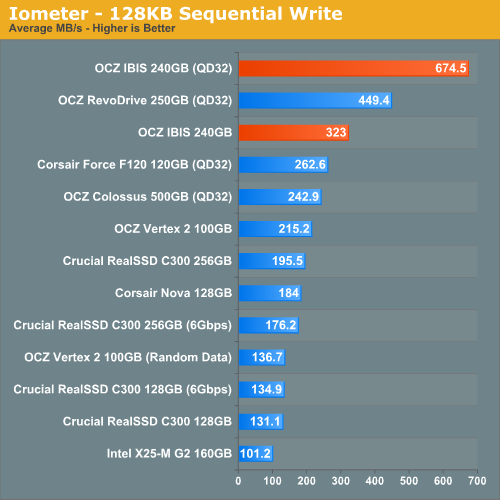
When we crank up the queue depth to 32 simulating a ton of sequential IO the performance gap grows tremendously. While standard SSDs are already limited by SATA at this point, the IBIS jumps to 675MB/s. That’s from a single HSDL port. A 4-way RAID of IBIS drives would deliver absolutely staggering performance assuming linear scaling.
Colossus owners will obviously feel very sad as a single SandForce drive comes close to outperforming the Colossus 500GB drive in this test. The IBIS just puts it to shame.
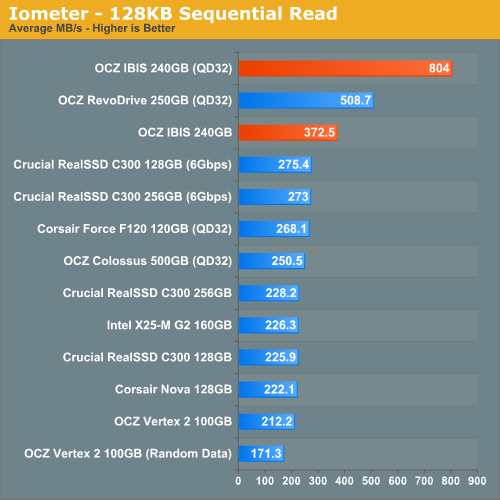
Sequential read speed is even more impressive. With a queue depth of 1 the IBIS was able to pull 372MB/s, a 77% increase over a single SandForce drive. Crank the queue depth up to 32 and our IBIS sample managed 804MB/s. Again, this is from a single HSDL channel, four of these in RAID-0 should be amazing.
Originally published at https://www.anandtech.com/show/3949/oczs-fastest-ssd-the-ibis-and-hsdl-interface-reviewed (Wayback Machine).