
Low Power Server CPUs: the energy saving choice?
- Posted in
- IT Computing
How useful are low power server CPUs?
We were quite a bit surprised that the lower power CPU did not return any significant energy savings compared to the X5670. Intuition tells you that the best server CPUs like the X5670 only would pay off in a high performance environment (for example an HPC server). But human intuition is a bad guide when dealing with physics. Cold hard measurements are a much better way to make up your mind. And all our measurements point in the same direction: the fastest Xeon offers a superior performance/watt ratio in a typical virtualization consolidation scenario.
You could argue that the X5670 is quite a bit more expensive; a server equipped with a dual X5670 will indeed cost you about $900 more. We admit: our comparison is not completely accurate price wise… as always we work with the CPUs that we got in the lab. But a typical server with these CPUs, 64 GB and some accessories will set you back $9000 easily. The 2.8 GHz Xeon X5560 is hardly 4% slower than the X5670, and will probably show the same favorable performance/watt ratio. And if you place a X5560 2.8 GHz instead of a L5640 2.26 GHz, you only add $200 dollar to a $8k-$9k server. That is peanuts, lost in the noise of the TCO calculation. So the question is real: are the "Low power Xeons" (L-series) useless and should you immediately go for the X-series?
Defeated as it may be, the L5640 can still play one trump card: lower maximum currents. Over the period of our 70 minutes of testing, we decided to take a look at maximum power. To avoid that any extreme peaks would muddle up the picture, we used the 95th percentile.
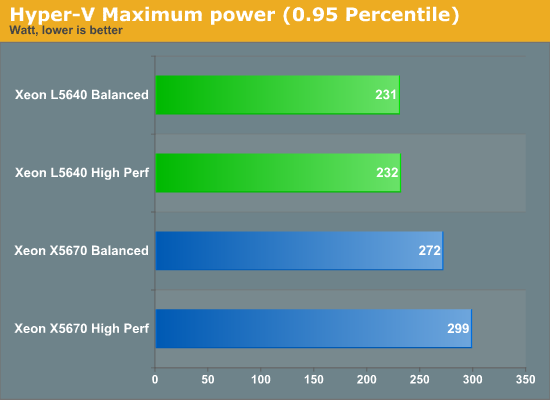
Let us focus on the “balanced” power plan. The L5640 makes sure power never goes beyond 231 W, while the peak of the X5670 is almost 20% higher. As a result, a rack of low power Xeon will be able to keep the maximum current consumed lower. You could consider the low power Xeon L5640 a “power capped” version of Xeon X5670. In many datacenters you pay a hefty fine if you briefly need more than the amp limit you have agreed upon. So the low power Xeon might save you money by guaranteeing that you never need more than a certain amperage.
Originally published at https://www.anandtech.com/show/3817/low-power-server-cpus-the-energy-saving-choice (Wayback Machine).