
AMD and Intel Mobile Rematch: Gateway NV5933u vs. Acer 5542
General Application Performance Compared
With the general overview of the two laptops out of the way, it's time to look at performance numbers. Starting with our general application benchmarks, we expect the i3-330M to easily win in these tests, particularly if an application can leverage more than two CPU cores. The i3 line doesn't have the Turbo modes found on i5 processors, but you still get Hyper-Threading which is good for an extra 10-20% performance depending on the application.
[Note: We're still collecting the Toshiba A505 with M600 results; at this point, the A505 Futuremark results are preliminary scores, as we've only had a chance to run them once. We'll have the final results in the forthcoming review.]
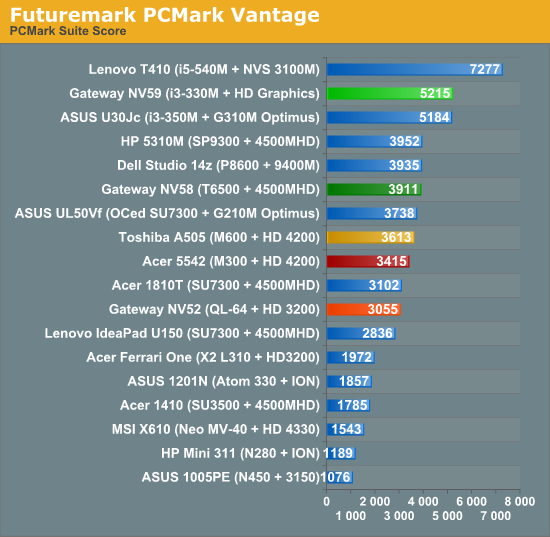
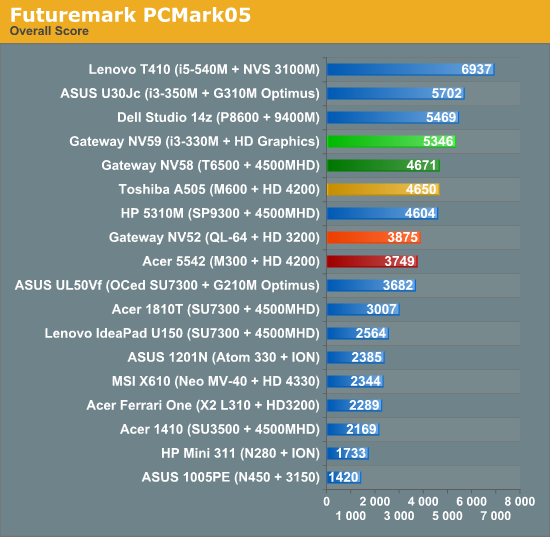
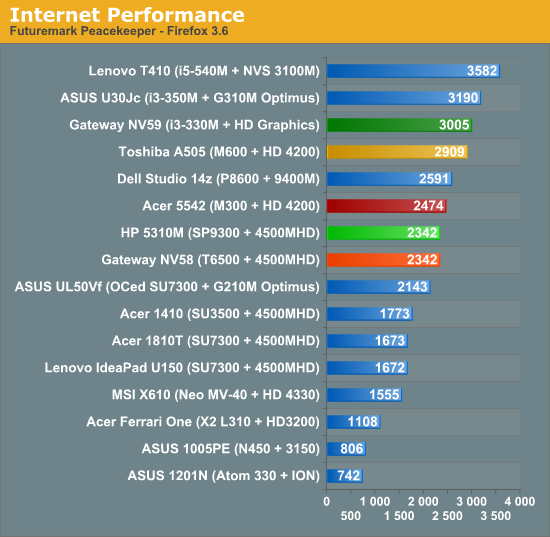
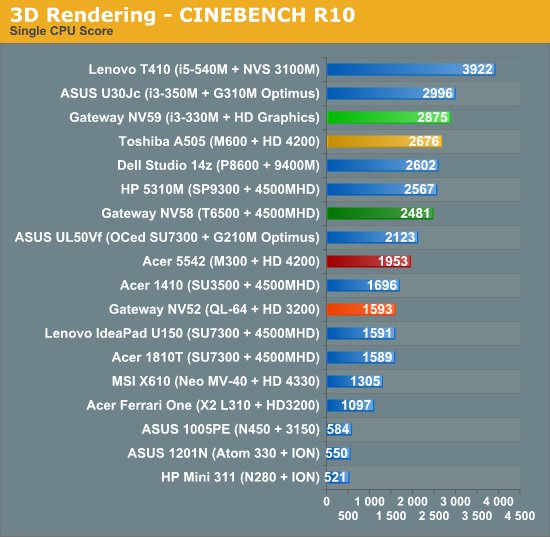
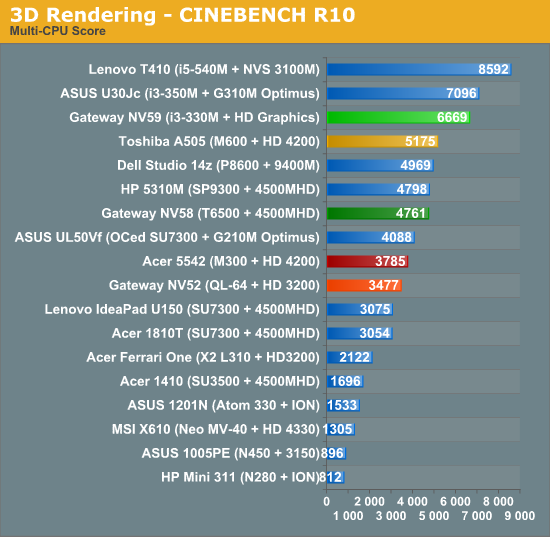
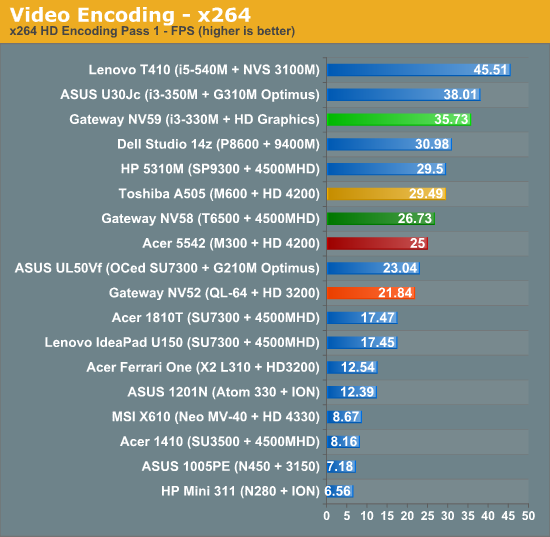
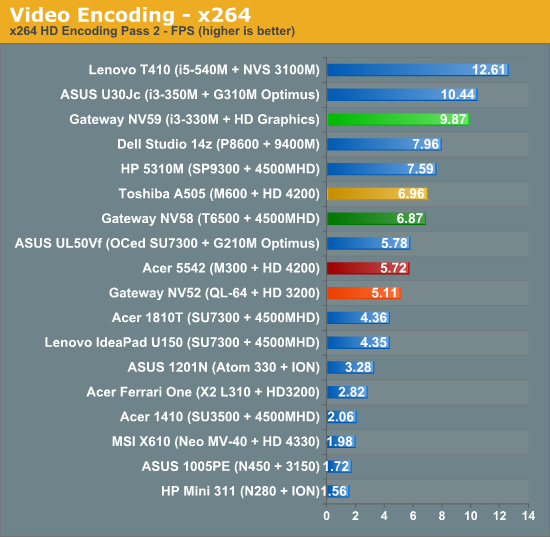
Let's start with PCMark, since it's a good representation of real world applications. PCMark puts the NV59 quite a bit ahead of the 5542, though with different hard drives there are other factors in play. The gap in Vantage is 52% while it's "only" 42% in 05, and in general use the NV59 certainly feels quite a bit faster. Results in the other application tests continue the trend of Intel leading in general performance. The closest score is in Peacekeeper, a single-threaded Internet benchmark, with the NV59 leading the 5542 by 21%. The x264 encoding advantage is 43% for pass one, and the second pass where multithreading really plays a role has the i3-330M leading by 73%. Cinebench is similar: 47% lead for i3-330M in single-threaded mode, and a 76% lead in the multi-threaded test.
It's no surprise that Intel is leading in CPU performance, as they've been ahead of AMD since Core 2 launched and Core i7/i5/i3 only increased that lead. That's not to say that the 5542 is slow, but the M300 isn't a very good competitor as far as general CPU performance is concerned. Clocked at 2.0GHz, architectural improvements make it slightly faster than the old QL-64, but chips like the M500 and M600 are much more competitive. We've included the Toshiba A5050 with a Turion II M600 for reference here, and it does much better. Of course Intel has plenty of faster CPUs as well—the i3-330M is their slowest i-Series processor. Anyway, as Atom has proven, if you're just surfing the Internet and running office applications any modern laptop is more than sufficient; these systems are substantially faster than netbooks and CULV laptops, so they're certainly in the category of "fast enough".
Also worth noting is the improvement in performance both platforms have shown relative to last year's models. We're using our Windows 7 results here, so the OS isn't a factor, and the basic entry-level AMD laptop is still 10-15% faster in many of the tests, even with a slightly lower clock speed. Clearly the change from an old K8-based architecture to the 45nm K10-based design helps, with PCMark05 being the only test where the 5542 didn't beat NV52. On the Intel side, the performance gap is much greater. The smallest gains are around 15% in single-core Cinebench and PCMark05. PCMark Vantage improves 33%, with Peacekeeper and x264 pass 1 around 30% as well. The biggest gains are in multi-threaded tests where Hyper-Threading is able to boost performance by up to 45% over the old T6500.
We also tested the latest release of Flash 10.1 with the latest drivers from both AMD and Intel. Unlike previous tests, all of our Flash video testing went off without a hitch—yes, even 1080p YouTube videos played in full screen mode without dropping frames. The NV5933u comes with a Blu-ray drive, and we also tested several Blu-ray movies, the most intensive being a 37Mbps AVC encode. There were no issues there either. But there's more to laptops than general performance, so let's look at a few other metrics.
Originally published at https://www.anandtech.com/show/3773/amd-and-intel-mobile-rematch-gateway-nv5933u-vs-acer-5542 (Wayback Machine).