
Intel Unveils Moorestown and the Atom Z600, The Fastest Smartphone Platform?
- Posted in
- Smartphones
- Intel
- Atom
- Mobile
- SoCs
Power Gating
Until the Atom Z600 series, the only Intel CPUs to power gate were the Nehalem/Westmere derived chips. In Moorestown, everything is both power and clock gated.
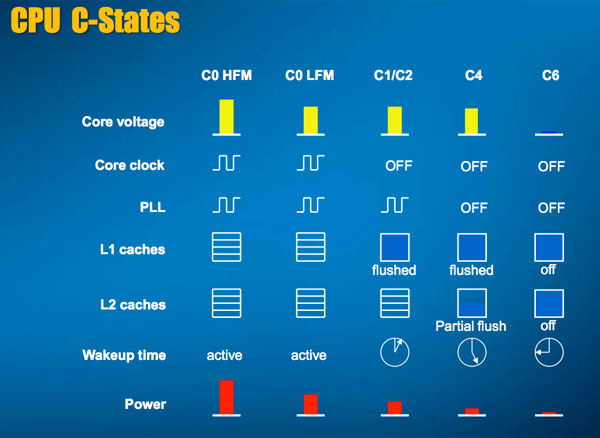
The CPU itself has its usual power states; C0 implies full power, full performance, and C6 is a deep sleep state where power is shut off to the entire CPU and state is saved in a small amount of active SRAM. There’s finer grained clock and power gating in Lincroft than in Intel’s Core i7.
Moorestown is a SoC platform however, so we need some new power states. Intel calls them S0i1 and S0i3. As with CPU power states, the higher the number, the more that’s shut off.
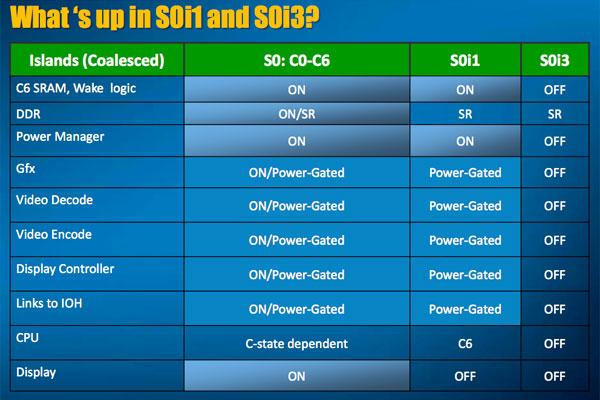
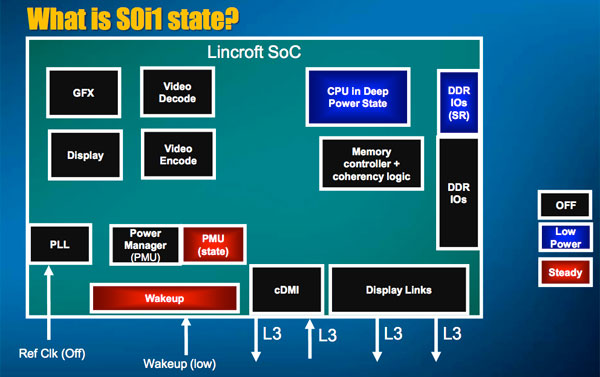
Virtually all blocks in Lincroft and Langwell are clock and power gated. In S0i1, everything from the CPU and GPU to interconnects are power gated. From the sounds of it, S0i1 is where you’d find your smartphone if you just left it on the table for a few seconds. The display would shut off and all internal components would be power gated. Pick it back up, hit a button and you get pretty quick recovery.
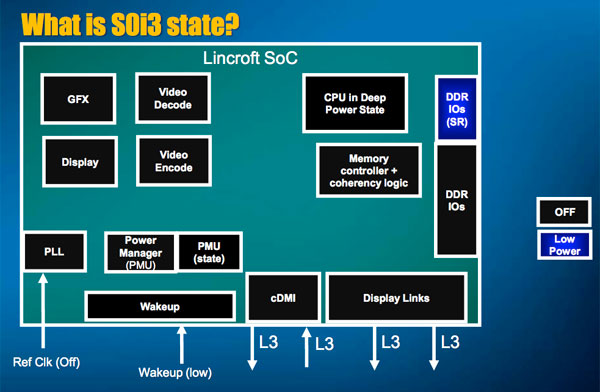
S0i3 however completely powers down virtually all components and keeps a small amount of SRAM active with state data. This is the phone locked and in your pocket state.
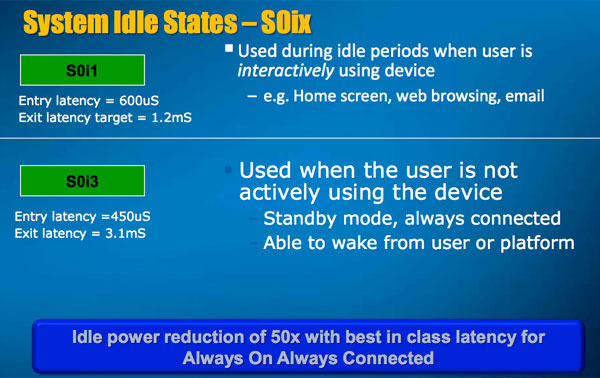
Getting out of these power states is relatively quick. S0i3 takes around 3ms while S0i1 takes 1ms.
The impact of these idle states is huge. On a reference Moorestown platform (this includes the Moorestown chips, display, 3G radio, basically a fully functional phone), Intel measured total platform power in S0i3 at 21 - 23mW. That’s a ~50x reduction compared to Menlow, and that’s what makes Moorestown suitable for use in a smartphone.
Originally published at https://www.anandtech.com/show/3696/intel-unveils-moorestown-and-the-atom-z600-series-the-fastest-smartphone-processor (Wayback Machine).