
The Highest-End Notebooks, 2009
Gaming Performance
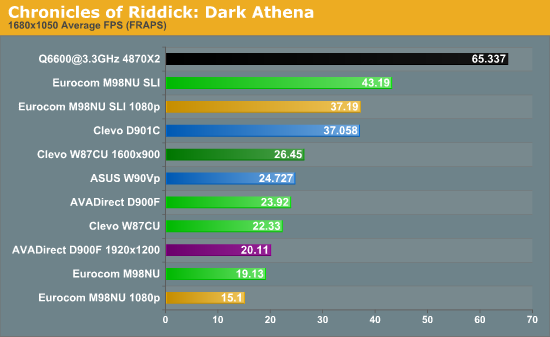
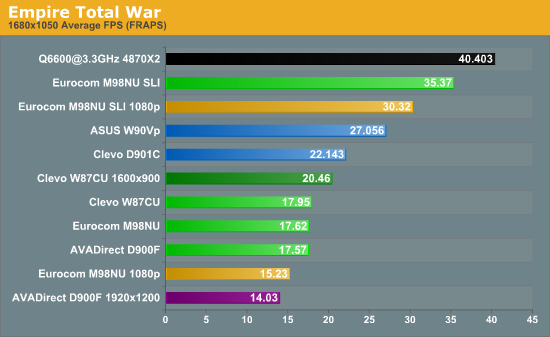
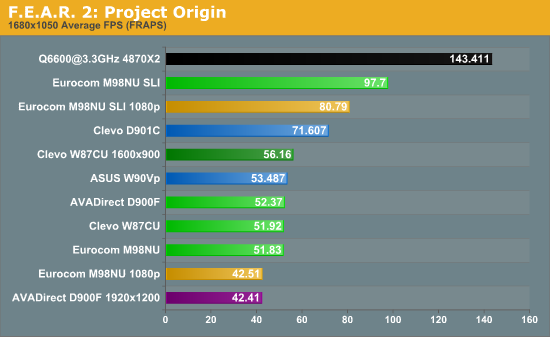
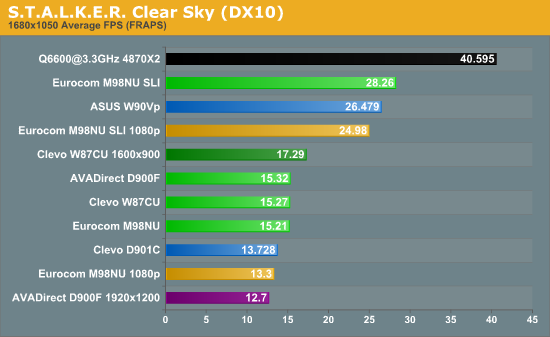
Here are the complete gaming results, using 1680x1050 as the baseline for comparison with other laptops. We're including the ASUS W90Vp (Core 2 Q9000 @ 2.20GHz with 4870X2), Clevo D901C (Core 2 E6850 with 8800M GTX SLI), and a desktop system (Q6600 @ 3.30GHz with 4870X2) as a point of reference.
We include the native resolution results for each LCD as well, which means HD+ (1600x900) for the W870CU, 1080p (1920x1080) for the M980NU, and WUXGA (1920x1200) for the D900F. In some cases, we run into CPU limitations; this will be apparent when both 1680x1050 and the native resolution deliver similar results. This is most likely to occur with the M980NU SLI configuration, but it may be present elsewhere. 1680x1050 has 22.5% more pixels than 1600x900, 1920x1080 has 17.5% more pixels than 1680x1050, and 1920x1200 has 30.6% more pixels than 1680x1050. If we are purely limited by the number of pixels the GPU(s) can render, we will see similar scaling to these percentages. Most of the time, other factors such as GPU memory bandwidth, GPU geometry, and CPU performance will also influence the frame rates.
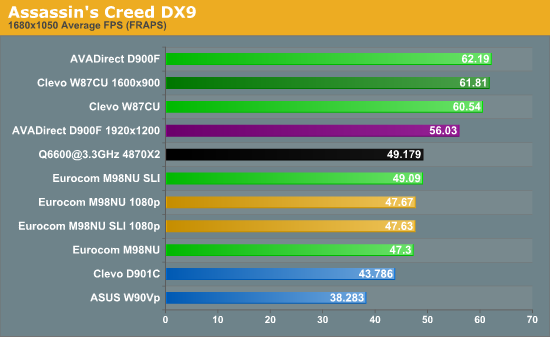
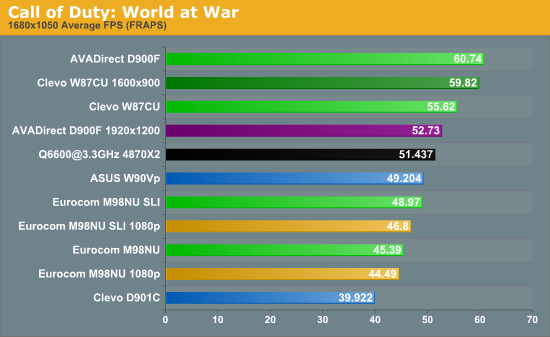
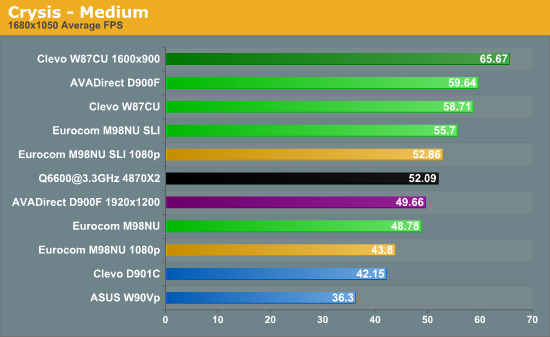
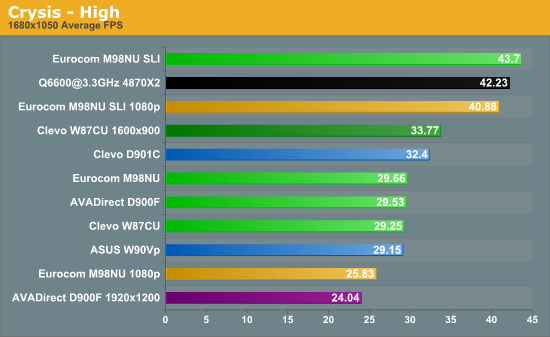
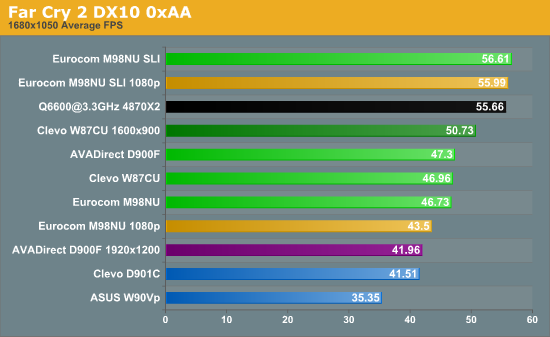
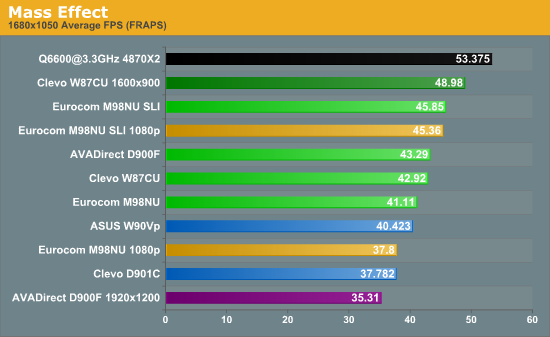
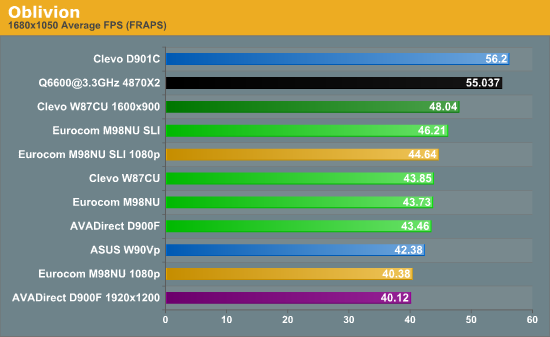
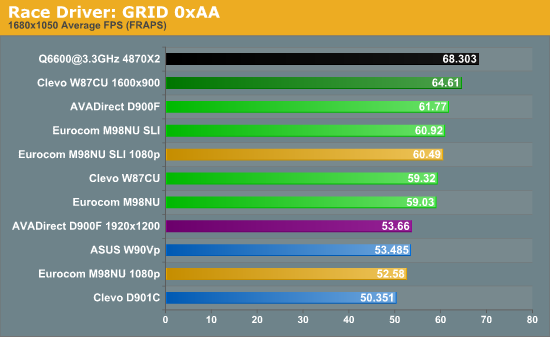
Gaming performance is about what you would expect for the most part, with the Eurocom M980NU taking top honors among the notebooks in the majority of games. However, there are definitely games where we are CPU limited with GTX 280M SLI. Assassin's Creed is the most obvious example, showing essentially no difference between SLI and single GPU mode, other than a slight increase in performance with SLI at 1680x1050. Call of Duty: World at War doesn't appear to scale very well with SLI at present -- whether this is a CPU limitation or a lack of updated SLI profiles isn't entirely clear. Crysis also appears to be running into CPU limitations, particularly at medium detail settings. Far Cry 2 with SLI could benefit from a faster CPU, and so could Mass Effect, Oblivion, and Race Driver: GRID.
On the other side of the table, we have games that scale extremely well with SLI. Dark Athena is almost completely GPU limited, along with Empire: Total War, F.E.A.R 2, and STALKER: Clear Sky. One of the interesting points is that the HD+ resolution on the W870CU is beneficial in several titles, with performance scaling almost linearly with the decrease in resolution. Any of the GPU limited titles we just mentioned should fall into this category.
On a final note, it's interesting to compare performance between the desktop system and these gaming laptops. We have to account for the fact that we are comparing ATI and NVIDIA hardware, which can definitely influence the results, but a system that now qualifies as a "midrange desktop" still comes out on top in the vast majority of these games. The only place where the desktop doesn't lead is in CPU limited titles (Assassin's Creed, Call of Duty, Crysis, and Far Cry 2), while in other titles the lead is substantial. Something the results don't show is how much easier it is to get updated drivers for the desktop. NVIDIA is doing better now with mobile reference drivers coming out quarterly, and sometimes even more frequently, but you can easily find updated desktop drivers every month for ATI cards, and just about as often for NVIDIA cards if you're willing to use beta drivers. It's possible to install unofficial beta drivers on laptops, but our experience is that performance often drops dramatically since they don't have all of the mobile hardware optimizations in place -- and don't even bother with unofficial drivers on SLI notebooks.
Originally published at https://www.anandtech.com/show/2858/the-highest-end-notebooks-2009 (Wayback Machine).