
Memory Scaling on Core i7 - Is DDR3-1066 Really the Best Choice?
- Posted in
- Memory
Sometimes Memory Bandwidth Makes a Difference
Thankfully, for the memory makers at least, things aren't always as bleak as the PCMark Vantage results. Out of the forty or so applications we tested (23 reported on) in compiling this article, these are the applications that displayed differences worth mentioning when either increasing memory bandwidth or decreasing latencies.
WinRAR 3.9b3 x64
This benchmark compresses our AT workload consisting of a main folder that contains 954MB of files in 15 subfolders. The result is a file approximately 829MB in size.
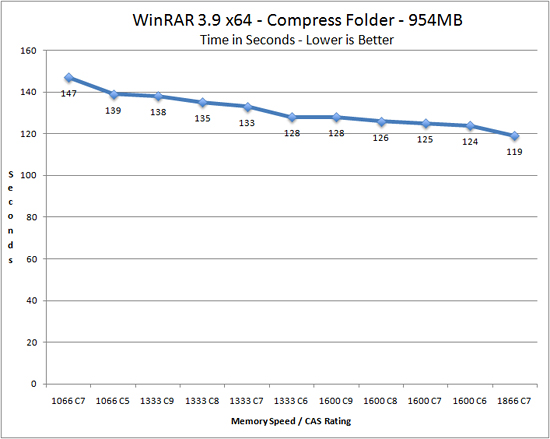
WinRAR loves bandwidth and latency improvements. Of all the applications we tested, this one responded best to improved memory performance. Going from DDR3-1066 C7 to DDR3-1866 C7 resulted in a 20% decrease in processing time by just varying memory speeds. Latency improvements within a given memory speed were most noticeable with 1066 C5 being about 6% quicker than 1066 C7 and 1333 C6 around 8% faster than 1333 C9.
Cinema 4D R11 x64
Cinema 4D R11 is one of our favorite programs to create high-end 3D images and animations. We track the time it takes to render a swimming pool layout.
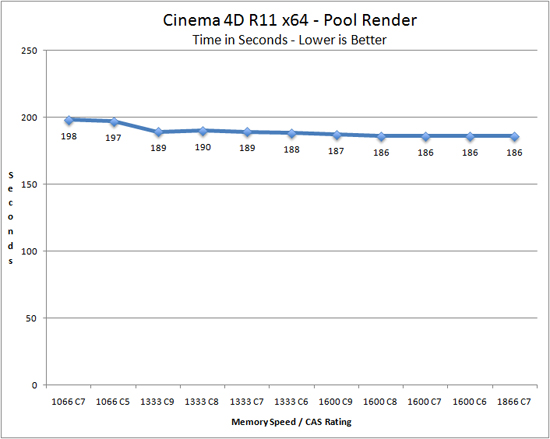
Maxon’s top flight program is bottlenecked at DDR3-1066 speeds and responded well to improved memory bandwidth with a 7% performance increase going from 1066 C7 to 1866 C7.
LightWave 3D 9.6 x64
Another popular 3D rendering program is Lightwave 3D 9.6. In this test we time the rendering of a single frame from an office building animation. The time to render the full scene is approximately four and a half hours.
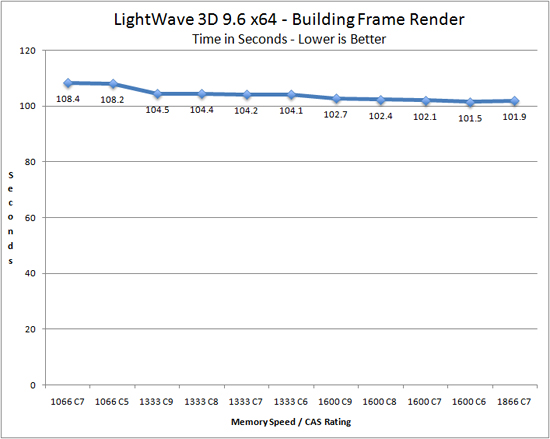
Newtek’s premier application responded well to improved memory bandwidth with a 6% advantage for DDR3-1866 C7 over DDR3-1066 C7.
Tom Clancy's H.A.W.X.
While not a true flight simulation or even serious air combat game, it is a lot of fun and looks visually stunning on a 30” monitor with all options turned up. In our case, we set all options to high, enable 2xAA and DX10, and then use FRAPS to time a custom demo sequence. We run three loops of the benchmark and average our scores for the results.
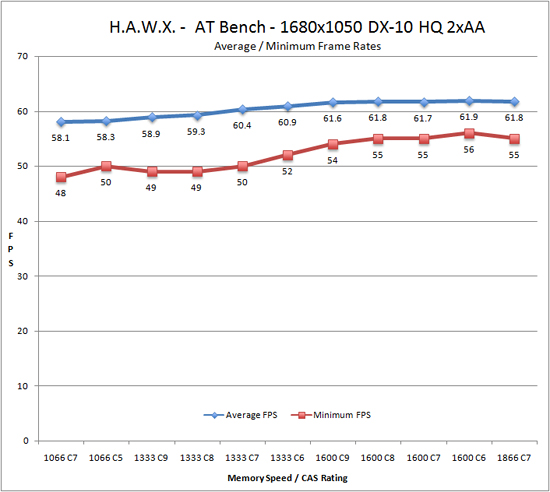
We noticed in several games that decreased latencies and/or increased bandwidth tended to improve minimum frame rates more so than average frame rates. In the case of H.A.W.X., minimum frame rates improved about 14% going from 1066 C7 to 1866 C7, while average frame rates improved 6%.
Originally published at https://www.anandtech.com/show/2792 (Wayback Machine).