
Overclocking Extravaganza: GTX 275's Complex Characteristics
- Posted in
- GPUs
Bringing it All Together: Everything OC'd
So each of core, shader and memory overclocking didn't produce dramatic results on their own, but when we put them all together we get quite a different picture. It is sort of hard to set an upper limit on maximum performance improvement when we are faced with different factors that limit performance which could all interact. Throwing more factors in there complicates it as well. I'm not a statistician or mathematician, but it is logical that we could never see a performance improvement greater than the product of the separate percent improvements to each subsystem (i.e. overclocked performance must be less than (stock performance) * 1.11 * 1.143 * 1.179).
The actual limit is lower than the 50% potential gain implied by this, as there is no way to gain the maximum benefit on overall performance by each subsystem simultaneously as gaining the maximum benefit requires that a subsystem be the sole significant bottleneck. I'm not sure how to model anything this complex, especially considering the fact that the performance of any one subsystem affects the efficiency of the other two. Please feel free to school me in the comments on this one.
But the proof that you can get huge returns on overclocking is in the pudding.
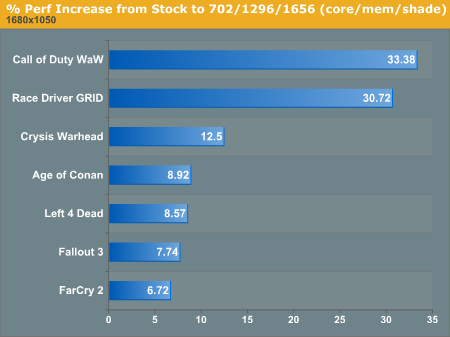
1680x1050 1920x1200 2560x1600
Call of Duty and Race Driver GRID get over a 30% boost at 1680x1050 when everything is overclocked simultaneously. Everything else sees respectable gains at over 1680x1050 while these huge boosts go away at higher resolution. An overall gain of 10% to 15% at 2560x1600 isn't too shabby at all, but it doesn't live up to the potential we clearly see in some of our other tests.
The complexity of the factors that go into these performance differences deserve a little more investigation. So we'll look at a few more tests before we throw out our raw numbers.
Originally published at https://www.anandtech.com/show/2778 (Wayback Machine).