
MSI X58M - Mighty Mouse
- Posted in
- Motherboards
General Performance – PCMark Vantage
Futuremark's PCMark Vantage x64 is probably the single most diverse set of benchmarks that can be run on a system to mimic real world usage scenarios. The TV and Movies, Gaming, and Music Suites can be frighteningly difficult to pass when a system is not set up correctly. We've had boards in the labs that will pass hours of Prime95 torture testing or OCCT that fail even the basic 30 minute run of PCMark Vantage, let alone the full 1 hour and 30 minute test run that we loop five times.
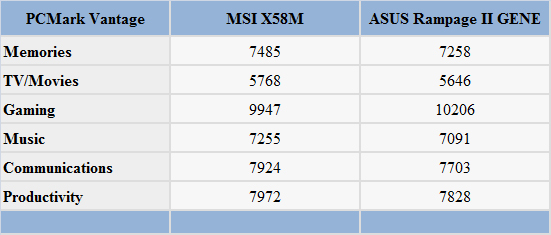
These test results surprised us, to the point where we ran the benchmark twenty five times on each board and across each of three different BIOS releases looking for an explanation. Historically, ASUS does very well in the gaming and 3D benchmarks which is evident in the gaming benchmark suite, but performance in the other test suites is different from previous results. We fired up our application benchmarks from the full review test suite and in each case, the MSI X58M had a slight advantage in applications ranging from Sony Vegas Pro 9.0 to Adobe Photoshop CS4. So, advantage to MSI in our general performance benchmarks.
General Performance – Multitasking
We devised a quick multitasking test that allows us to stress test these platforms with real world applications that simultaneously utilize the GPU, CPU, memory, and storage subsystems. We load up Sony Vegas Pro 9.0 64-bit and set it to transcode a 1080p video while running our Far Cry 2 loop benchmark at 1680x1050 2xAA DX10 High Quality in window mode. Average CPU usage is 98% throughout this process with HT enabled. We also capture the total system power draw at the wall less the monitor and keep track of Core 1 temperatures via Everest 5.01. We tested at 21x160 (3.3GHz) since this setting is basically a free overclock with our setups as voltages do not need to be increased - in fact, we actually lowered core vid slightly from the auto setting of 1.080V.
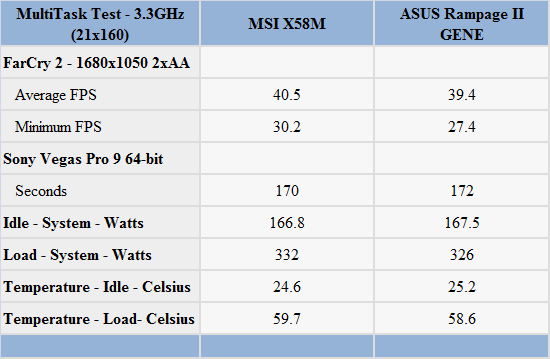
The MSI X58M’s performance numbers were just ahead of the ASUS board in both the frame rate measurement and the time it took to complete the 1080p transcode. Both boards were extremely stable and neither one failed during 25 iterations of this benchmark. Ambient temperatures were at 21C during testing.
The MSI board holds a slight advantage in idle wattage since the Core i7 920 is idling at 0.840V compared to 1.006V for the ASUS board due to differences in the BIOS setup. At full load the 920 is drawing 1.008V on the MSI board and around 0.972V on the ASUS board, once again due to BIOS differences in how Core Vid is applied with power management features enabled. This results in a slightly lower system draw for the MSI at idle and higher than the ASUS at full load with temperatures following the same pattern.
If we enable ASUS’s iTracker software on their GTX 260 Matrix card and set the profile to power savings, our system idle numbers dropped to 159W and load ranges to 310W on both boards. These are excellent numbers for a top tier performance setup considering our case and component choices.
Gaming Performance – Far Cry 2
This title has beautiful graphics, an open ended environment, and is fun to play. If you dial up the graphics options, the game rewards with you some fantastic visuals courtesy of the Dunia Engine. The game also features the most impressive benchmark tool we have seen in a PC game. We set the performance feature set to Very High, graphics to High, and enable DX10 with AA set to 2x. The in-game benchmark tool is utilized with the Ranch Small level and we report an average of three test runs.
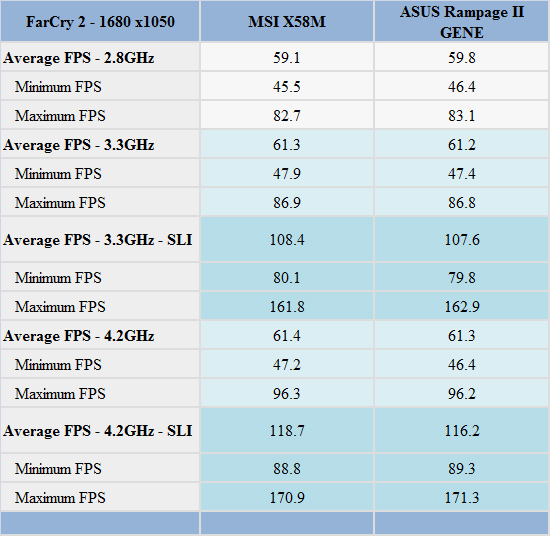
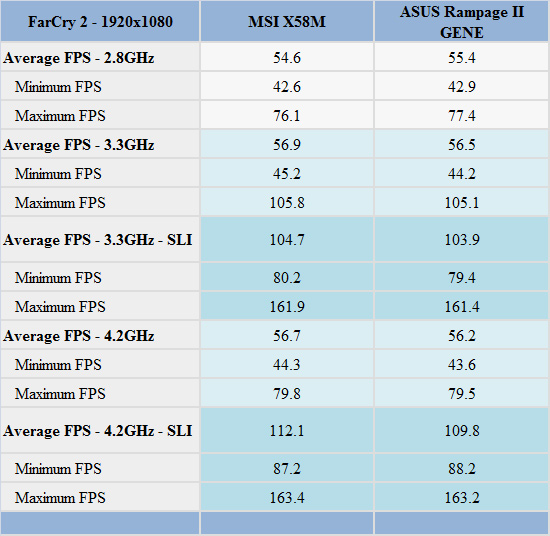
We have always applauded ASUS for their strong graphics results in a variety of tests and our PCMark Vantage test revealed their particular strength in the gaming test. We see the ASUS board continuing this pattern in the stock core speed with single card results. Interestingly enough, once we raise the core clock speed or introduce SLI into the equation, the MSI X58M generates better results. The differences are minimal but for the first time in recent memory, we do not see ASUS winning this particular benchmark.
Originally published at https://www.anandtech.com/show/2771 (Wayback Machine).