
EVGA X58 Classified - Trophy Board
- Posted in
- Motherboards
The Board
 |
The final rendition of the heatsink is a little smaller than what was on our ES sample. The reduction in size makes the heatsink compatible with the bulkier CPU coolers and allows the use of a "long" soundcard in the top PCI-E slot. Feature wise, everything we mentioned in our ES preview made it to retail release.
The ES board did leave us hopeful of a release with minimal end-user issues. On the BIOS front at time of publication, the one remaining requested fix is proper CPU FAN Speed recovery from S3 Sleep states. EVGA is addressing this and a fix should be ready shortly.
A certain amount of "pickiness" has also been revealed with certain batches of PSUs. We've encountered no problems ourselves using the venerable PCP 1200W and Corsair HX1000w PSUs. Based on these problems and ones that we have experienced with other X58 boards, we suspect the problems are with start-up current protection timing on older units. We recommend you head over to the EVGA forums to see if your PSU is on the potential hazard list before you purchase the components for your build. Units from Enermax and Thermaltake seem to be those with the most compatibility issues thus far, although not all batches seem affected, suggesting that revisions are already in the wild.
The retail board exhibited excellent compatibility with our own test hardware. Everything from onboard sound to various USB devices and peripheral cards including RAID controllers works. We can find nothing negative when it comes to overall functionality of the board.
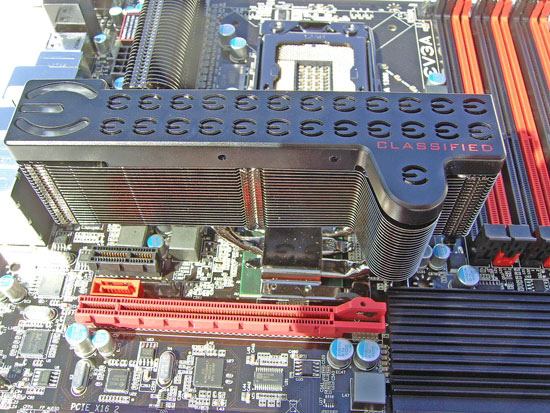
Despite its size, the IOH cooler employed by EVGA on the Classified is not suitable for passive cooling of the IOH/ICH and NF200 when used in a closed PC case during overclocking runs. We have found temperatures can easily soar over 80C if there is no cross-flow across the heatsink. EVGA's design allows the user to mount a small 40mm fan to the PCI-E slot side of the heatsink that should help reduce temperatures into the 50C region and ensure stability when overclocking.
Unfortunately, you will have to buy a fan separately, which we think should have been included in the retail package considering the price of the motherboard. A well-executed waterblock option with a heatpipe linking all critical areas would also have been welcome on a board in this price range. Active cooling of this heatsink is necessary in any overclocking configuration; expect overclocking and even stock stability in poorly ventilated cases to be somewhat flaky without some form of cross-flow.
CPU side mounting holes are not provided, because the space between the heatsink and most of the larger CPU coolers is not sufficient to place a dedicated fan into this area. It is possible to mount coolers like Thermalright Ultra 120 or Noctua NHU12P in either direction. There's just enough room to allow for push-pull fan configurations too, leaving a paper width of space between either the memory modules and the fan or the IOH heatsink and the fan in both orientations.
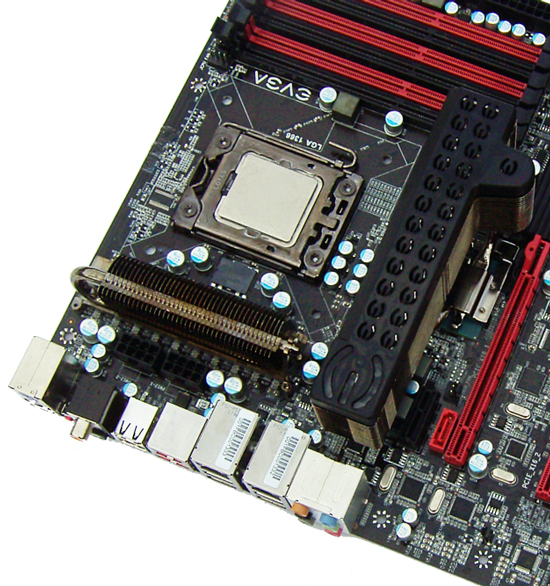
The PWM heatsink is segregated from the IOH heatsink and cools both the PWM FET's and inductors. The low voltage situations experienced in daily use do not require active cooling in this area. However, you'll find that cross-flow is again needed to keep temps in the 40-50C region when overclocking as the heat dump from the FET's and Inductors into the sink becomes quite substantial as soon as you elevate VID above 1.4V or so. It's not always easy getting airflow into this area of a board either. Again, a 40mm fan will suffice for the most part, but you'll probably have to find some way of balancing it around the heatsink or using a case like the CM Stacker 830 with fans in the side door that blow air across the board.
Originally published at https://www.anandtech.com/show/2764 (Wayback Machine).