
The Core 2 Quad Q8400: Intel's $183 Phenom II 940 Competitor
- Posted in
- CPUs
Overclocking with a 10% Increase in Core Voltage
While there's something nice about not having to do anything to overclock your CPU other than adjusting a single parameter, tweaking your core voltage has the potential to significantly increase your overclocking potential.
Let's start with the Phenom II X4 940. Using the stock AMD cooler and pushing a max 10% increase in core voltage we ended up with 3.6GHz and a 2.2GHz NB frequency at 1.475V:
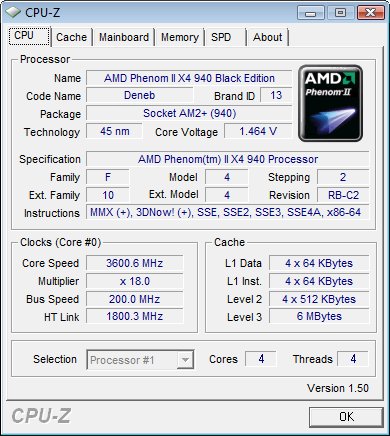
I was able to get the chip up to 3.9GHz but not stable enough to complete all of my tests over a significant period of time. Still, a 20% overclock with a moderate increase in core voltage isn't bad at all.
The Core 2 Quad Q8400 saw a 15% increase in clock speed without touching the core voltage. Bumping the core voltage up to 1.45V bought us another 11% taking the chip up to 3.36GHz:
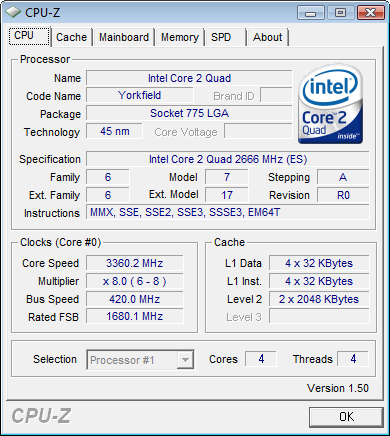
At 3.6GHz vs. 3.36GHz, AMD's clock speed advantage grows to ~7%. Not as big as the 12.7% clock speed advantage at stock frequencies but bigger than the 4% difference in our stock voltage OC attempt.
| Processor | Adobe Photoshop CS4 | x264 HD - 2nd pass | POV-Ray | Far Cry 2 | Idle Power | Load Power |
| AMD Phenom II X4 940 @ 3.6GHz | 20.3s | 21.3 fps | 2839 | 51.5 fps | 120.8W | 256W |
| Intel Core 2 Quad Q8400 @ 3.36GHz | 18.0s | 22.3 fps | 2771 | 59.5 fps | 139.9W | 213W |
At max overclock something interesting happens. Obviously the Q8400 holds on to the lead in Photoshop and Far Cry 2, but POV-Ray goes back to AMD. The x264 encode ends up being a mild victory by the Q8400. Far Cry 2 is bizzare as the Phenom II saw no performance improvement from 3.2GHz up to 3.6GHz, regardless of how many times I ran the test I could never get a higher frame rate out of the system - even with CnQ disabled.There must be some other bottleneck operating here, but it's not a GPU one since the Q8400 was able to scale all the way up to 59.5 fps with the same graphics card.
The situation seems to boil down to this - at max frequency the Phenom II will probably retain its performance lead in 3D rendering and ray-tracing applications, while the video encoding lead goes to Intel. Power consumption also favors the Q8400 significantly.
Originally published at https://www.anandtech.com/show/2762 (Wayback Machine).