
Revealing The Power of DirectX 11
- Posted in
- GPUs
Tessellation: Because The GS Isn't Fast Enough
Microsoft and AMD tend to get the most excited about tessellation whenever the topic of DX11 comes up. AMD jumped on the tessellation bandwagon long ago, and perhaps it does make sense for consoles like the XBox 360. Adding fixed function hardware to quickly and efficiently handle a task that improves memory footprint has major advantages in the living room. We still aren't sold on the need for a tessellator on the desktop, but who's to argue with progress?
Or is it really progressive? The tessellator itself is fixed function rather than programmable. Sure, the input to and output of the tessellator can be manipulated a bit through the Hull Shader and Domain Shader, but the heart of the beast is just not that flexible. The Geometry Shader is the programmable block in the pipeline that is capable of tessellation as well as much more, but it just doesn't have the power to do tessellation on any useful scale. So while most everything has been moving towards programmability in the rendering pipe, we have sort of a step backward here. But why?
The argument between fixed function and programmable hardware is always one of performance versus flexibility and usefulness. In the beginning, fixed function was necessary to get the desired performance. As time went on, it became clear that adding in more fixed function hardware to graphics chips just wasn't feasible. The transistors put into specialized hardware just go unused if developers don't program to take advantage of it. This made a shift toward architectures where expanding the pool of compute resources that could be shared and used for many different tasks became a much more attractive way to go. In the general case anyway. But that doesn't mean that fixed function hardware doesn't have it's place.
We do still have the problem that all the transistors put into the tessellator are worthless unless developers take advantage of the hardware. But the reason it makes sense is that the ROI (return on investment: what you get for what you put in) on those transistors is huge if developers do take advantage of the hardware: it's much easier to get huge tessellation performance out of a fixed function tessellator than to put the necessary resources into the Geometry Shader to allow it to be capable of the same tessellation performance programmatically. This doesn't mean we'll start to see a renaissance of fixed function blocks in our graphics hardware; just that significantly advanced features going forward may still require the sacrifice of programability in favor of early adoption of a feature. The majority of tasks will continue to be enabled in a flexible programmable way, and in the future we may see more flexibility introduced into the tessellator until it becomes fully programmable as well (or ends up just being merged into some future version of the Geometry Shader).
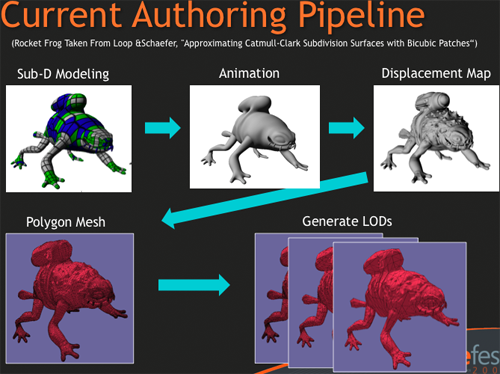
Now don't let this technical assessment of fixed function tessellation make you think we aren't interested in reaping the benefits of the tessellator. Currently, artists need to create different versions of their objects for different LODs (Level of Detail -- reducing or increasing complexity as the object moves further or nearer the viewer), and geometry simulation through texturing at each LOD needs to be done by pixel shaders. This requires extra work from both artists and programmers and costs a good bit in terms of performance. There are also some effects than can only be done with more geometry.
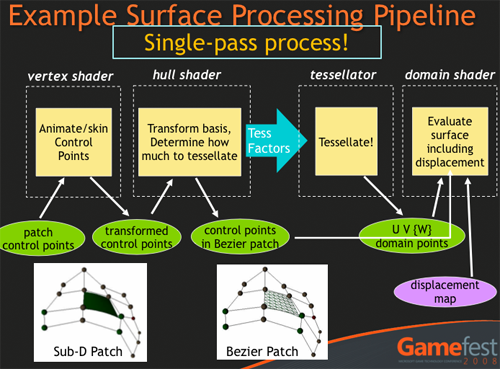
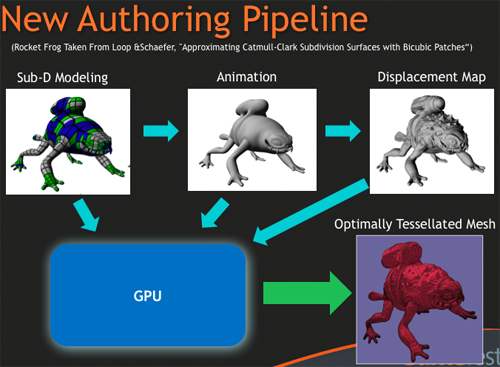
Tessellation is a great way to get that geometry in there for more detail, shadowing, and smooth edges. High geometry also allows really cool displacement mapping effects. Currently, much geometry is simulated through textures and techniques like bump mapping or parallax occlusion mapping or some other technique. Even with high geometry, we will want to have large normal maps for our lighting algorithms to use, but we won't need to do so much work to make things like cracks, bumps, ridges, and small detail geometry appear to be there when it isn't because we can just tessellate and displace in a single pass through the pipeline. This is fast, efficient, and can produce very detailed effects while freeing up pixel shader resources for other uses. With tessellation, artists can create one sub division surface that can have a dynamic LOD free of charge; a simple hull shader and a displacement map applied in the domain shader will save a lot of work, increase quality, and improve performance quite a bit.
If developers adopt tessellation, we could see cool things, and with the move to DX11 class hardware both NVIDIA and AMD will be making parts with tessellation capability. But we may not see developers just start using tessellation (or the compute shader for that matter) right away. Because DirectX 11 will run on down level hardware and at the release of DX11 we will already have a huge number cards on the market capable of running a subset of DX11 bringing with it a better, more refined, programming language in the new version of HLSL and seamless parallelization optimizations, we will very likely see the first DX11 games only implementing features that can run completely on DX10 hardware.
Of course, at that point developers can be fully confident of exploiting all the aspects of DX10 hardware, which they still aren't completely taking advantage of. Many people still want and need a DX9 path because of Vista's failure, which means DX10 code tends to be more or less an enhanced DX9 path rather than something fundamentally different. So when DirectX 11 finally debuts, we will start to see what developers could really do with DX10.
Certainly there will be developers experimenting with tessellation, but these will probably just be simple amplification to get rid of those jagged edges around curved surfaces at first. It will take time for the real advanced tessellation techniques everyone is excited about to come to fruition.
Originally published at https://www.anandtech.com/show/2716 (Wayback Machine).