
Thermaltake TR2 QFan Series
- Posted in
- Cases/Cooling/PSUs
 |
Conclusion
The first time we saw the TR2 QFan on the show floor, we were extremely happy to see that someone was still planning to offer a good PSU targeting users that need less than 500W. The four power supplies we've tested today perform very well and we have no problem recommending them to anyone putting together a moderate PC. All we need now is retail availability.
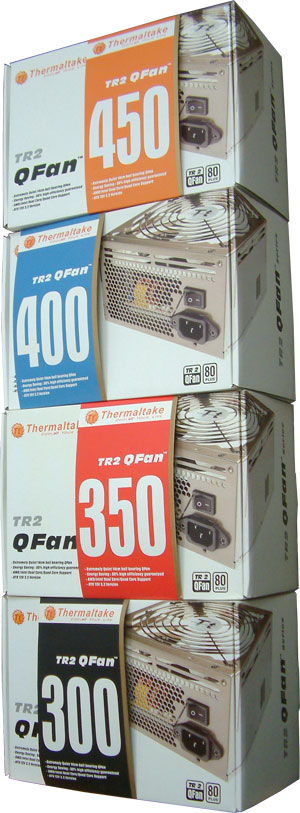
In terms of features and performance, the QFan marketing sounds nice but we didn't see any actual benefit in testing. Thermaltake also cut corners in other areas to keep costs down; some of the cost cutting measures will matter, but others are trivial. Packaging for example uses the same simple box for all of the units, with the only difference being the large paper wrap that lists the wattage. All of the cables and connectors on the various units are also identical, as the bigger concern.
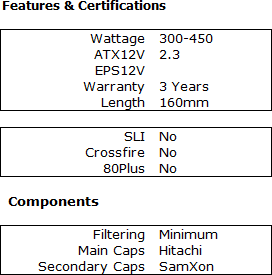
The connectors are a little limited on all of the units, with a maximum configuration being a GPU that requires two 6-pin PEG connectors. The 12V rail is also a concern, but typical midrange graphics cards should run fine even on the smallest 300W unit. There are also sufficient Molex and SATA connectors on hand for most users looking at this range of power supply.
DC regulation is average with around 5% on all rails. The 3.3V rail differs among the four units we tested, but the other rails are all similar. The efficiency ratings are great for lower output PSUs, and all of the units reach 85% to 86% maximum efficiency with 230VAC. That will be a great selling point for these units and we hope that more people will actually pay attention to these results.
As for the fan speed and the resulting acoustical noise, we can say that the fan control works well; with increasing temperatures, the fan spins faster. We just don't see the sense in advertising a promising feature like the QFan that actually doesn't seem to add much to the package. The temperature of the first two heatsinks stays below 40°C, but the secondary heatsink temperature reaches 80°C, which is not very good. As mentioned earlier, a larger heatsink should perform a little better.
With all of the power supply companies heavily marketing their high-end, high capacity PSU models, it's difficult to gauge how much interest there will be in good quality 300W to 500W PSUs. Even Thermaltake doesn't appear to be very bullish on the subject, as we first heard about the TR2 series over eight months ago.
 |
Even after all this time, these units are still not available on retail shelves, so we don't know what prices will be. We can only hope that Thermaltake will manage to offer these power supplies at a reasonable price, so that more users will end up purchasing something appropriate to their needs. Not only does it cost more money to purchase a 600W-1000W PSU, but if you aren't routinely drawing 300W+ of power such large PSUs end up being less efficient. If all you need is a single 6-pin PEG connector for your graphics card, and you don't plan to heavily overclock your system, the Thermaltake TR2 QFan series of power supplies should be near the top of your shopping list.
Originally published at https://www.anandtech.com/show/2670 (Wayback Machine).