
Corsair DDR3-2133 - How high and fast will it go?
- Posted in
- Memory
Reaching DDR3-2133, the hard way
We can rule out the use of quad-core processors in this task for a start. There are no quad-core processors currently available that can run 533FSB in a 24/7 configuration. Therefore, we are left looking at the dual-core Wolfdales, which represent a light enough load on the system to scale well over 500FSB. Of course, we stress a disclaimer at this point: there are always the offspring of Satan's donkey in the marketplace - some of us just are not born lucky when it comes to getting good retail processors.
Such was our case, so we're now limiting ourselves even further with a decent Wolfdale teamed up with an interesting X48 board to achieve at least stock DDR3-2133 specifications for the modules - and perhaps go a little higher. The constant thorn in my conscience while writing all this is few if any people buy 2GB kits - especially $500+ kits - anymore unless they are serious about benchmarking. However, benchmarkers are just as fussy as everyone else involved in overclocking. They want kits that scale well with voltage while running tight latencies at a very high bandwidth.
This Samsung based part can certainly satisfy the bandwidth requirements and then some, but it's not known for its ability to run tight latencies up high. This pretty much puts these particular 2GB kits into a niche within a niche market. It's rather like deciding between a 39 or 40 carat diamond for a dinner ring when your better half is already wearing a 45 carat wedding ring.
There might just be a redeeming quality for the Samsung part, as it is a very light capacitive load. This means it's less demanding of the MCH output stages compared to the typical Micron D9JNL, which gives it the potential to scale a little higher in raw speed. It may not manage tight latencies, but we must remember that Intel's Core 2 architecture has already shown it usually favors raw processor MHz as long as the all-important tRD (Performance Level) register is kept as low as possible.
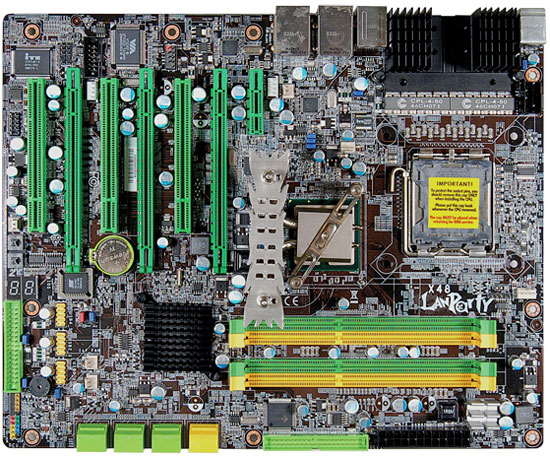
Shortly after the Corsair kit arrived in the labs, DFI shipped us their new LANParty UT X48 T3R motherboard. It uses DDR3 and is armed to the rafters with overclocking options - we thought we'd found the perfect partner. In truth, we could not have been more wrong at the time. The BIOS was still very much alpha level and had more quirks, knots, and idiosyncrasies than we care to list. We found ourselves receiving a new BIOS every few days just to get modules (any modules, much less these) to either boot or get the board to even resemble an overclocking product.
The rest was really down to our own inability to master this BIOS. Sure we've done it all before, but this one really is different and took every ounce of patience to get from A to Z. Finally, we are in a position to start appreciating the qualities of DFI's hell-boy, though it is still not without its disappointments. We provided our BIOS settings in the gallery below.


A full lowdown on this board will be given in an upcoming review. Meanwhile, let's look at what this red carpet pairing of parts can do. Will they self destruct, or will they waltz together like Astaire and Rogers?
Originally published at https://www.anandtech.com/show/2605 (Wayback Machine).