
CyberPower: 4.0 GHz QX9770 and SLI GTX 280s
- Posted in
- Systems
Gaming/3D Performance
This section should first be prefaced with a nod to the Ridata SSDs used in this system. SSDs are the new rage, but unless a component like this can provide tangible performance benefits to the casual user, it's largely worthless. In this case, the load times for games and benchmarks (all installed on the SSD) were much faster than a traditional hard drive, tearing through loading and precaching screens. Bearing in mind that the solid state discs are space limited, however, you may need to select a few of your choice games and leave the 10GB+ installations (especially of games that don't rely as heavily on load times) to the data drives.
3DMark 2006
Once again we start things off with the classic synthetic 3D benchmark, run with default demo options only.
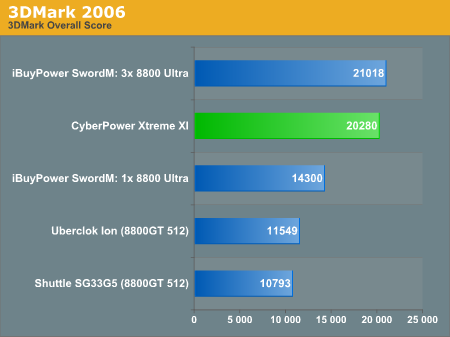
It's impressive that two GTX 280s are providing nearly enough power to match triple 8800 Ultras, but at the same time we're comparing the latest and greatest from NVIDIA to last generation hardware. Considering you can now purchase three 9800 GTX+ cards for $600 vs. $840 for two GTX 280 cards, and you might be tempted to stick with last-gen hardware. Of course, 3-way SLI isn't always as seamless as 2-way SLI.
3DMark Vantage
We gave some coverage to 3DMark Vantage when it first debuted. As a brief recap, Vantage runs on Windows Vista only, and has four different default test settings: Entry, Performance, High, and Xtreme. We promised more results in the preview, and today we have just that, comparing the Xtreme XI to our original test system. Vantage will be a new addition to our test suite, and though the new payment scheme is inconvenient, it is still user reproducible (once).
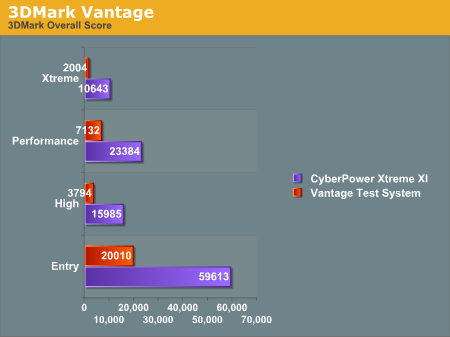
The CyberPower machine well and truly demolishes a respectable gaming machine (Q6600 @ 3.3GHz, SLI 3870s). We have a new bar to shoot for. Then again, the cost of the "old" Vantage test system comes out to a paltry $1200 or so. The disparity between the CPU and GPU score is quite a bit less on the CyberPower machine at Xtreme settings (1920x1200), a testament to the power of the GTX 280s.
Crysis
Crysis is punishing to even the most recent PC hardware. This demo also has two built-in benchmarks in the "bin32" folder, one "CPU" and the other "GPU". We ran several configurations to show the scalability of this game. We ran all benchmarks three times, discarding the first result and averaging the other two. We ran all tests at "High" quality unless otherwise specified. Per Derek's recent findings, Crysis benchmarks were run with VSync at default settings (i.e. not forced off in the driver).
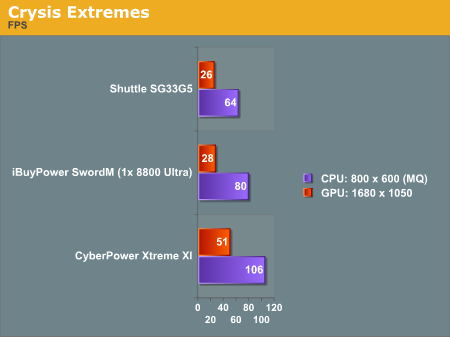
Looking at opposite ends of the spectrum here, we see that the CPU benchmark runs very quickly, but remember that Crysis has a seemingly endless thirst for GPU power and is completely GPU bound at higher resolutions.
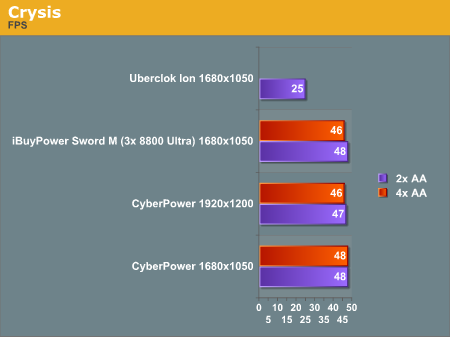
We see further evidence of the brick wall here; at the higher resolutions, frame rates consistently stick around the 45-50 mark at High quality. Raising the quality level to Very High at 4xAA yielded a 15 FPS result, so that's not really an option. Also, we noticed none of the "hitching" or jumpiness with this system that we did with our previous SLI system. As some of the comments from the last system article noted, it may be that the 790i platform resolves these issues.
World in Conflict
World in Conflict is a strategy war-game where the Cold War has erupted into a full-scale conflict between the U.S. and the Soviet Union. The demo has a built-in benchmark under Options->Graphics. Quality settings in the game also modify anti-aliasing and anisotropic filtering; however, these were controlled independently while all other settings were left at the default for that quality.
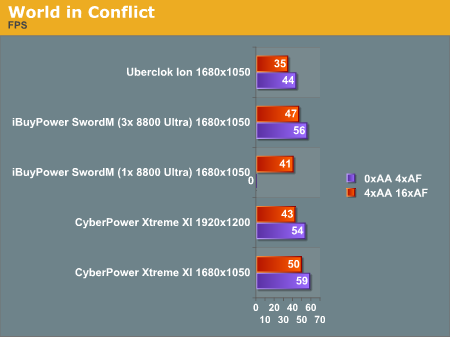
We have very good results here with the CyberPower system. Also worth noting is that at 1680x1050 0xAA 4xAF, the frame rate never drops below 30 FPS, making game play enjoyable even during periods of large explosions (and even at 1920x1200, it only drops to 27). It's very impressive to see the SLI GTX system beat out the Tri-SLI 8800 Ultras here.
Metal Knight Zero Pre-Alpha Benchmark
NVIDIA recently released their "Force Within" Power Pack that included new Detonator drivers with PhysX acceleration for 8xxx, 9xxx, and GT200-class video cards. It also offers some demos, UT3 maps, a full game (Warmonger), and a trial version of Badaboom, among other things. We downloaded MKZ and gave the "High" (1920x1200) benchmark a whirl.
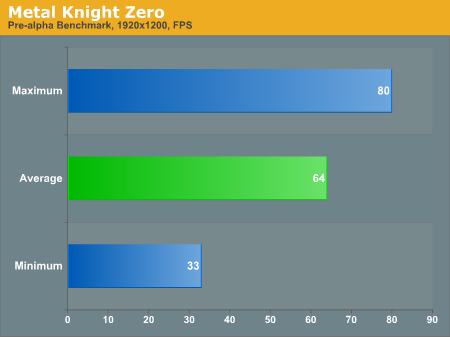
The game runs through a pre-recorded timedemo that is clearly aimed at showing off the PhysX capabilities. Banners blowing in the breeze while getting shot up with holes and ripping down, and vehicles exploding into little tiny bits is the norm.
Originally published at https://www.anandtech.com/show/2595 (Wayback Machine).