
OCZ Flex II - Life at 1200MHz
- Posted in
- Memory
3DVantage Results
 |
 |
Our 3DVantage tests completed at High settings with a final score of 3935 with DDR2-1200 and 3924 with DDR2-960 settings using the Zotac 9800GTX. The scores are basically even with the GPU result going to the DDR2-1200 setting while the CPU Score was slightly higher on the DDR2-960 option.
Our Everest results showed a wider disparity with the DDR2-1200 setting having an advantage in the Read, Copy, and Latency numbers by a measurable difference. The DDR2-960 setting operated at a 1:1 memory ratio compared to 4:5 for the DDR2-1200. At DDR2-960, memory timings were 5-4-4-12 at 1.88V with tRD (performance level) set to 12. Comparatively, at DDR2-1200 the memory timings were at 5-5-5-15 at 2.08V with tRD set to 8. Both tRD values were set manually with all phases pulled in resulting in actual tRD values near 11 and 7 respectively.
Our tRD values were arrived at after numerous hours of stress testing and represent 24/7 stability results. We were disappointed in the tRD settings at DDR2-960; even on a significantly more demanding 1:1 ratio as we expected numbers near 9 which probably would have resulted in similar throughput and latency numbers. We are still working with ASUS on tuning the BIOS and additional tuning of the clock skews, GTL-Ref, and other sub-timings have resulted in a tRD setting at 10, but we have not completed stability testing yet. However, initial test results are closer to the DDR2-1200 settings.
Game/Sandra Results
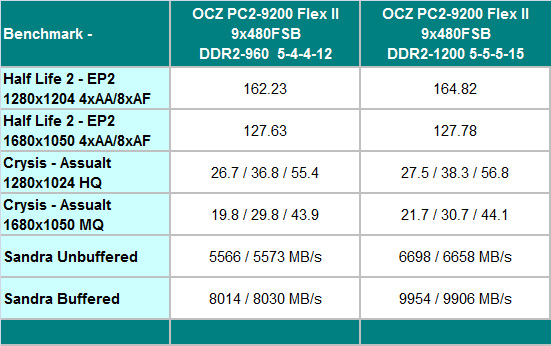
We ran a few additional tests based on two of the more popular games along with Sandra Memory Bandwidth numbers. Our results speak for themselves, as DDR2-1200 is just slightly faster at the 1280x1024 resolution and basically even at 1680x1050. Although not reported, the 1920x1200 numbers are identical, as this setting becomes truly GPU dependent. This is not surprising as most current game engines are much more dependent on the GPU and to some extent the CPU for improvements in frame rates rather than subsystems like memory or storage.
Our Sandra numbers show a 20% advantage in the unbuffered test and a 24% improvement in the buffered test. We typically see a translation in these advantages (also true for Everest) in applications that are truly memory sensitive; however, even those differences are typically within a few percent of each other. Benchmarks like 3Dmark 2001SE, SuperPi, older games like Battlefield 2, and WinRAR will typically show the greatest differences compared to typical applications.
Quick Thoughts
In the end, users purchasing this memory will typically be those looking for any performance advantage and this memory delivers on OCZ’s promise of the highest performing 2x2GB DDR2 memory kit available. While the ability to reach and maintain a stable DDR2-1200 setting was impressive to us, the more impressive aspect of this memory is its ability to run at 4-4-3-10 timings on 1.80V at DDR2-800 or 5-5-4-12 at DDR2-1066 on 1.95V. Really, the greatest strength of this memory is offering a multitude of timings and reasonable voltages up to its DDR2-1200 ceiling in a 4GB package. Pardon the pun, but this memory really is flexible. We will see just how much in our next article.
Originally published at https://www.anandtech.com/show/2530 (Wayback Machine).