
ASUS P5Q3 Deluxe: An Early Preview of P45 Express Performance
- Posted in
- Motherboards
Test System Configuration & General System Performance (PCMark Vantage)
| Test System Configurations | |
| Motherboards |
ASUS Striker II Extreme (NVIDIA nForce 790i-Ultra SPP and 570 MCP)
EVGA NVIDIA nForce 780i SLI MSI PN7 Platinum (NVIDIA nForce 750i SPP) ASUS P5E3 Premium (Intel X48 Experss MCH and ICH9R) ASUS P5K3 Deluxe (Intel P35 Experss MCH and ICH9R) ASUS P5Q3 Deluxe (Intel P45 Express MCH and ICH10R) |
| Processors |
Intel Core 2 Duo E8500 (ES)
Dual-core, 3.16GHz, 6MB Unified L2 Cache, 9.5x Multiplier, 1333 FSB Intel Core 2 Extreme QX9770 (ES) Quad-core, 3.20GHz, 2x6MB Unified L2 Cache, 8.0x Multiplier, 1600 FSB |
| Memory |
4x1GB OCZ DDR3 PC3-14400 Platinum Edition
4x1GB OCZ DDR2 PC2-8000 Platinum Extreme Edition |
| Graphics Card | ASUS EN8800GTS TOP 512MB (G92) |
| Cooling | D-tek FuZion CPU block, EK-FC88 GT/GTS full coverage GPU blocks, ThermoChill PA120.3 radiator, 3x SUNON KDE1212PMB3-6A 120x38mm fans, Laing D5 pump, 1/2" ID (3/4" OD) Tygon tubing |
| Power Supply | OCZ EvoStream 600W Modular PSU |
| Hard Drive | Western Digital WD250YS, 250GB, 7200RPM, SATA 3Gb/s, 16MB buffer |
| Video Driver | NVIDIA 169.25 (latest WHQL) |
| Operating System | Windows Vista Ultimate (x64) SP1 with DirectX 10.1 |
In order to compare the relative performance of base gaming rigs built using each chipset, we assembled identically configured systems in which the only component that was varied was the motherboard. All other components - including the CPU, memory modules (whenever possible), PSU, and graphics card - were simply transferred from one system to the next. An ASUS Striker II Extreme was used for the 790i base, an ASUS P5E3 Premium represented our choice in X48 motherboards, the ASUS P5K3 Deluxe for the P35 and the new contender, the ASUS P5Q3 Deluxe, provided the platform for testing the P45 chipset.
System power was measured at the wall, and thus our reported results do not make use of any power efficiency correction factor that would be helpful in more accurate relating actual power draw to typically system power consumption. This is an unimportant detail as these findings are merely intended to provide a means for differentiating one chipset from the next.
Data was collected after booting each system and allowing sufficient time for all OS activity to die down (about 7 minutes) and after total system load was noted to have stabilized for at least 30 seconds while stressing the CPU using a multi-instancing, 64-bit build of Prime95. "Small FFTs" were tested in order to create maximum CPU load while the "Blend" option was used to stress the memory subsystem (and thus the MCH).
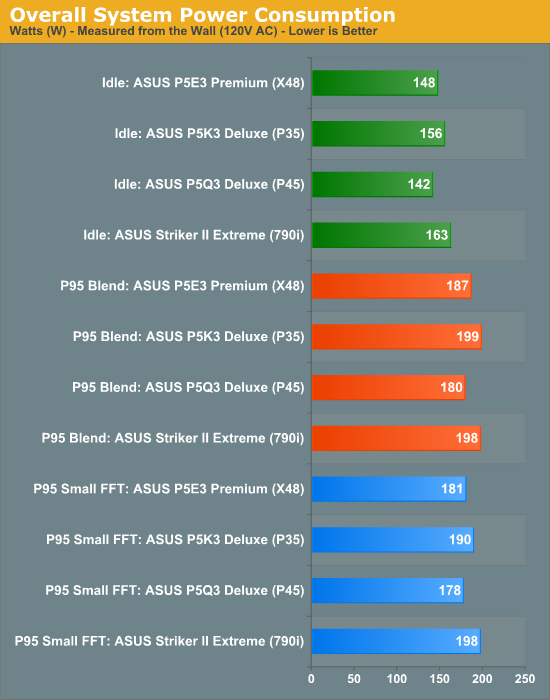
At idle the P5Q3 Deluxe (P45) shows a savings of about 6W on average beyond the already low power usage of our X48 test system. Of these results, perhaps the power consumption figures for the P35 board were the most surprising - despite running hotter even the X48 system showed better efficiency than the older P35 chipset. The Striker II Extreme, with the NVIDIA nForce 790i-Ultra chipset, ranked a distant fourth, consuming 7W more than P35 and proving once again that power efficiency often takes a back seat to performance when dealing with high-end systems.
Loading each system by running Prime95 in "Small FFT" mode results in near identical power consumption figures for the P45 and X48 systems. The NVIDIA 790i-based board and the P5K3 (P35) trailed the pack, drawing over 10% more power clock-for-clock than either board featuring a 4-series Intel chipset.
Finally, "Blend" mode shows the P45 board providing quite interesting results - our wall power meter registered little difference between this mode and "Small FFTs". This suggests that the P45 chipset's prefetch algorithms are tuned for exceptionally low power operation even when memory intensive applications call for heavy access to data stored in main system memory. X48 is a stark contrast to this as programs that rely on heavy traffic to system memory consistently result in higher system power consumption.
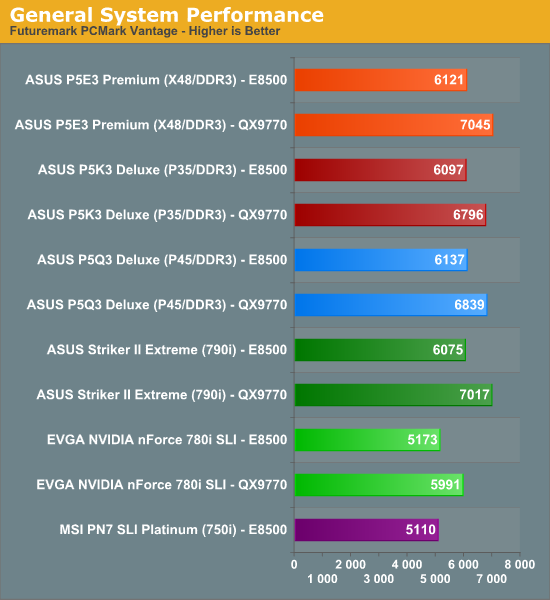
We ran a just enough of PCMark Vantage as necessary for the generation of proper total system score. As a rule of thumb, DDR3 systems generally out-score their DDR2 counterparts by at least 1000 PCMarks, regardless of tuning. When placed side-by-side P35, P45 and X48 look a lot like NVIDIA's 790i-Ultra when it comes to measuring overall system productivity.
One of the useful aspects of PCMark Vantage is that these figures can serve as baseline results for comparing our test systems to yours at home. Try to match your components as closely as possible to ours, with the exception of your motherboard, when contrasting your results with those shown here.
Originally published at https://www.anandtech.com/show/2525 (Wayback Machine).