
OCZ EliteXStream 800W and 1000W
- Posted in
- Cases/Cooling/PSUs
Internals, Continued
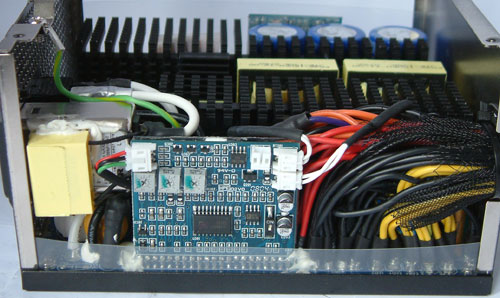
Going over to the secondary side, we can see the large sister PCB with the security features and fan control. There are two temperature diodes attached to the control unit, which are both attached to the secondary heatsink. The PS232S from Silicon Touch Technologies is also no stranger to us, with many of the companies using this or similar chips in their power supplies.
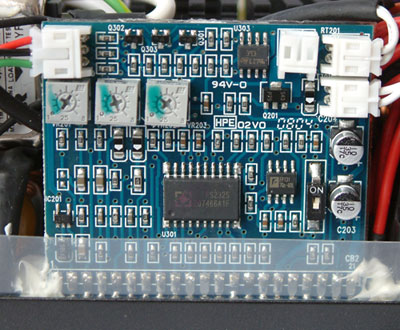
On the left side of the sister PCB, we see three potentiometers that the manufacturer can use to adjust the voltage output after production. The problem with this is that it's possible for the potentiometers to come loose after a while, and the output voltage would change if that occurs. To prevent this there is a little drop of blue glue you can see on the picture below. It's still a slight risk, though probably 90% of all power supplies in the retail market use this approach. It's an easy way to lower production failure rates, since the manufacturer can easily adjust the output voltages, potentially saving a unit from the scrap heap.
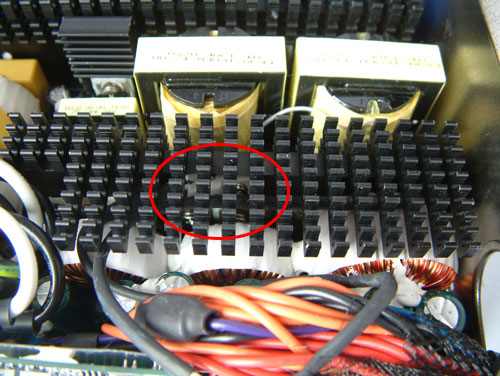
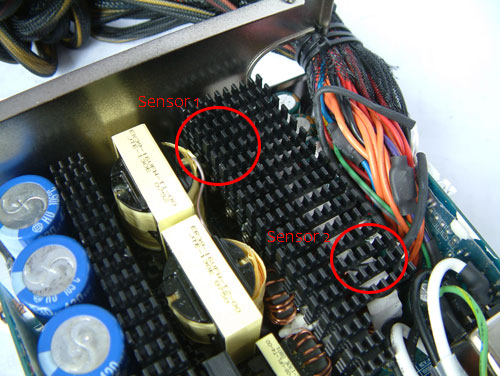
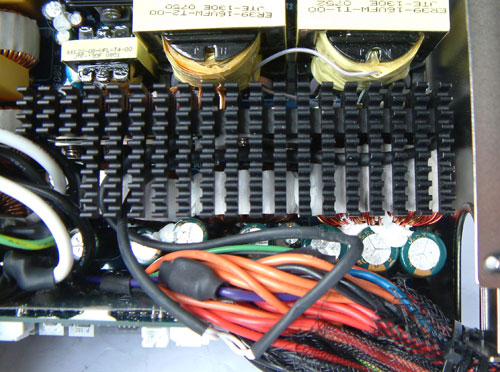
The two temperature diodes attach to the secondary heatsink. The first one is on the left side and the other is on the right side.
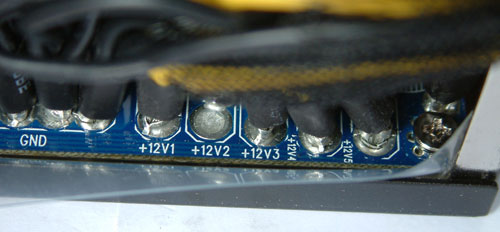
The PCB shows several markings, including 12V rails numbered 1 to 5. Indeed this power supply was designed for several separated 12V rails, but many manufacturers are ignoring the specifications related to maximum amperage on a single 12V rail. Instead, they do whatever they think is best to provide a problem-free product.
All secondary capacitors come from Teapo, which we find in many power supplies. We have never had any problems with these caps so far.
Originally published at https://www.anandtech.com/show/2497 (Wayback Machine).