
Gateway P-6831 FX: Best Midrange Gaming Notebook Ever
- Posted in
- Laptops
Other Application Performance
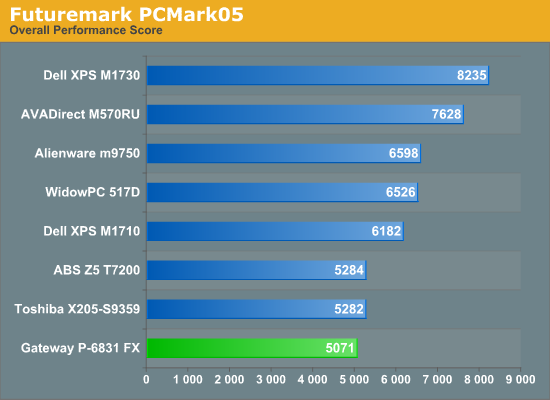
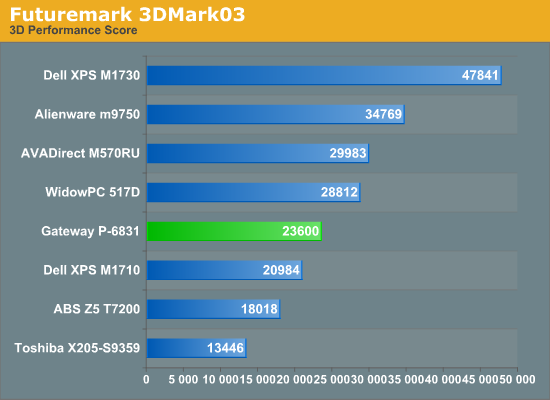
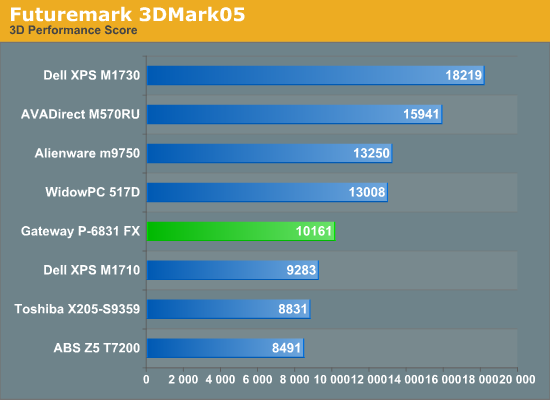
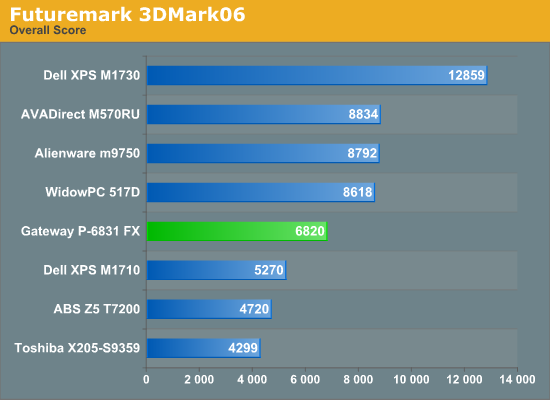
Finally, we ran several other performance benchmarks, including the popular Futuremark 3DMark and PCMark test suites. Since this is primarily a gaming notebook, we aren't as concerned with performance in general applications. Besides, just about any modern computer is more than sufficient for your typical office and Internet work. Because of the slower CPU, the Gateway P-6831 scores much lower in many of these benchmarks — excepting 3DMark, of course.
 |
The Gateway P-6831 places right where we would expect it to in these tests. In the 3DMark benchmarks, it falls below all of the 8800M GTX notebooks as well as the SLI notebooks we've tested, but it bests everything else. In PCMark05, it places at the bottom of the pack, helped by the 5400RPM hard drive and the T5450 CPU. Note that for 3DMark06, you need to use an extrenal LCD capable of 1280x1024 resolution to generate comparable results. (At the default 1280x800 use the 1440x900 laptop LCD, our score improved to 7005.)
We're also including full PCMark Vantage results starting with this review. Most of the scores should be similar to PCMark05, but for now we only have results from the AVADirect M570RU, Dell M1730, and Gateway P-6831 laptops, and variation between benchmark runs seems to be a bit higher than other tests (around 5%). Our results are summarized in the following table:
| PCMark Vantage Performance Breakdown | |||
| AVADirect (Clevo) M570RU |
Dell XPS M1730 | Gateway P-6831 FX |
|
| PCMark Suite | 3995 | 4496 | 2946 |
| Memories Suite | 3127 | 3559 | 2293 |
| TV and Movies Suite | 2585 | 2853 | 2140 |
| Gaming Suite | 4429 | 4015 | 2687 |
| Music Suite | 3808 | 4390 | 2988 |
| Commincations Suite | 3558 | 3907 | 2852 |
| Productivity Suite | 3954 | 4189 | 2041 |
| HDD Test Suite | 3137 | 4139 | 2585 |
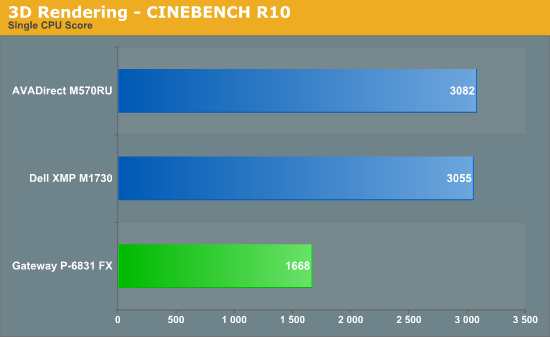
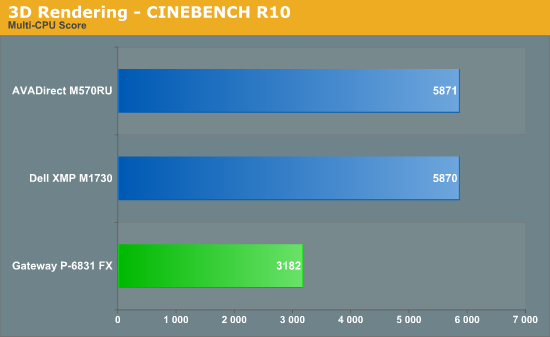
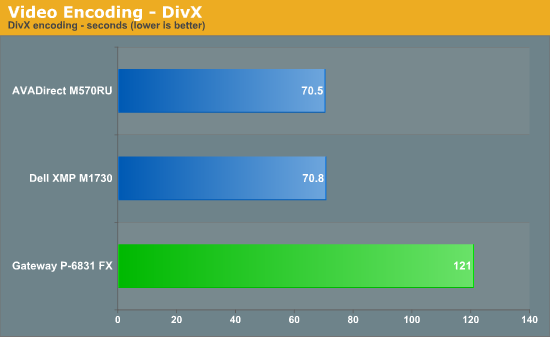
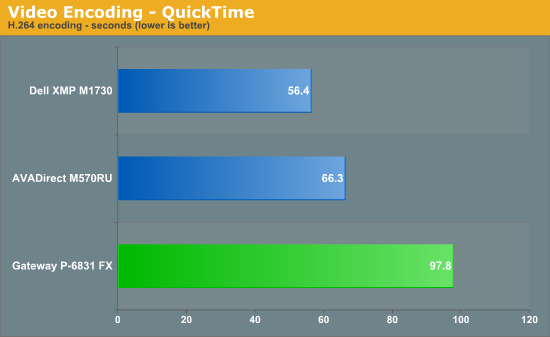
In video encoding and 3D rendering, the CPU is almost the sole determinant of performance. We only have results from Penryn X9000 systems for these tests, and outside of QuickTime (where the RAID 0 hard drive array helps the XPS system), we see better than linear clock speed scaling from the X9000. The 2.8GHz chip is clocked 68% faster than the T5450, and it performs up to 85% faster. Having three times as much L2 cache certainly helps.
Again, keep in mind as we see CUDA enabled applications in the future, raw CPU performance may turn out to be less important for these highly parallelizable tasks.
Originally published at https://www.anandtech.com/show/2490 (Wayback Machine).