
ASUS Striker II Formula under the Microscope
- Posted in
- Motherboards
"Stable" Dual-core and Quad-core Overclocking Results
E8500 on Windows XP SP3 with Cell Shock's 2x1GB Kit
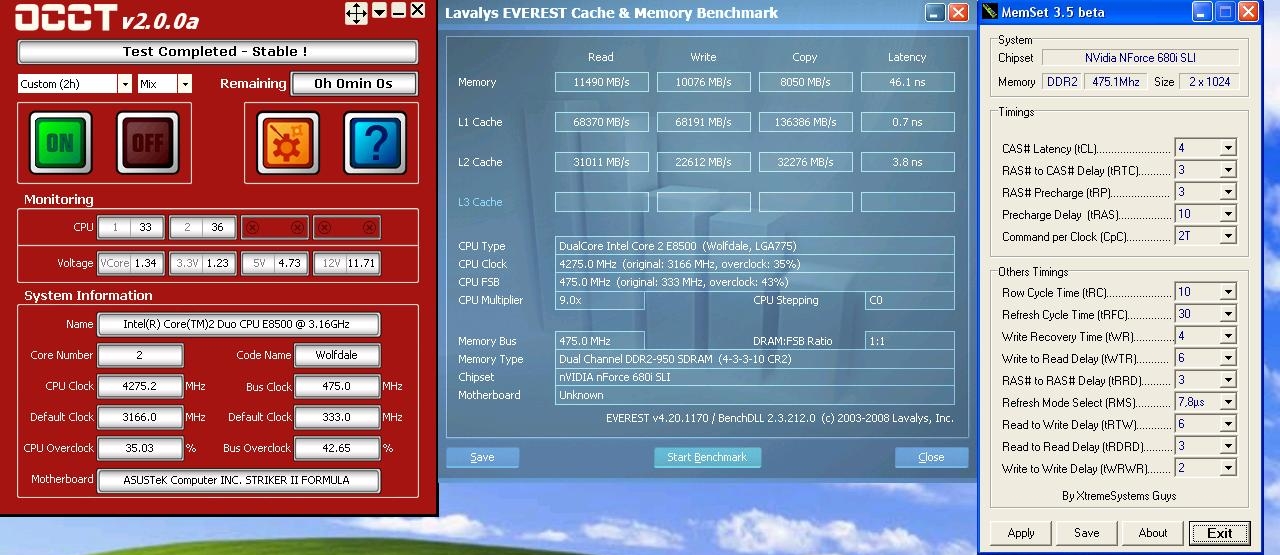 |
For dual-core processors running the XP operating system, the interesting zone is certainly around 475FSB running in sync mode. Don't be fooled by the memory speed at 950Mhz; remember 1:1 mode allows the most efficient form of data transfer via the MCH. For the Cell Shock modules - which use Micron's top D9GKX DDR2 bin - these speeds are a breeze. What's more, the speed comes at a voltage that the board and modules can easily operate at on a 24/7 basis.
We found that more than 2.15V on our modules was not necessary to hold these speeds 100% stable. The modules are certainly capable of a lot more, but it is nearly impossible to achieve it within warranty specifications. Of course YMMV (Your Mileage May Vary), but in general, if you have good DDR2 modules that are aggressively binned, this is the sweet-spot for operation on this board. We tested with a VMCH (Northbridge Voltage) at a mere 1.3V on our board to hold this setting steady. For us, this represents the greatest level of performance return per watt of energy expenditure.
E8500 with 8GB of OCZ's finest on Vista 64-bit
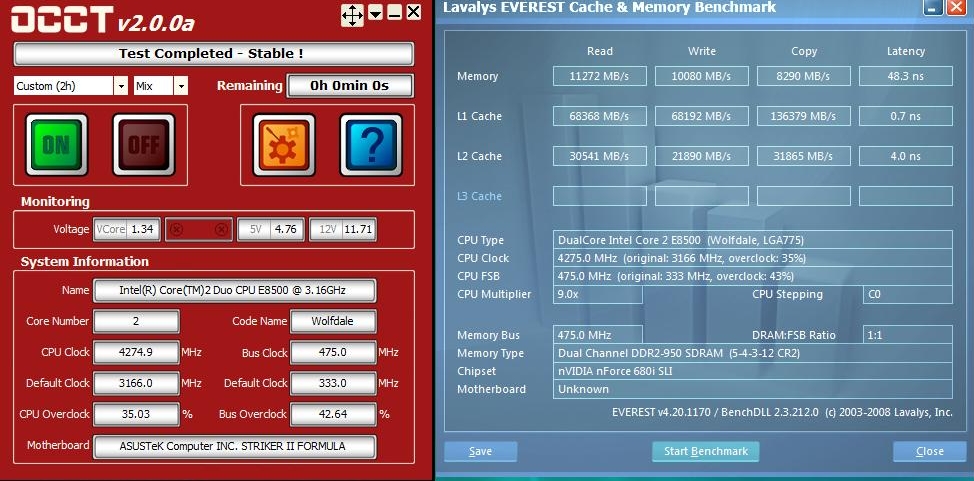 |
This was the shocker for us, using 8GB of OCZ memory with a dual-core E8500. The modules only required 1.95V to hold this speed, while VMCH was at 1.4V - both respectable. The read speeds are higher than we have managed on any Intel chipset using 8GB of memory. Sure, this is not mainstream yet, but we think that testing with 8GB offers an opportunity to check a board's stability much more than 2GB configurations. We have seen lower access latency on earlier Striker II BIOS releases; however, the stability was not there at these voltages. Things are a bit more sensible now and the board passed everything we threw at it - including multiple Crysis and PCMark Vantage test runs over the course of the last two weeks. Now the question is what happens when we replace the dual-core with a quad-core processor.
QX9650, 8GB, and Vista 64-bit equals trouble
This is where things enter the twilight zone. Finding stability at higher FSBs with quad-core CPUs can be quite a challenge on the 680i/780i chipset. On the back of our 8GB memory overclocking success using the E8500, we decided to go straight for the jugular and use 8GB of memory with the QX9650. Let's start with what we thought would be a stable configuration.
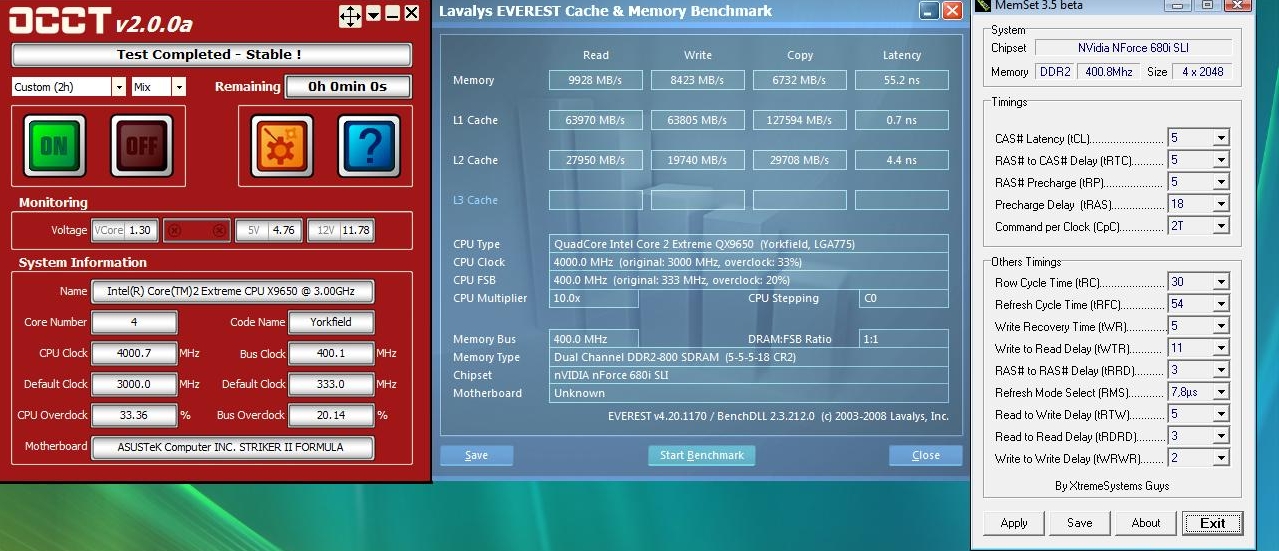 |
Although the transition in processors and configurations seems small when you look at the screenshots on the page, it does not show how long it took us to acquire this screenshot. Our initial attempts were all made by trying to dial in all the memory timings ourselves. Eventually we realized that tWTR needs to be very loose when using the QX9650 and set manually to 11 at the minimum. After repeated attempts, we let the board set the rest of the secondary timings via memory SPD. We stumbled across OCCT's base test with a pass, but Crysis failed in its first loop. PCMark Vantage also threw a "fit" when the 3D Gaming test began. We tried everything we could to get 3D stability but no amount of memory timing adjustments or component voltages brought us to the promised land of 3D stability.
The next step was to lower CPU multipliers and reduce CPU speed in order to coax a little more overhead from the Northbridge. Again we failed, all the way down to 3.2GHz when using 1600QFSB (400FSB). As the QX9650 has the advantage of an unlocked multiplier, we decided to use the 10x multi and a lower FSB speed. We even went down to using a 4GB configuration with the 2X2GB modules and found the same overall FSB wall. In the end we found that 3.5GHz with an FSB of 1400QFSB (350MHz) was the highest we could achieve and still pass PCMark Vantage. It seems that FSBs in the region of 400MHz have marginal stability with the quad-core processors when stressed with actual application benchmarks. We ran out of time to test with a 2GB configuration but will include this in part two when we take a close look at the abilities of EVGA's 780i board once we coax it back to life.
Originally published at https://www.anandtech.com/show/2484 (Wayback Machine).