
ASRock Penryn 1600SLI-110dB : Penryn on the 650i, are you kidding me?
- Posted in
- Motherboards
ASRock Penryn 1600SLI-110dB Features -
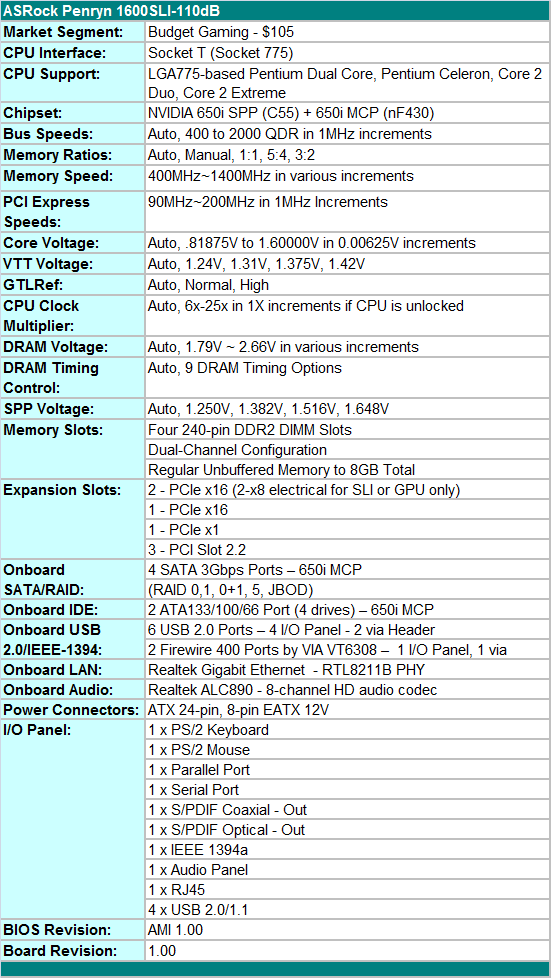
The current retail pricing on this board is in the $105 range and we fully expect it to drop to right under $100 shortly. ASRock has loaded this board up with the new Realtek ALC890 8-Channel HD audio codec, Firewire 400 capability, a legacy friendly I/O panel, SLI capability, Gigabit Ethernet, a single PCI Express x1 slot, three PCI slots, four SATA 3Gbps capable ports, two IDE ports, and six USB 2.0/1.1 connectors. While light on USB connectivity compared to similarly priced boards, the overall balance of features on this board is impressive for its price range. We also would like to commend ASRock on utilizing a decent on-board audio codec with the ALC890 instead of the ALC883 that we see popping up on the budget boards, especially ASUS's latest uATX boards. While several discrete sound solutions provide significantly better audio output, we would have to rate the ALC890 near the top of current on-board solutions.
ASRock has made a decision to go upscale with several of its boards in recent weeks and this particular sample is one of their first efforts. A good, if not great first effort by a company that historically locked down its BIOS tighter than most banks do their safes. While not approaching the level of customization offered by the likes of DFI or ASUS, this particular BIOS does offer a nice array of features to help the user get the most out of its performance. We have been working with ASRock on a few glitches that we have encountered during testing, the most notable being the lack of a downward multiplier option on non-Extreme Core 2 processors.
Also, overclocking with our 8GB configuration was an interesting experience trying to figure out a stable selection of settings that provided absolute stability. It turned out that setting GTLRef to High and increasing VTT voltages to 1.375V did wonders for us, even at stock settings in some cases. Our only other gripe at this stage is that using the clear CMOS jumper will wipe out the time and date settings. If that is a setting that you generally skip after a clear CMOS event, do not do it on this board as Microsoft Vista does not have a compassionate understanding for this situation, nothing like calling tech support in India at 3 am in the morning to remind one to double check the BIOS settings.
That brings about an interesting point with this board, the BIOS recovery system generally worked unless you set the board way outside its normal capability. Usually after three resets or power on/off events the board would POST with safe settings, but going over the line meant a full shutdown and clear CMOS procedure. The BIOS does not offer saved settings so all options had to be reset. Granted most users will not need this, but if you are trying to dial a board in, it can become frustrating at times.
Originally published at https://www.anandtech.com/show/2446 (Wayback Machine).