
ASUS Maximus Extreme - the Extreme Benchmarker's Choice?
- Posted in
- Motherboards
XP Overclocking Benchmarks
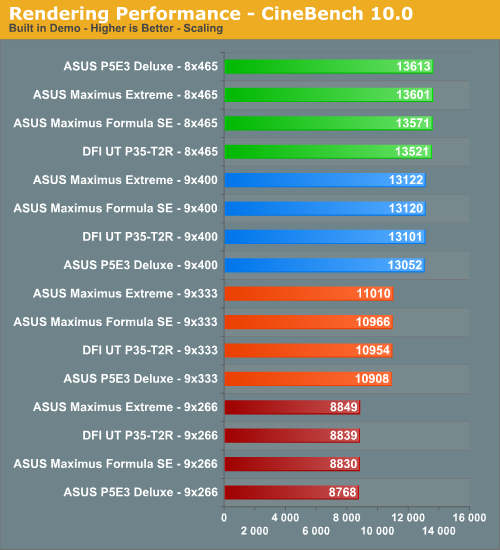
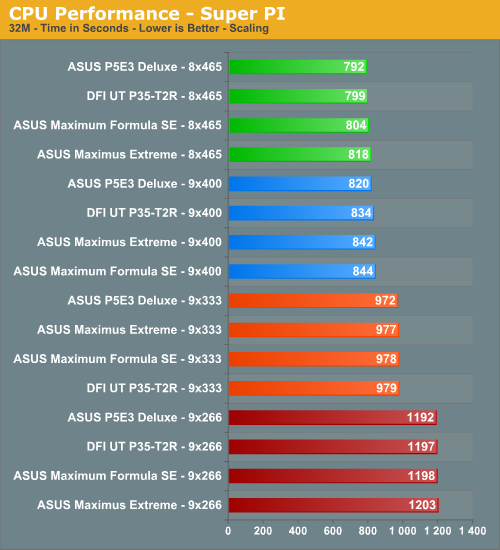
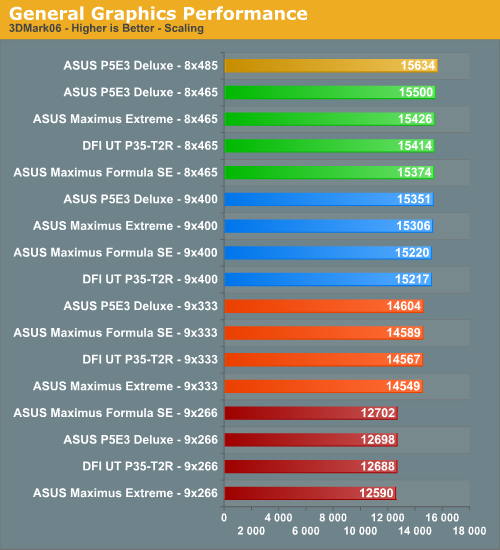
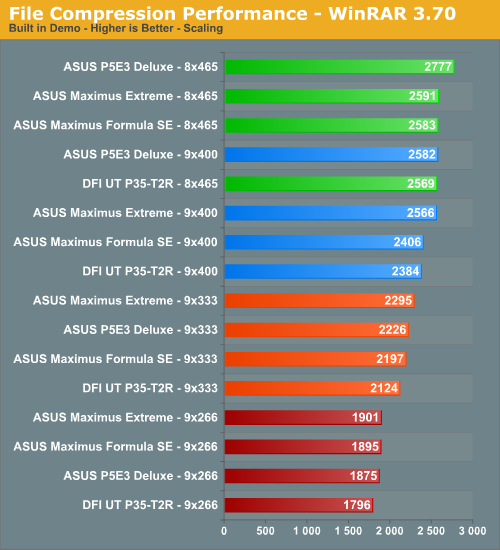
Thoughts on basic overclocking
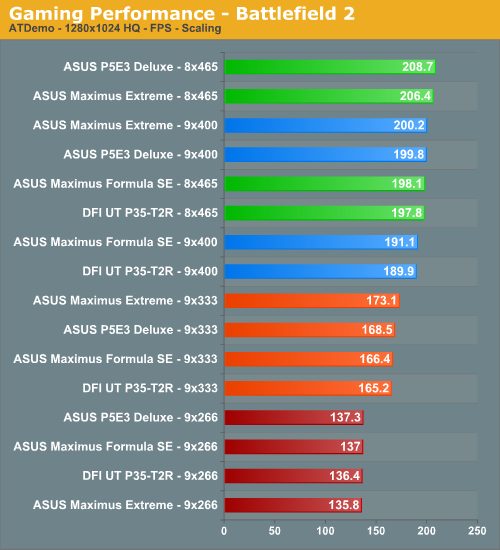
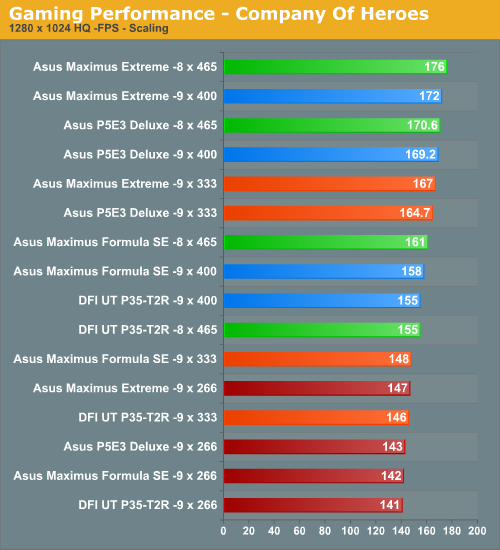
The Maximus Extreme fares well in all our 3D based tests. Obviously, the performance gains are not huge, as you never get double the performance for double the price. Results between the P5E3 Deluxe and the Maximus Extreme are tight, so choosing either board for a daily system is not going to offer significant advantages at this level of overclocking. Benchmarks such as Super Pi 32M really benefit from very tight secondary RAM timings - often far beyond the capabilities of complete system stability - so take the largely un-tuned results here with a pinch of salt. The board is stable up to around 465 FSB with 65nm quad processors. For those who are interested in Folding@Home, 450 FSB is the real limit.
Although not shown here, we did run some Vista based stability testing with 4GB of memory. Results were very promising: full 4GB stability at DDR3 1700-1800 with 1N command rate also came in around 445-450FSB. Users who buy this board with 24/7 use in mind will generally be avid gamers. For this purpose, the X38 boards are marginally faster than their P35 based counterparts are. Also remember, with X38 boards the option of dual - or in this case triple - graphics cards can provide a level of future proofing. Especially as gaming engines are becoming more complex, dual GPUs will be necessary to play games at high-res with maximum detail settings for the near future.
If the sole reason for choosing this board is the additional DDR3 performance gains (albeit small), then top-end DDR3-1800 modules will be necessary to realize any benefits. At speeds below DDR3-1600 to DDR3-1333, CA 6 to CAS5 performance with DDR3 will show results close to DDR2-1150 at CAS5. If you prefer dual graphics cards without the added expenditure hit of DDR3 memory, there are a couple of DDR2 X38 boards to chose from. The ASUS Maximus Formula fills the role admirably for more advanced overclockers or the Gigabyte GA-X38-DQ6 is a nice alternative.
Originally published at https://www.anandtech.com/show/2394 (Wayback Machine).