
AMD's 3rd generation Opteron versus Intel's 45nm Xeon: a closer look
- Posted in
- IT Computing
Fritz Chess Benchmark (Windows 32-bit)
WinRAR and Fritz Chess are probably less important to most people than the other benchmarks we ran. However, the reason why we include them in this article is that their profile is so different from the other applications. In this way, we get more insight into the different new architectures.
| Fritz Chess | |
| Profile | Total |
| Average IPC (on AMD 2350) | 0.99 |
| Instruction mix | |
| Floating Point | 4% |
| SSE | 0% |
| Branches | 17% |
| Performance indicators on Opteron 2350 | |
| Branch misprediction | 12% |
| L1 datacache ratio | 0.65 |
| L1 Instruction ratio | 0.37 |
| L1 datacache miss | 1% |
| L1 Instruction cache miss | 1% |
| L2 cache miss | 0% |
We have said this before but it warrants repeating: you'll find a decent amount of complex branches in a chess program. 17% branches is not that extraordinary, but the fact that 12% of those branches are mispredicted is. If we compare a 2GHz Opteron 22xx with an Opteron 23xx, we should see if the improvements in branch prediction pay off.
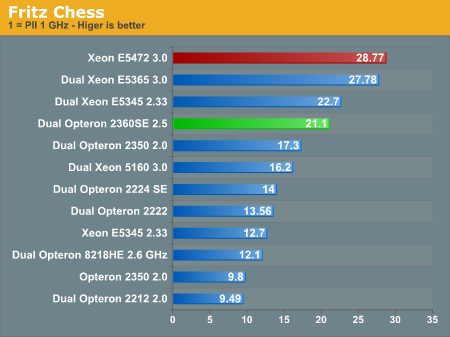
The Opteron 2350 is about 3% faster than the Opteron 22xx, core for core, clock for clock. We believe we can assume that the branch prediction improvements are minor, as the Fritz chess benchmark runs in the L1 and L2 cache.
HPC
Several of the HPC benchmarks are too expensive for us to test, but we can get some information from AMD's and Intel's own benchmarking. According to Intel, the new Intel Xeon 5472 (1.89 score) is about 26% faster than the Xeon 5365 (1.5 score) when running the fluent benchmark. According to AMD, the Opteron 2350 is about 10% to 60% faster than a 2.33GHz Xeon E5345. That doesn't give us much comparison data, but at first sight it seems that AMD will be competitive in Fluent even at lower clock speeds (2.5GHz versus 3GHz).
We get a little more data in LS-DYNA. Both AMD and Intel have published results.
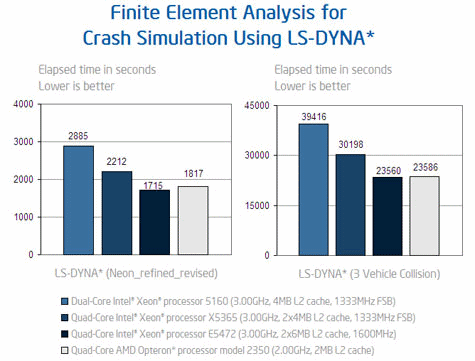
Intel's own marketing material seems to admit that a Xeon E5472 with 800MHz memory is just as a fast as AMD's quad-core at 2GHz. AMD's 2.5GHz model will surely take the lead in LS-DYNA. Looking at the Fluent and LS-DYNA benchmarks it appears that AMD will remain very competitive in the HPC market.
One benchmark where Intel's newest chip really shines is the Black-Scholes algorithm: as most of the calculations involve divisions, the new Xeon 54xx chips are about 50% faster than their older Xeon 53xx siblings, clock for clock. Unfortunately, our compilation of Black-Scholes failed on the quad-core AMD, so we have to postpone those results for now.
Originally published at https://www.anandtech.com/show/2386 (Wayback Machine).