
400-450W PSU Roundup
- Posted in
- Cases/Cooling/PSUs
Corsair PFC, Temperature, Fan Speed, and Acoustics
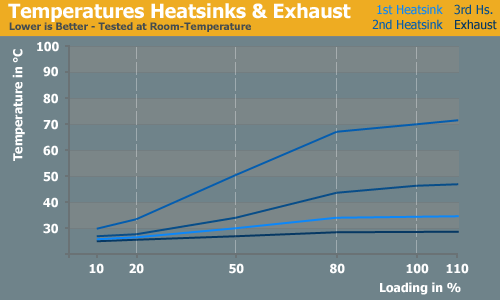
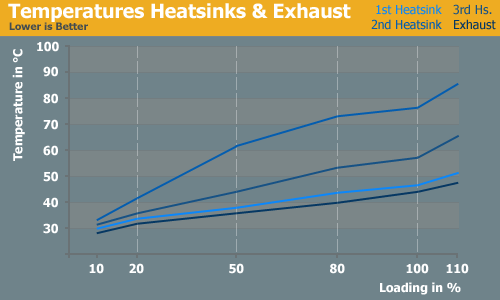
Again, we find that the exhaust temperature is much lower than the heatsink temperatures. This indicates the heatsinks are not properly dissipating heat into the streaming air. Instead, the heat stays inside the power supply and builds up over time. While the positioning of the fan and perhaps the airflow might be to blame, the more likely problem is that the heatsinks simply aren't large enough and lack sufficient surface area. In our stress test heat chamber, we see the temperatures that are twice as high as the exhaust temperature, with the secondary heatsink reaching 85°C at the worst-case 110% load. Running a PSU under such conditions for an extended period of time would almost certainly result in a dead power supply, but it did manage to survive our short-term stress test.
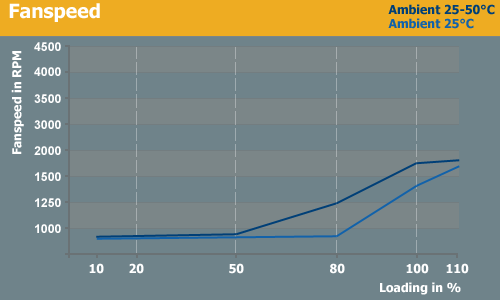
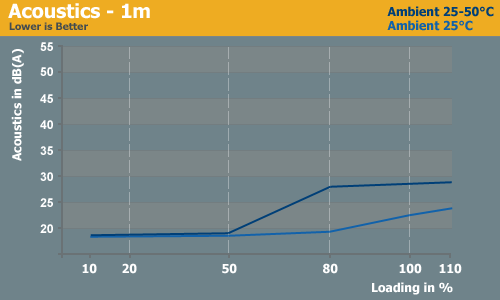
Up to medium load, the power supply is extremely quiet registering less than 20dB(A). Higher loads result in increased fan speed and noise levels, and in our stress chamber we reach a maximum noise level of 28dB(A) at 80% of load (350W). However, 28dB(A) is still very quiet so in terms of noise levels users should be very pleased with Corsair. The problem is, low noise levels and low fan RPMs contribute to the relatively high heat sink temperatures. We are not sure if Corsair really tested this unit under stressful conditions - maximum load and a high ambient temperature - and we would caution users against using any of these power supplies in such an environment. Under more sedate operating conditions, however, the Corsair 450VX performs extremely well.
Again, we find that the exhaust temperature is much lower than the heatsink temperatures. This indicates the heatsinks are not properly dissipating heat into the streaming air. Instead, the heat stays inside the power supply and builds up over time. While the positioning of the fan and perhaps the airflow might be to blame, the more likely problem is that the heatsinks simply aren't large enough and lack sufficient surface area. In our stress test heat chamber, we see the temperatures that are twice as high as the exhaust temperature, with the secondary heatsink reaching 85°C at the worst-case 110% load. Running a PSU under such conditions for an extended period of time would almost certainly result in a dead power supply, but it did manage to survive our short-term stress test.
Up to medium load, the power supply is extremely quiet registering less than 20dB(A). Higher loads result in increased fan speed and noise levels, and in our stress chamber we reach a maximum noise level of 28dB(A) at 80% of load (350W). However, 28dB(A) is still very quiet so in terms of noise levels users should be very pleased with Corsair. The problem is, low noise levels and low fan RPMs contribute to the relatively high heat sink temperatures. We are not sure if Corsair really tested this unit under stressful conditions - maximum load and a high ambient temperature - and we would caution users against using any of these power supplies in such an environment. Under more sedate operating conditions, however, the Corsair 450VX performs extremely well.
Originally published at https://www.anandtech.com/show/2371 (Wayback Machine).