
Ultra High-End PSU Roundup
- Posted in
- Cases/Cooling/PSUs
Cooler Master Real Power Pro 1250W
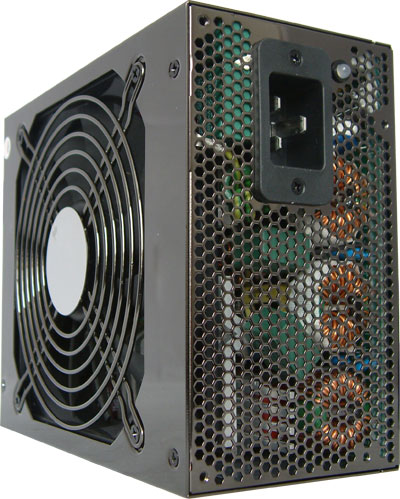
Cooler Master sent us their latest and strongest version of the Real Power Pro product line rated at 1250W. The above picture shows a power supply that looks like many other units on the market; the actual manufacturer in this case is Enhance. When we open up the PSU, the heritage of the power supply will become more apparent. Indications of the original manufacturer are the green square capacitors on the filtering stage directly in front of the punched exhaust holes. Cooler Master went to Enhance for its high-end power supplies on certain models; unfortunately, this is not always the case since we have just seen that the M620 is manufactured by a lower quality offering.
There are a couple other interesting features that can be seen in the above picture. First, there's no manual power switch - a feature that's not strictly necessary but which can still prove convenient times. We can also see that the jack for the power cord has a different shape. Yes, Cooler Master decided to break with tradition and use a proprietary power cable. At this point we want to thank Cooler Master for this great invention since we needed to totally overwork the power distribution in our heat chamber (it is embedded within the walls of the box). Still, most people will have to worry about such difficulties, and we have to admit that this new plug is quite nice and fits securely into the jack.
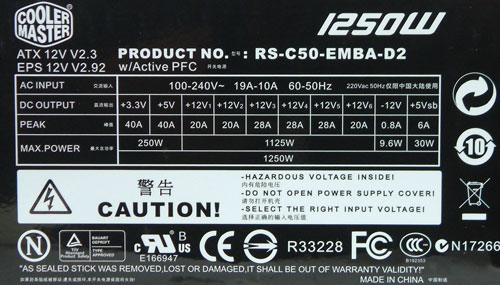
The Real Power Pro has in total six 12V rails with a maximum combined power of 1125W. The different 12V rails are nicely marked with a different color in each of the yellow cables. This makes it easy to separate the rails for different graphics cards since it will not be helpful to use only one or two 12V rails when you have more to choose from. By the way, the little logo on the right side is the German so called "green dot" and means that the material is recyclable. The third logo on the right with the crossed trash can means you are not allowed to throw this power supply in the normal trash. It is quite clear why the last logo is printed on the label, but the first one? The only thing recyclable on this PSU will be the label itself - okay, and the exterior casing if you want to take time to rip out the internals. Maybe that is what Cooler Master wants to tell us? But maybe more logos just look cool....
The power supply itself comes with a dark mirror coating and the large fan is located on the bottom side of the case. As there is no power switch on the backside you will need to pull the plug to fully separate your PC system from the power grid. Opinions on whether or not this is a useful trait will generally fall into one of two categories. Some people never separate their PC from grid power anyway, while other people can switch off power using a switch for the wall outlet (or on a power strip). If you are in the first group you can be relieved since the power consumption of this power supply is just 1W while turned off.
Cables and Connectors
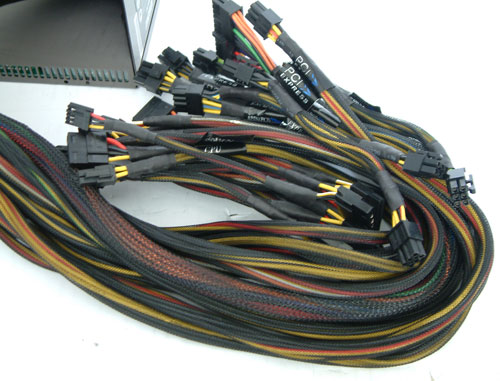
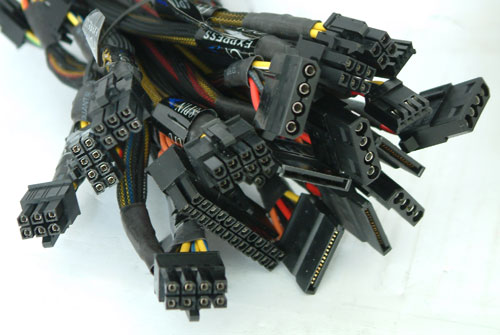
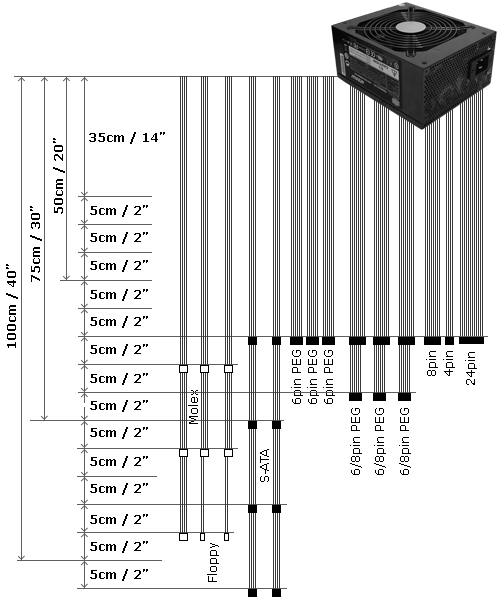
The Real Power Pro has a different approach on power distribution to the components than the PCP&C; Turbo Cool. There are six 6-pin PEG connectors and three 8-pin connectors. That means you have nine total PEG connectors from which to choose - certainly an impressive number, though not something we can currently use in most PCs. With a minimum length of 60cm the cables are long enough for any high-end system. Our second unit today is rated at just 50W more on the label, but the choice of connectors is quite better than what PCP&C; offers. We have eight SATA and seven Molex connectors, and for workstations the 8-pin EPS connector is also present. All cables are sleeved to help things stay organized, as we would expect on any high-end power supply.
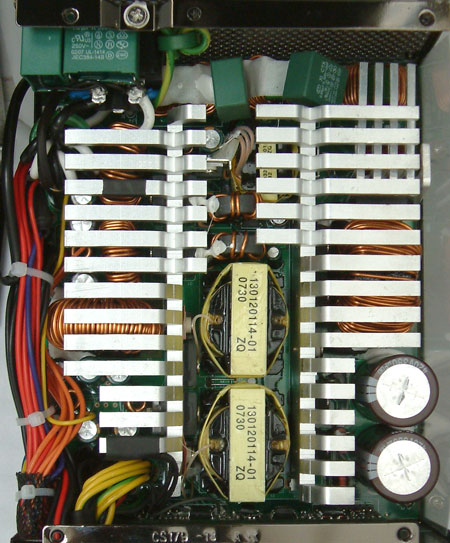
The inside reveals for certain that this is indeed an Enhance manufactured PSU. It is well arranged and all of the components seem to get enough air from the large fan that will blow directly at them. The heat sinks are both a reasonable size and thickness and should do a good job dissipating heat from the attached components. The secondary heat sink has two temperature diodes attached with black shrinking hoses on two fins. The fan control gets its data from these diodes for controlling fan speed.
The filtering stage and PFC circuit looks very well developed since the layout is based on previous models with lower wattage ratings. There are two capacitors from Nippon Chemi-Con rated at 390µF and 420V which is a very good choice. The secondary side has Teapo caps installed which is a more common cost effective choice for mainstream power supplies. The two transformers in the middle of the PCB supply the dizzying number of rails for this PSU.
Cooler Master sent us their latest and strongest version of the Real Power Pro product line rated at 1250W. The above picture shows a power supply that looks like many other units on the market; the actual manufacturer in this case is Enhance. When we open up the PSU, the heritage of the power supply will become more apparent. Indications of the original manufacturer are the green square capacitors on the filtering stage directly in front of the punched exhaust holes. Cooler Master went to Enhance for its high-end power supplies on certain models; unfortunately, this is not always the case since we have just seen that the M620 is manufactured by a lower quality offering.
There are a couple other interesting features that can be seen in the above picture. First, there's no manual power switch - a feature that's not strictly necessary but which can still prove convenient times. We can also see that the jack for the power cord has a different shape. Yes, Cooler Master decided to break with tradition and use a proprietary power cable. At this point we want to thank Cooler Master for this great invention since we needed to totally overwork the power distribution in our heat chamber (it is embedded within the walls of the box). Still, most people will have to worry about such difficulties, and we have to admit that this new plug is quite nice and fits securely into the jack.
The Real Power Pro has in total six 12V rails with a maximum combined power of 1125W. The different 12V rails are nicely marked with a different color in each of the yellow cables. This makes it easy to separate the rails for different graphics cards since it will not be helpful to use only one or two 12V rails when you have more to choose from. By the way, the little logo on the right side is the German so called "green dot" and means that the material is recyclable. The third logo on the right with the crossed trash can means you are not allowed to throw this power supply in the normal trash. It is quite clear why the last logo is printed on the label, but the first one? The only thing recyclable on this PSU will be the label itself - okay, and the exterior casing if you want to take time to rip out the internals. Maybe that is what Cooler Master wants to tell us? But maybe more logos just look cool....
The power supply itself comes with a dark mirror coating and the large fan is located on the bottom side of the case. As there is no power switch on the backside you will need to pull the plug to fully separate your PC system from the power grid. Opinions on whether or not this is a useful trait will generally fall into one of two categories. Some people never separate their PC from grid power anyway, while other people can switch off power using a switch for the wall outlet (or on a power strip). If you are in the first group you can be relieved since the power consumption of this power supply is just 1W while turned off.
Cables and Connectors
The Real Power Pro has a different approach on power distribution to the components than the PCP&C; Turbo Cool. There are six 6-pin PEG connectors and three 8-pin connectors. That means you have nine total PEG connectors from which to choose - certainly an impressive number, though not something we can currently use in most PCs. With a minimum length of 60cm the cables are long enough for any high-end system. Our second unit today is rated at just 50W more on the label, but the choice of connectors is quite better than what PCP&C; offers. We have eight SATA and seven Molex connectors, and for workstations the 8-pin EPS connector is also present. All cables are sleeved to help things stay organized, as we would expect on any high-end power supply.
The inside reveals for certain that this is indeed an Enhance manufactured PSU. It is well arranged and all of the components seem to get enough air from the large fan that will blow directly at them. The heat sinks are both a reasonable size and thickness and should do a good job dissipating heat from the attached components. The secondary heat sink has two temperature diodes attached with black shrinking hoses on two fins. The fan control gets its data from these diodes for controlling fan speed.
The filtering stage and PFC circuit looks very well developed since the layout is based on previous models with lower wattage ratings. There are two capacitors from Nippon Chemi-Con rated at 390µF and 420V which is a very good choice. The secondary side has Teapo caps installed which is a more common cost effective choice for mainstream power supplies. The two transformers in the middle of the PCB supply the dizzying number of rails for this PSU.
Originally published at https://www.anandtech.com/show/2357 (Wayback Machine).