
Ultra High-End PSU Roundup
- Posted in
- Cases/Cooling/PSUs
Tagan ITZ 1300W Efficiency, Temperatures, Fan Speed and Acoustics
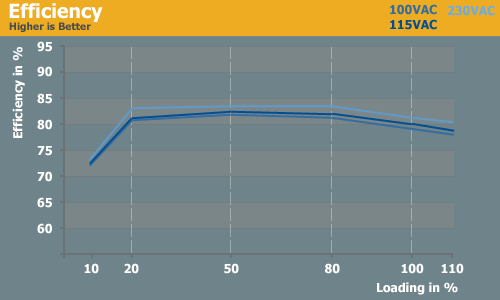
The efficiency is similar to what we have seen from the other two power supplies. The difference we can see here is the nicely even curve which is constantly above 80% with any load above 260W, with a slight drop near the 100% load mark.
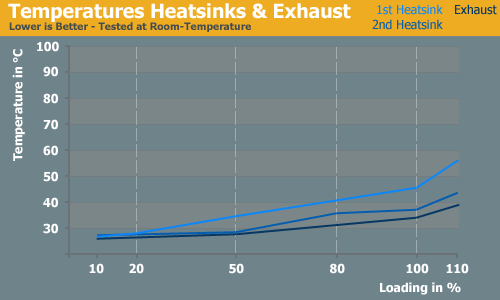
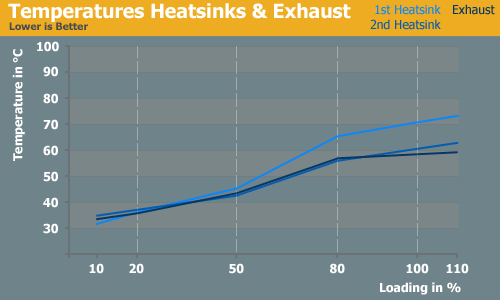
The temperatures increase slowly during room temperature testing which is a good sign for a well arranged airflow. Just with overload the temperature is suddenly making a big step of over 10°C within a few minutes. Under the hotter heat chamber conditions the temperature begins to increase at medium load and beyond. Naturally, the fans are also spinning faster at this point, but they are nearing their limit. The temperature of both heat sinks mostly stabilizes by 80% load, beyond which point heat is only increasing slowly.
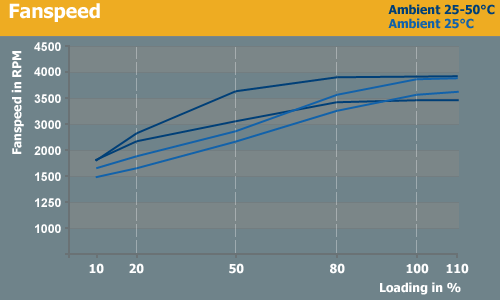
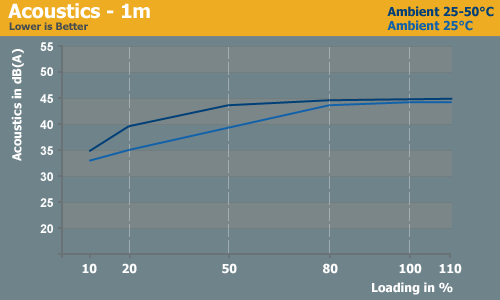
The push-pull fan configuration is quite effective, and having a more powerful fan on the exhaust also works quite well. In this way there is a kind of vacuum established which lets air come in through the venting holes on the side. The result is that the components are cooler but this kind of power supply still gets very hot and needs proper airflow to function. This can only be done with high speed fans, and with up to 4000 RPM this might be enough. Also with this power supply we see the full speed already reached at half of the full load while in the heat chamber. Under room temperature conditions the fan is steadily spinning faster and only reaches maximum RPM at full load. It's again clear that the amount of airflow necessary to cool a 1300W power supply cannot be achieved without producing noise, and therefore we see up to 45dB(A) under hot conditions. With low speeds at lower loads you can still hear the fan quite easily, but in a PC system this noise will not be as audible as when we had it open and running in front of us.
The efficiency is similar to what we have seen from the other two power supplies. The difference we can see here is the nicely even curve which is constantly above 80% with any load above 260W, with a slight drop near the 100% load mark.
The temperatures increase slowly during room temperature testing which is a good sign for a well arranged airflow. Just with overload the temperature is suddenly making a big step of over 10°C within a few minutes. Under the hotter heat chamber conditions the temperature begins to increase at medium load and beyond. Naturally, the fans are also spinning faster at this point, but they are nearing their limit. The temperature of both heat sinks mostly stabilizes by 80% load, beyond which point heat is only increasing slowly.
The push-pull fan configuration is quite effective, and having a more powerful fan on the exhaust also works quite well. In this way there is a kind of vacuum established which lets air come in through the venting holes on the side. The result is that the components are cooler but this kind of power supply still gets very hot and needs proper airflow to function. This can only be done with high speed fans, and with up to 4000 RPM this might be enough. Also with this power supply we see the full speed already reached at half of the full load while in the heat chamber. Under room temperature conditions the fan is steadily spinning faster and only reaches maximum RPM at full load. It's again clear that the amount of airflow necessary to cool a 1300W power supply cannot be achieved without producing noise, and therefore we see up to 45dB(A) under hot conditions. With low speeds at lower loads you can still hear the fan quite easily, but in a PC system this noise will not be as audible as when we had it open and running in front of us.
Originally published at https://www.anandtech.com/show/2357 (Wayback Machine).