
ASUS P5E3 Deluxe: X38 and DDR3 arrives... almost
- Posted in
- Motherboards
Gaming and Graphics Performance
The 3DMark series of benchmarks developed and provided by Futuremark are among the most widely used tools for benchmark reporting and comparisons. Although the benchmarks are very useful for providing apples-to-apples comparisons across a broad array of GPU and CPU configurations, they are not a substitute for actual application and gaming benchmarks. In this sense we consider the 3DMark benchmarks to be purely synthetic in nature but still valuable for providing consistent measurements of performance.
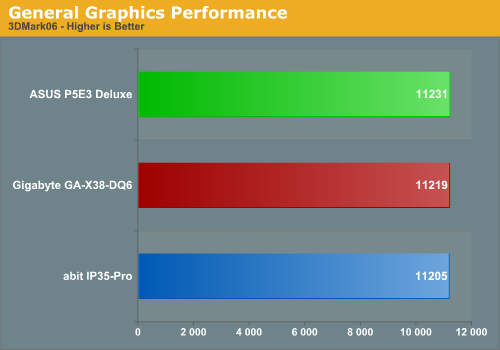
In our 3DMark06 test, all of the boards are basically even in this test. When looking at the individual tests, the ASUS board scores slightly better in the SM2.0 and SM3.0 tests while the CPU scores are just about identical between all three boards - we'll ignore the ASUS board's seven point advantage.
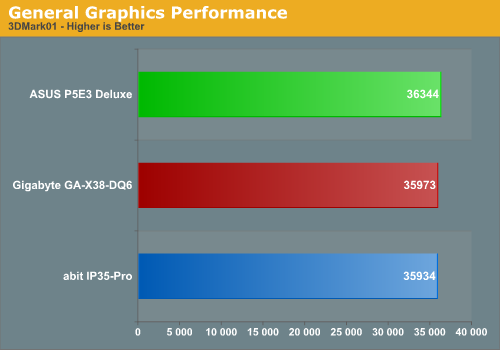
In the more memory and CPU throughput sensitive 3DMark01 benchmark we see our ASUS P5E3 Deluxe board is around 1% faster. We believe Gigabyte still has some tuning left to complete with their DDR2 X38 board as it scored a fairly anemic 35311 with the memory set to DDR2-800 with 3-4-3-9 1T timings. The differences in performance are not really noticeable in either 3DMark unless you're looking to reach the top of the ORB, which we have a good feeling the X38 was designed to do with the right setup.
Gaming Performance
As usual, gaming performance was tested with a couple popular games. We ran our benchmarks at a 1280x1024 resolution with high quality settings
Battlefield 2
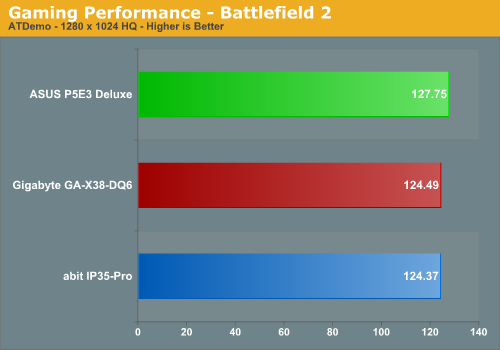
This benchmark is performed using DICE's built-in demo playback functionality with additional capture capabilities designed in house. During the benchmark, the camera switches between players and vehicles in order to capture the most action possible. There is a significant amount of smoke, explosions, and vehicle usage as this a very GPU intensive Battlefield 2 benchmark. We run Battlefield 2 using medium quality graphics settings available in the video settings. The game itself is best experienced with average in-game frame rates of 35 and up.
Prey
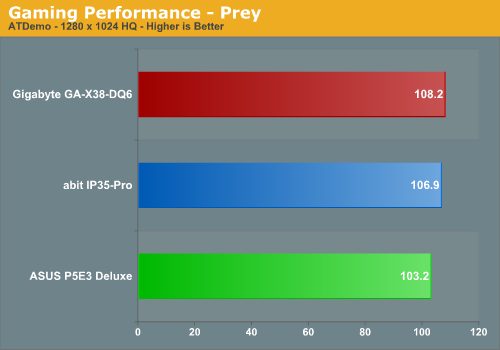
Prey offers some superb action sequences, unique weapons and characters, and is a visually stunning game at times. It still requires a very good GPU to run it with all of the eye candy turned on. We set all graphic settings to their maximum except for AA/AF and utilize a custom timedemo that takes place during one of the more action oriented sequences. We generally find the game to be enjoyable with an average frame rate above 35fps.
Gaming Summary
The ASUS P5E3 provides an almost 3% improvement in frame rates under BF2, which tends to be more CPU limited than most games, but in the latency sensitive Prey benchmark we find it falls about 5% behind the Gigabyte board. This is the only benchmark where we witnessed a measurable decrease in performance when utilizing DDR3 at 1066 on the X38 chipset. For now, we will chalk it up to the BIOS needing fine tuning as other latency sensitive benchmarks did not show this pattern in offline testing. Once we receive the shipping BIOS for the retail boards, we will revisit these same games and provide CrossFire results against the P35 and 975X equipped boards. However, the preliminary CrossFire results show minimal gains for the X38 over the 975X when comparing percentage increases between single and dual card configurations.
The 3DMark series of benchmarks developed and provided by Futuremark are among the most widely used tools for benchmark reporting and comparisons. Although the benchmarks are very useful for providing apples-to-apples comparisons across a broad array of GPU and CPU configurations, they are not a substitute for actual application and gaming benchmarks. In this sense we consider the 3DMark benchmarks to be purely synthetic in nature but still valuable for providing consistent measurements of performance.
In our 3DMark06 test, all of the boards are basically even in this test. When looking at the individual tests, the ASUS board scores slightly better in the SM2.0 and SM3.0 tests while the CPU scores are just about identical between all three boards - we'll ignore the ASUS board's seven point advantage.
In the more memory and CPU throughput sensitive 3DMark01 benchmark we see our ASUS P5E3 Deluxe board is around 1% faster. We believe Gigabyte still has some tuning left to complete with their DDR2 X38 board as it scored a fairly anemic 35311 with the memory set to DDR2-800 with 3-4-3-9 1T timings. The differences in performance are not really noticeable in either 3DMark unless you're looking to reach the top of the ORB, which we have a good feeling the X38 was designed to do with the right setup.
Gaming Performance
As usual, gaming performance was tested with a couple popular games. We ran our benchmarks at a 1280x1024 resolution with high quality settings
Battlefield 2
This benchmark is performed using DICE's built-in demo playback functionality with additional capture capabilities designed in house. During the benchmark, the camera switches between players and vehicles in order to capture the most action possible. There is a significant amount of smoke, explosions, and vehicle usage as this a very GPU intensive Battlefield 2 benchmark. We run Battlefield 2 using medium quality graphics settings available in the video settings. The game itself is best experienced with average in-game frame rates of 35 and up.
Prey
Prey offers some superb action sequences, unique weapons and characters, and is a visually stunning game at times. It still requires a very good GPU to run it with all of the eye candy turned on. We set all graphic settings to their maximum except for AA/AF and utilize a custom timedemo that takes place during one of the more action oriented sequences. We generally find the game to be enjoyable with an average frame rate above 35fps.
Gaming Summary
The ASUS P5E3 provides an almost 3% improvement in frame rates under BF2, which tends to be more CPU limited than most games, but in the latency sensitive Prey benchmark we find it falls about 5% behind the Gigabyte board. This is the only benchmark where we witnessed a measurable decrease in performance when utilizing DDR3 at 1066 on the X38 chipset. For now, we will chalk it up to the BIOS needing fine tuning as other latency sensitive benchmarks did not show this pattern in offline testing. Once we receive the shipping BIOS for the retail boards, we will revisit these same games and provide CrossFire results against the P35 and 975X equipped boards. However, the preliminary CrossFire results show minimal gains for the X38 over the 975X when comparing percentage increases between single and dual card configurations.
Originally published at https://www.anandtech.com/show/2329 (Wayback Machine).