
Swiftech H2O-120 Compact and Corsair Nautilus 500: Is Water Better?
- Posted in
- Cases/Cooling/PSUs
Overclocking
As cooling solutions do a better job of keeping the CPU at a lower temperature, it is reasonable to expect the overclocking capabilities of the CPU will increase. In each test of a cooler we measure the highest stable overclock of a standard X6800 processor under the following conditions:
CPU Multiplier: 14x (Stock 11x)
CPU voltage: 1.5875V
FSB Voltage: 1.30V
Memory Voltage: 2.20V
nForce SPP Voltage: 1.35V
nForce MCP Voltage: 1.7V
HT nForce SPP <-> MCP: Auto
Memory is set to Auto timings on the 680i and memory speed is linked to the FSB for the overclocking tests. This removes memory as any kind of impediment to the maximum stable overclock. Linked settings on the 680i are a 1066FSB to a DDR2 memory speed of DDR2-800. As FSB is raised the linked memory speed increases in proportion. The same processor is used in all cooling tests to ensure comparable results.
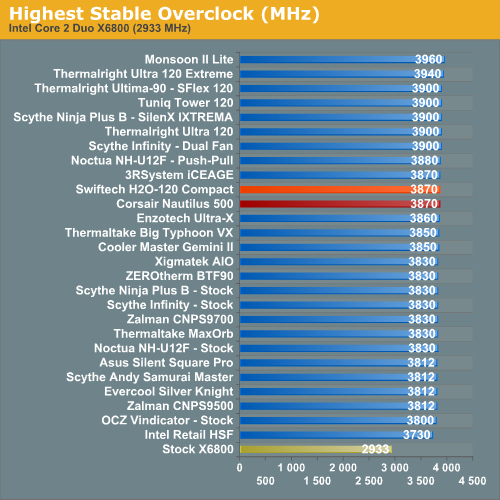
The Swiftech H2O-120 Compact and Corsair Nautilus 500 both topped out at 3870 MHz - near the top of tested air coolers but below the 3.94 GHz of the Thermalright Ultra-120 eXtreme, and the 3.90GHz of five tested air coolers. Once again test results - this time in overclocking - are near the top but do not match or exceed the best air coolers tested at AnandTech.
It was quite a surprise to find overclocks on the P35 motherboard also topped out at 3.87 GHz, particularly since we could not duplicate the 14X base multiplier on the ASUS P5K Deluxe motherboard. We achieved 3.87 GHz by choosing the 333 strap and setting a FSB of 352 with the 11X multiplier. This turned out to be the highest stable overclock on the P35 board with either water cooler - the same results found on the EVGA 680i board.
As stated many times, the overclocking abilities of the CPU will vary at the top, depending on the CPU. This particular CPU does higher FSB speeds than any X6800 we have tested, but the 3.9GHz top speed with the Tuniq is pretty average among the X6800 processors we have tested with Tuniq cooling. A few of the other processors tested with the best air coolers reach just over 4.0GHz, but the range has been 3.8 to 4.0GHz. Stock cooling generally tops out 200 to 400 MHz lower, depending on the CPU, on the processors tested in our lab.
As cooling solutions do a better job of keeping the CPU at a lower temperature, it is reasonable to expect the overclocking capabilities of the CPU will increase. In each test of a cooler we measure the highest stable overclock of a standard X6800 processor under the following conditions:
CPU Multiplier: 14x (Stock 11x)
CPU voltage: 1.5875V
FSB Voltage: 1.30V
Memory Voltage: 2.20V
nForce SPP Voltage: 1.35V
nForce MCP Voltage: 1.7V
HT nForce SPP <-> MCP: Auto
Memory is set to Auto timings on the 680i and memory speed is linked to the FSB for the overclocking tests. This removes memory as any kind of impediment to the maximum stable overclock. Linked settings on the 680i are a 1066FSB to a DDR2 memory speed of DDR2-800. As FSB is raised the linked memory speed increases in proportion. The same processor is used in all cooling tests to ensure comparable results.
The Swiftech H2O-120 Compact and Corsair Nautilus 500 both topped out at 3870 MHz - near the top of tested air coolers but below the 3.94 GHz of the Thermalright Ultra-120 eXtreme, and the 3.90GHz of five tested air coolers. Once again test results - this time in overclocking - are near the top but do not match or exceed the best air coolers tested at AnandTech.
It was quite a surprise to find overclocks on the P35 motherboard also topped out at 3.87 GHz, particularly since we could not duplicate the 14X base multiplier on the ASUS P5K Deluxe motherboard. We achieved 3.87 GHz by choosing the 333 strap and setting a FSB of 352 with the 11X multiplier. This turned out to be the highest stable overclock on the P35 board with either water cooler - the same results found on the EVGA 680i board.
As stated many times, the overclocking abilities of the CPU will vary at the top, depending on the CPU. This particular CPU does higher FSB speeds than any X6800 we have tested, but the 3.9GHz top speed with the Tuniq is pretty average among the X6800 processors we have tested with Tuniq cooling. A few of the other processors tested with the best air coolers reach just over 4.0GHz, but the range has been 3.8 to 4.0GHz. Stock cooling generally tops out 200 to 400 MHz lower, depending on the CPU, on the processors tested in our lab.
Originally published at https://www.anandtech.com/show/2328 (Wayback Machine).