
Swiftech H2O-120 Compact and Corsair Nautilus 500: Is Water Better?
- Posted in
- Cases/Cooling/PSUs
Cooling at Stock Speed
Some users will never overclock their CPU, but they still want to run the coolest CPU temperatures possible to enhance stability and extend CPU life. It is conventional wisdom that water cools better, but is that really true? The Swiftech H2O-120 Compact and Corsair Nautilus 500 both use high-output and relatively quiet 120mm fans - the same fan configuration used in the best air coolers. Both water coolers are reported, with the Corsair results in red and the Swiftech in orange.
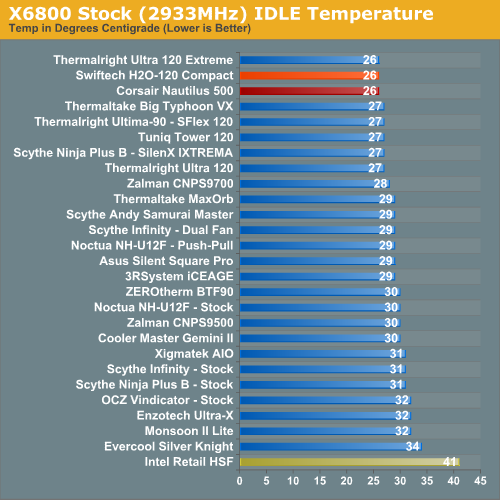
The very good Intel stock air cooler keeps the X6800 at 41C at idle, compared to the Corsair Nautilus 500 and Swiftech H2O-120 Compact which both kept idle temperature to a very low 26C. The 26C results are the best ever seen in AnandTech idle cooler benchmarking and match the top-performing Thermalright Ultra-120 eXtreme. The Tuniq120, the Ultra-120, and the Ultima-90 with a 120mm fan are one degree higher at 27C. All these results are dramatic improvements over the Intel stock cooler performance at 41C, and they represent an excellent performance by the water cooling kits, which match the best air cooler tested at stock idle.
Test results under the same conditions on the Intel P35 platform show the same pattern, but Intel TAT results are generally 1-2C higher than the NVIDIA Monitor results with the same CPU. CoreTemp shows idle temps about 2C cooler than NVIDIA Monitor.
It is more difficult to effectively simulate a computer being stressed by all of the conditions it might be exposed to in different operating environments. For most home users CPU power is most taxed with contemporary gaming. Therefore our stress test simulates playing a demanding game. The Far Cry River demo is looped for 30 minutes and the CPU temperature is captured at 4 second intervals with the NVIDIA Monitor "logging" option. The highest temperature during the load test is then reported. Momentary spikes are ignored, as we report a sustained high-level temp that you can expect to find in this recording configuration. This test configuration roughly equates to an 80% CPU load test using Intel TAT.
Cooling efficiency of the Corsair and Swiftech water cooling systems was then compared under load conditions at stock speed to the retail HSF and other recently tested CPU coolers.
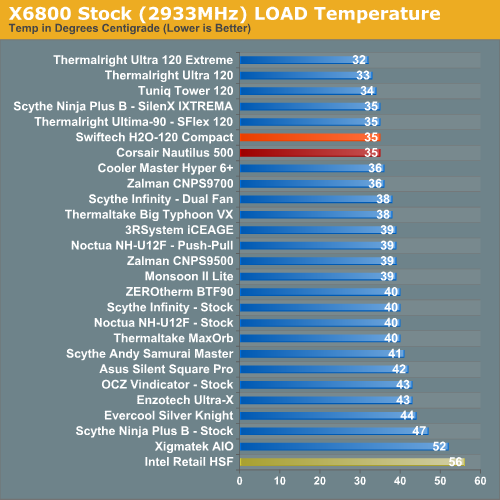
The Corsair Nautilus 500 and Swiftech H2O-120 Compact under load at stock speeds both reach a maximum temperature of 35C. This is one of the top performances under these conditions, but the Thermalright Ultra-120 eXtreme (32C), Ultra-120 (33C), and Tuniq Tower 120 (34C) all do a bit better in this test. The Thermalright Ultima-90 with an S-FLEX 120 fan matches the 35C as does the Scythe Ninja Plus B with a SilenX IXTREMA fan. This compares to the stock Intel air cooler at 56C under load.
It was really expected that the water coolers would outperform the best air coolers under load, since they can theoretically dissipate more wattage. The water cooling performance is still excellent under load, but a few top air coolers do even better than water cooling.
The temperature pattern with TAT and CoreTemp on the P35 is a bit different under load conditions than Idle. All four results are higher (poorer) than the NVIDIA Monitor results on the 680i. CoreTemp results under the same test conditions are a couple of degrees higher than NVIDIA Monitor, while TAT results were a surprising 5C higher with both water cooling systems compared to the same system test results measured with NVIDIA Monitor.
The purpose of these comparisons of the same tests measured using three different core temperature utilities is to get a better understanding of how each program compares in temperature measurement under different test conditions. This will hopefully provide the insight needed to select a standardized program for temperature measurements on our new cooling test bed.
Some users will never overclock their CPU, but they still want to run the coolest CPU temperatures possible to enhance stability and extend CPU life. It is conventional wisdom that water cools better, but is that really true? The Swiftech H2O-120 Compact and Corsair Nautilus 500 both use high-output and relatively quiet 120mm fans - the same fan configuration used in the best air coolers. Both water coolers are reported, with the Corsair results in red and the Swiftech in orange.
The very good Intel stock air cooler keeps the X6800 at 41C at idle, compared to the Corsair Nautilus 500 and Swiftech H2O-120 Compact which both kept idle temperature to a very low 26C. The 26C results are the best ever seen in AnandTech idle cooler benchmarking and match the top-performing Thermalright Ultra-120 eXtreme. The Tuniq120, the Ultra-120, and the Ultima-90 with a 120mm fan are one degree higher at 27C. All these results are dramatic improvements over the Intel stock cooler performance at 41C, and they represent an excellent performance by the water cooling kits, which match the best air cooler tested at stock idle.
| Intel P35 Idle Stock Speed - Temperature in Degrees Celsius | |
| Swiftech H2O - TAT | 28 |
| Swiftech H2O - CoreTemp | 24 |
| Corsair Nautilus 500 - TAT | 27 |
| Corsair Nautilus 500 - CoreTemp | 24 |
Test results under the same conditions on the Intel P35 platform show the same pattern, but Intel TAT results are generally 1-2C higher than the NVIDIA Monitor results with the same CPU. CoreTemp shows idle temps about 2C cooler than NVIDIA Monitor.
It is more difficult to effectively simulate a computer being stressed by all of the conditions it might be exposed to in different operating environments. For most home users CPU power is most taxed with contemporary gaming. Therefore our stress test simulates playing a demanding game. The Far Cry River demo is looped for 30 minutes and the CPU temperature is captured at 4 second intervals with the NVIDIA Monitor "logging" option. The highest temperature during the load test is then reported. Momentary spikes are ignored, as we report a sustained high-level temp that you can expect to find in this recording configuration. This test configuration roughly equates to an 80% CPU load test using Intel TAT.
Cooling efficiency of the Corsair and Swiftech water cooling systems was then compared under load conditions at stock speed to the retail HSF and other recently tested CPU coolers.
The Corsair Nautilus 500 and Swiftech H2O-120 Compact under load at stock speeds both reach a maximum temperature of 35C. This is one of the top performances under these conditions, but the Thermalright Ultra-120 eXtreme (32C), Ultra-120 (33C), and Tuniq Tower 120 (34C) all do a bit better in this test. The Thermalright Ultima-90 with an S-FLEX 120 fan matches the 35C as does the Scythe Ninja Plus B with a SilenX IXTREMA fan. This compares to the stock Intel air cooler at 56C under load.
It was really expected that the water coolers would outperform the best air coolers under load, since they can theoretically dissipate more wattage. The water cooling performance is still excellent under load, but a few top air coolers do even better than water cooling.
| Intel P35 Load Stock Speed - Temperature in Degrees Celsius | |
| Swiftech H2O - TAT | 40 |
| Swiftech H2O - CoreTemp | 37 |
| Corsair Nautilus 500 - TAT | 40 |
| Corsair Nautilus 500 - CoreTemp | 37 |
The temperature pattern with TAT and CoreTemp on the P35 is a bit different under load conditions than Idle. All four results are higher (poorer) than the NVIDIA Monitor results on the 680i. CoreTemp results under the same test conditions are a couple of degrees higher than NVIDIA Monitor, while TAT results were a surprising 5C higher with both water cooling systems compared to the same system test results measured with NVIDIA Monitor.
The purpose of these comparisons of the same tests measured using three different core temperature utilities is to get a better understanding of how each program compares in temperature measurement under different test conditions. This will hopefully provide the insight needed to select a standardized program for temperature measurements on our new cooling test bed.
Originally published at https://www.anandtech.com/show/2328 (Wayback Machine).