
ZEROtherm BTF90: Sting like a Butterfly?
- Posted in
- Cases/Cooling/PSUs
Overclocking
As cooling solutions do a better job of keeping the CPU at a lower temperature, it is reasonable to expect the overclocking capabilities of the CPU will increase. In each test of a cooler we measure the highest stable overclock of a standard X6800 processor under the following conditions:
CPU Multiplier: 14x (Stock 11x)
CPU voltage: 1.5875V
FSB Voltage: 1.30V
Memory Voltage: 2.00V
nForce SPP Voltage: 1.35V
nForce MCP Voltage: 1.7V
HT nForce SPP <-> MCP: Auto
Memory is set to Auto timings on the 680i and memory speed is linked to the FSB for the overclocking tests. This removes memory as any kind of impediment to the maximum stable overclock. Linked settings on the 680i are a 1066FSB to a memory speed of DDR2-800. As the FSB is raised the linked memory speed increases in proportion. The same processor is used in all cooling tests to ensure comparable results.
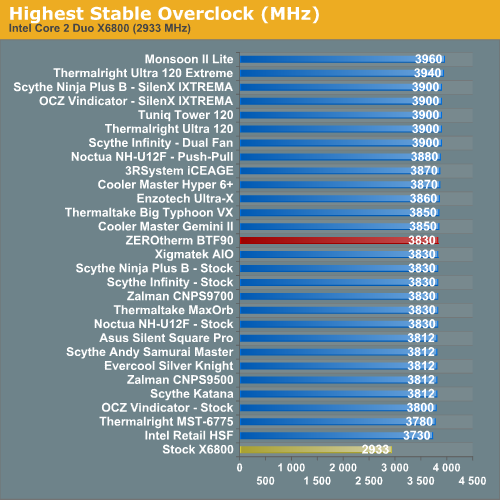
The ZEROtherm BTF90 reached a stable 3.83 GHz, which places it in the middle of the overclocking pack. Again, considering cooling is with a 92mm fan pushing just 42.8 CFM the overclocking must be considered excellent. While the BTF90 could not compete to the 3.90 to 3.94GHz measured with the best heatpipe towers, its performance over the effective range to 3.83GHz is very good.
There is no doubt that the BTF90 is able to dissipate 150W or more of heat. This merely points out the extreme demands that our overclocking cooling tests make of coolers while we push an X6800 processor to its overclock limits. The power requirements of a Core 2 Duo X6800 processor at rated speed and voltage is around 75 watts. At the overclocked speed of 3.830GHz at the commonly required 1.5375V to 1.5625V the wattage has doubled - to 148W to 153W. At the highest air OC with this X6800 of 3.94GHz with a Thermalright Ultra 120 eXtreme wattage has risen to 165W to 168W.
The stock Intel Retail cooler is really an excellent cooler, and the requirement that a tested cooler must perform better than the included Intel cooler is more demanding than you might think. THe Intel stock cooler topped out at 3.73 GHz at just below 1.5V. This means the stock Intel cooler is dissipating 135W at the highest overclock it could reach. These figures should help put in perspective the relative efficiency of the coolers being tested and the extreme conditions of our maximum overclock cooling test bed.
However, a C2D pushed to the incredible overclocks they can reach draws a lot of power, and our cooling test is designed to find where the top coolers fail. Keep this in mind when looking at our cooling results. Many of the middle coolers in our roundup have done very well when tested with AMD processors or with less demanding cooling test procedures.
As cooling solutions do a better job of keeping the CPU at a lower temperature, it is reasonable to expect the overclocking capabilities of the CPU will increase. In each test of a cooler we measure the highest stable overclock of a standard X6800 processor under the following conditions:
CPU Multiplier: 14x (Stock 11x)
CPU voltage: 1.5875V
FSB Voltage: 1.30V
Memory Voltage: 2.00V
nForce SPP Voltage: 1.35V
nForce MCP Voltage: 1.7V
HT nForce SPP <-> MCP: Auto
Memory is set to Auto timings on the 680i and memory speed is linked to the FSB for the overclocking tests. This removes memory as any kind of impediment to the maximum stable overclock. Linked settings on the 680i are a 1066FSB to a memory speed of DDR2-800. As the FSB is raised the linked memory speed increases in proportion. The same processor is used in all cooling tests to ensure comparable results.
The ZEROtherm BTF90 reached a stable 3.83 GHz, which places it in the middle of the overclocking pack. Again, considering cooling is with a 92mm fan pushing just 42.8 CFM the overclocking must be considered excellent. While the BTF90 could not compete to the 3.90 to 3.94GHz measured with the best heatpipe towers, its performance over the effective range to 3.83GHz is very good.
There is no doubt that the BTF90 is able to dissipate 150W or more of heat. This merely points out the extreme demands that our overclocking cooling tests make of coolers while we push an X6800 processor to its overclock limits. The power requirements of a Core 2 Duo X6800 processor at rated speed and voltage is around 75 watts. At the overclocked speed of 3.830GHz at the commonly required 1.5375V to 1.5625V the wattage has doubled - to 148W to 153W. At the highest air OC with this X6800 of 3.94GHz with a Thermalright Ultra 120 eXtreme wattage has risen to 165W to 168W.
The stock Intel Retail cooler is really an excellent cooler, and the requirement that a tested cooler must perform better than the included Intel cooler is more demanding than you might think. THe Intel stock cooler topped out at 3.73 GHz at just below 1.5V. This means the stock Intel cooler is dissipating 135W at the highest overclock it could reach. These figures should help put in perspective the relative efficiency of the coolers being tested and the extreme conditions of our maximum overclock cooling test bed.
However, a C2D pushed to the incredible overclocks they can reach draws a lot of power, and our cooling test is designed to find where the top coolers fail. Keep this in mind when looking at our cooling results. Many of the middle coolers in our roundup have done very well when tested with AMD processors or with less demanding cooling test procedures.
Originally published at https://www.anandtech.com/show/2299 (Wayback Machine).