
Zippy Gaming G1 (GSM-6600P): Hybrid or Fence-Sitter?
- Posted in
- Cases/Cooling/PSUs
Testing
As usual we are testing with our Chroma programmable loads equipment to fully load each rail to a specific amount. This is important to get truly accurate results and not merely approximate values. The tests are conducted in two different temperature environments. One is normal room temperature of 25-26°C, while the second environment goes from room temperature and increases steadily up to 50°C. Especially during the higher temperatures we will see how good the power supplies are and what they're really made of. Components inside will perform much worse at higher temperatures, but we expect any good quality PSU to deal with such test conditions without failing.
Note: If you would like to know more about our testing methodology, equipment, and environment, please read our Power Supply testing overview.
3.3V DC Output
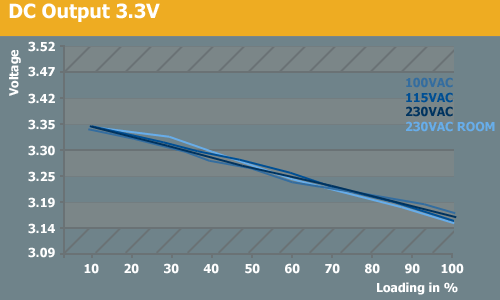
The 3.3V rail is the worst performing rail on the G1 power supply. It has a steadily decreasing voltage drop but does stay within specifications fortunately. Before sending us the samples the marketing people at Zippy expressed a little concern about the high temperature test environment, since their PSUs are rated at only 40°C. (We have to add here that most companies are rating their power supplies at just 25°C, so Zippy shouldn't have been concerned at all.) Temperatures didn't actually affect the results much, however, as even at room temperature we see similar performance from the various rails.
5V DC Output
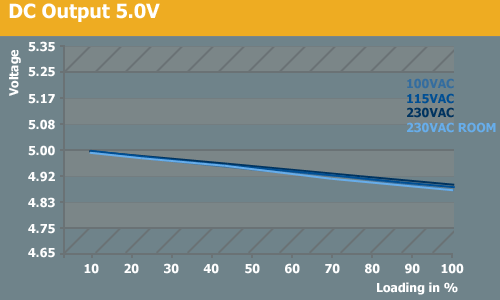
The 5V rail looks better and maintains a relatively steady output. With a range of 5.00V to 4.88V the 5V rail can be described as very stable. We might like to see the voltages shifted up 0.05V, but it's not really necessary.
12V DC Output
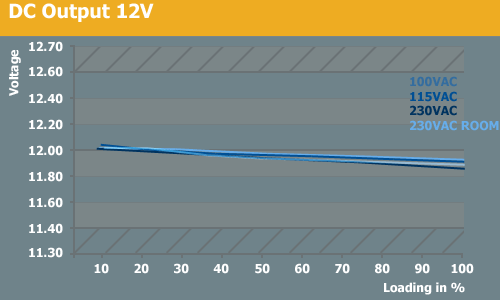
We weren't surprised to see the most stable 12V rails of any PSU we've tested so far - a clear indication of Zippy's server PSU roots. It doesn't matter what temperature, input voltage, or load use with this power supply; it gets to work and always delivers an extremely stable 12V output. The lowest output we measured was just 11.83V at 50°C and maximum load. We have not seen better results so far.
5Vsb DC Output
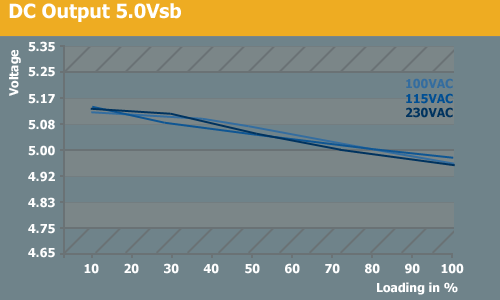
The 5Vsb rail has good results over the range of loads. It starts out somewhat high (which is usually considered better than being low) and at the highest load we had just a few millivolts less than the ideal.
As usual we are testing with our Chroma programmable loads equipment to fully load each rail to a specific amount. This is important to get truly accurate results and not merely approximate values. The tests are conducted in two different temperature environments. One is normal room temperature of 25-26°C, while the second environment goes from room temperature and increases steadily up to 50°C. Especially during the higher temperatures we will see how good the power supplies are and what they're really made of. Components inside will perform much worse at higher temperatures, but we expect any good quality PSU to deal with such test conditions without failing.
Note: If you would like to know more about our testing methodology, equipment, and environment, please read our Power Supply testing overview.
3.3V DC Output
| 3.3V Rail | |||
| Percentage | Ampere | Wattage | Wattage (All Rails) |
| 10% | 1.86 | 6.23 | 60.19 |
| 20% | 3.72 | 12.43 | 120.16 |
| 30% | 5.59 | 18.62 | 179.95 |
| 40% | 7.45 | 24.66 | 239.54 |
| 50% | 9.31 | 30.72 | 298.95 |
| 60% | 11.17 | 36.75 | 358.06 |
| 70% | 13.03 | 42.74 | 417.19 |
| 80% | 14.9 | 48.57 | 475.44 |
| 90% | 16.76 | 54.47 | 533.52 |
| 100% | 18.62 | 60.33 | 591.82 |
The 3.3V rail is the worst performing rail on the G1 power supply. It has a steadily decreasing voltage drop but does stay within specifications fortunately. Before sending us the samples the marketing people at Zippy expressed a little concern about the high temperature test environment, since their PSUs are rated at only 40°C. (We have to add here that most companies are rating their power supplies at just 25°C, so Zippy shouldn't have been concerned at all.) Temperatures didn't actually affect the results much, however, as even at room temperature we see similar performance from the various rails.
5V DC Output
| 5V Rail | |||
| Percentage | Ampere | Wattage | Wattage (All Rails) |
| 10% | 1.86 | 9.3 | 60.19 |
| 20% | 3.72 | 18.56 | 120.16 |
| 30% | 5.59 | 27.78 | 179.95 |
| 40% | 7.45 | 36.95 | 239.54 |
| 50% | 9.31 | 45.99 | 298.95 |
| 60% | 11.17 | 55.07 | 358.06 |
| 70% | 13.03 | 64.11 | 417.19 |
| 80% | 14.9 | 72.86 | 475.44 |
| 90% | 16.76 | 81.79 | 533.52 |
| 100% | 18.62 | 90.49 | 591.82 |
The 5V rail looks better and maintains a relatively steady output. With a range of 5.00V to 4.88V the 5V rail can be described as very stable. We might like to see the voltages shifted up 0.05V, but it's not really necessary.
12V DC Output
| 12V Rail | |||
| Percentage | Ampere | Wattage | Wattage (All Rails) |
| 10% | 3.64 | 43.75 | 60.19 |
| 20% | 7.27 | 87.24 | 120.16 |
| 30% | 10.91 | 130.81 | 179.95 |
| 40% | 14.55 | 174.31 | 239.54 |
| 50% | 18.18 | 217.62 | 298.95 |
| 60% | 21.82 | 260.75 | 358.06 |
| 70% | 25.45 | 303.87 | 417.19 |
| 80% | 29.09 | 346.75 | 475.44 |
| 90% | 32.73 | 389.16 | 533.52 |
| 100% | 36.36 | 431.96 | 591.82 |
We weren't surprised to see the most stable 12V rails of any PSU we've tested so far - a clear indication of Zippy's server PSU roots. It doesn't matter what temperature, input voltage, or load use with this power supply; it gets to work and always delivers an extremely stable 12V output. The lowest output we measured was just 11.83V at 50°C and maximum load. We have not seen better results so far.
5Vsb DC Output
| 5Vsb Rail | |||
| Percentage | Ampere | Wattage | Wattage (All Rails) |
| 10% | 0.18 | 0.92 | 60.19 |
| 20% | 0.36 | 1.84 | 120.16 |
| 30% | 0.55 | 2.81 | 179.95 |
| 40% | 0.73 | 3.71 | 239.54 |
| 50% | 0.91 | 4.61 | 298.95 |
| 60% | 1.09 | 5.49 | 358.06 |
| 70% | 1.27 | 6.38 | 417.19 |
| 80% | 1.45 | 7.25 | 475.44 |
| 90% | 1.64 | 8.17 | 533.52 |
| 100% | 1.82 | 9.01 | 591.82 |
The 5Vsb rail has good results over the range of loads. It starts out somewhat high (which is usually considered better than being low) and at the highest load we had just a few millivolts less than the ideal.
Originally published at https://www.anandtech.com/show/2293 (Wayback Machine).