
The Enermax Liberty - Getting long in the tooth, but still worth a look
- Posted in
- Cases/Cooling/PSUs
Temperatures
Room Temperature
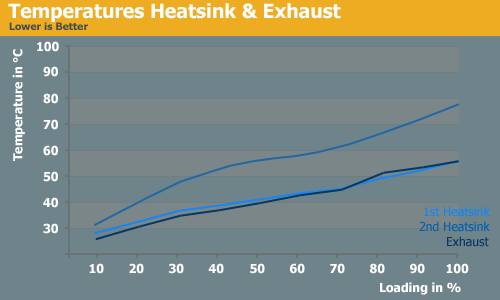
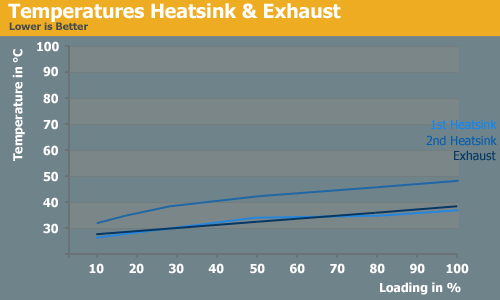
During the room temperature test the temps of the heatsinks is very low. At only 50°C on the secondary heatsink and 40°C on the primary it is definitely a good result. This has a lot to do with the fan, which begins increasing its rotational speed rapidly at loads above 50%. The heatsink design helps as well, as it leaves enough air so that components under it can be cooled as well.
Fan Speed
Room Temperature
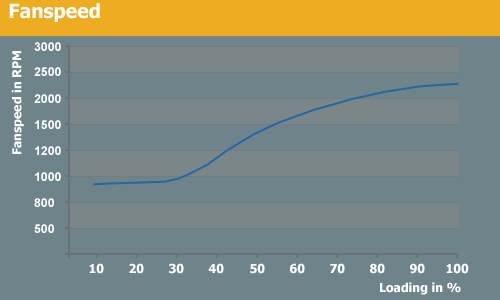
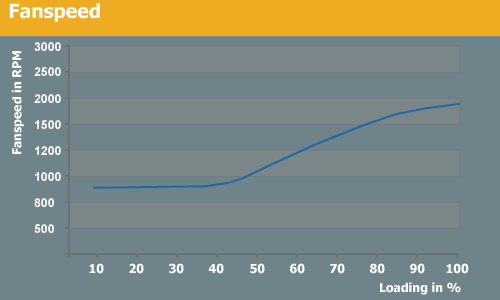
The curves of the two different ambient temperatures look similar; they only differ in maximum speed and the point at which the fan starts rotating faster. At room temperature fan speed starts ramping up at around 40% of load (around 250W). The curve then goes steadily up to its highest point of almost 2000 RPM. With higher ambient temperature the fan starts to spin faster at 30% load which is an approximate 190W. We measured a difference of about 250 RPM between the two ambient temperatures.
Acoustics
Room Temperature
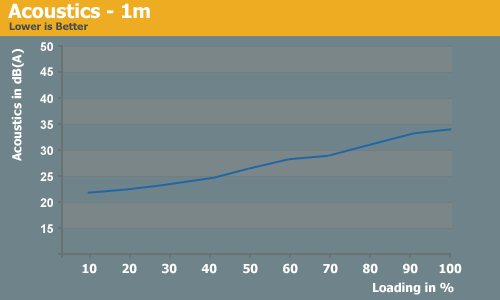
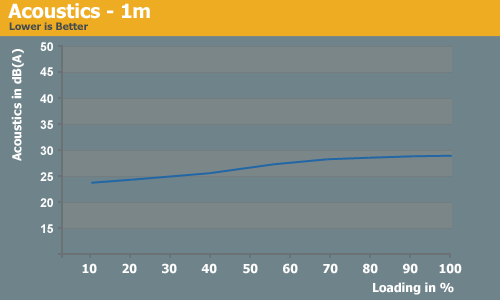
The two tests at room temperature and high temperature show clear differences in terms of noise levels. We measured 5dB(A) more under high temperatures when the fan was spinning 250 RPM faster. Enermax doesn't make a big deal about noise levels and has always stated that they prefer to have a well-performing power supply which can only be done by a fan that actually moves enough air through the housing. Enough air means that the fan needs to spin at higher speeds, and that means it will produce more noise. In comparison to some of the higher power units we've looked at the Liberty does quite well at being quiet; then again, it's only providing a maximum of 500W vs. 850W on some of the units we've tested.
Room Temperature
During the room temperature test the temps of the heatsinks is very low. At only 50°C on the secondary heatsink and 40°C on the primary it is definitely a good result. This has a lot to do with the fan, which begins increasing its rotational speed rapidly at loads above 50%. The heatsink design helps as well, as it leaves enough air so that components under it can be cooled as well.
Fan Speed
Room Temperature
The curves of the two different ambient temperatures look similar; they only differ in maximum speed and the point at which the fan starts rotating faster. At room temperature fan speed starts ramping up at around 40% of load (around 250W). The curve then goes steadily up to its highest point of almost 2000 RPM. With higher ambient temperature the fan starts to spin faster at 30% load which is an approximate 190W. We measured a difference of about 250 RPM between the two ambient temperatures.
Acoustics
Room Temperature
The two tests at room temperature and high temperature show clear differences in terms of noise levels. We measured 5dB(A) more under high temperatures when the fan was spinning 250 RPM faster. Enermax doesn't make a big deal about noise levels and has always stated that they prefer to have a well-performing power supply which can only be done by a fan that actually moves enough air through the housing. Enough air means that the fan needs to spin at higher speeds, and that means it will produce more noise. In comparison to some of the higher power units we've looked at the Liberty does quite well at being quiet; then again, it's only providing a maximum of 500W vs. 850W on some of the units we've tested.
Originally published at https://www.anandtech.com/show/2289 (Wayback Machine).