
NVIDIA 680i SLI: Official 1333MHz FSB CPU Support Arrives
- Posted in
- CPUs
QX6850 Quad Core Overclocking:
We need to state up front that our QX6850 sample is not the best of the lot when it comes to overclocking. In fact, it seems downright disappointing to us as it does not matter what voltages or board we utilize: this processor refuses to POST once you dial in 4GHz.
We are utilizing the recently released P30 BIOS that features additional tuning for 1333MHz FSB processors. We did notice some improvements over the P29 Beta but to be honest, the majority of improvements are with the 1066FSB based processors. These improvements range from slightly higher overclocks with lower voltage requirements to improved compatibility with our RAID cards.
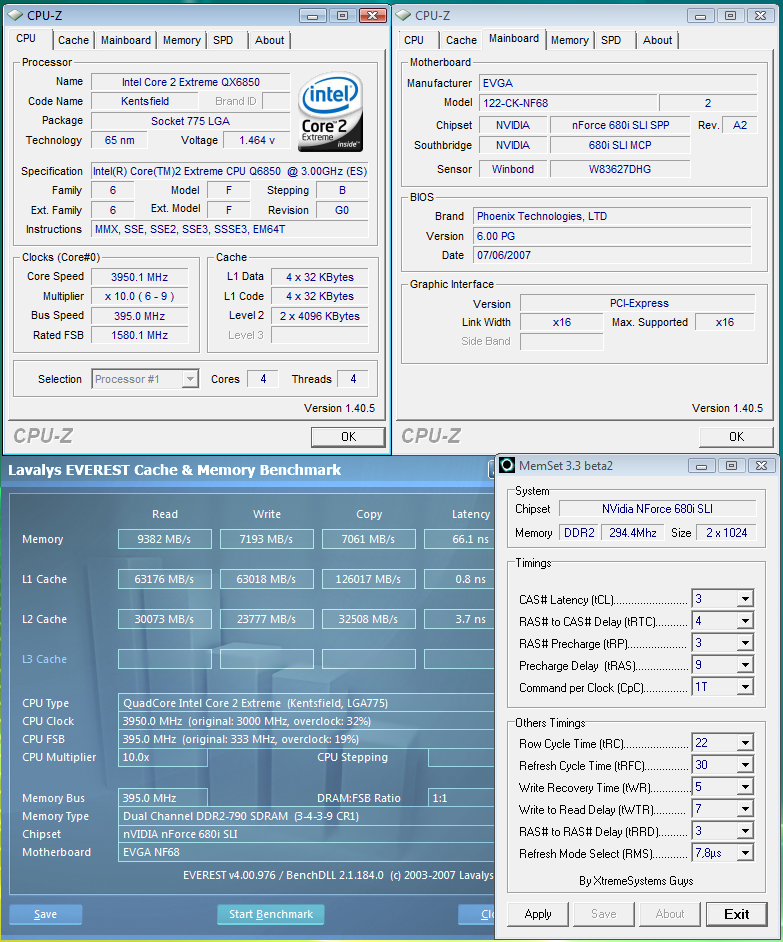
Our first test is designed to maximize our CPU speed while also overclocking the FSB as much as possible. We ended up with a final 10x395 setting with our memory operating in Sync mode at DDR2-790 with timings at 3-4-3-9 1T. We noticed with this CPU and board combination that throughout testing we had a choice of either running tight timings near DDR2-800 or having to really loosen up the timings at DDR2-1066 or above in order to maintain stability.
Our OCZ PC2-9200 will normally do 4-4-4-12 timings up to DDR2-1100 but we had to run 5-5-5-15 or higher above 1000 with this CPU. We determined our best memory throughput and latencies were around DDR2-800 so we remained in this range throughout testing. We also tried additional memory modules from Corsair, G.Skill, and SuperTalent with the same results. It appears to us that some fine tuning is still required with the P30 BIOS at this time.
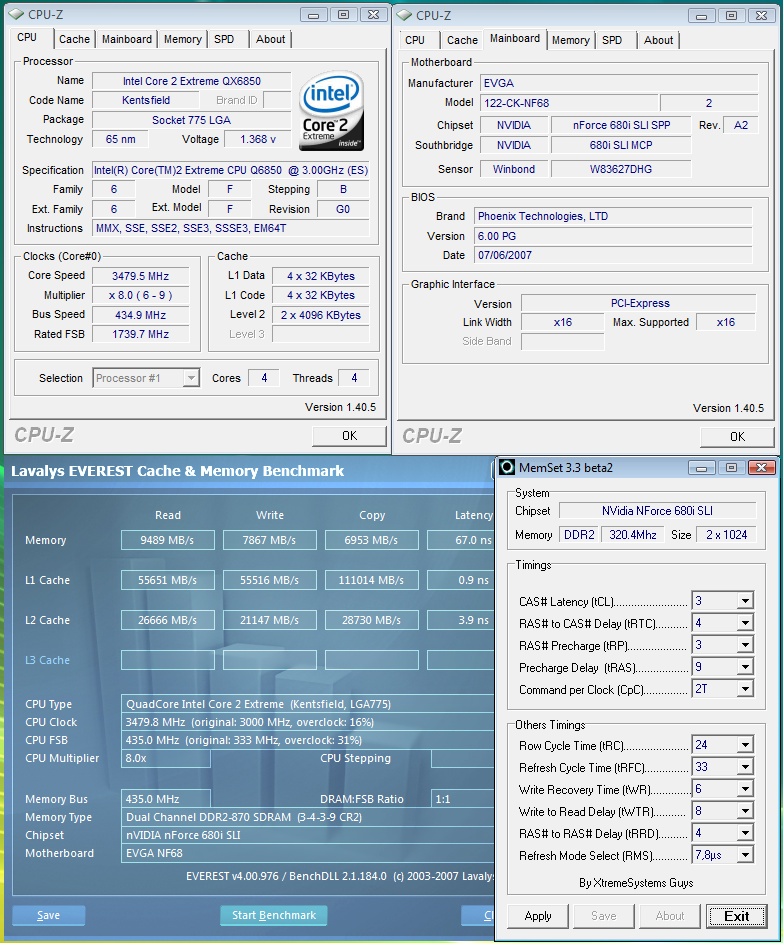
We dropped the multiplier on our QX6850 to eight and were rewarded with a final 8x435FSB setting compared to a 8x475FSB on the ASUS Blitz Extreme board. This board did make it to 8x470FSB with greatly increased voltages, but it was not stable over the time it takes to run our benchmark test suite. The main culprit is heat and even with additional air cooling, the system is just not stable on a 24/7 basis.
We should also note that we experienced one of the infamous 680i "holes" with our component combination that started around 440FSB and stayed until the 465FSB range. That left us with a choice of 435FSB or 470FSB; we really tried to make the 470FSB work on a consistent basis but we just could not get the system stable enough to sign off on it for daily usage. Once again, we had a degree of difficulty running our memory in the DDR2-1066 to 1170 range without resorting to very loose timings with 5-7-7-24 required at DDR2-1170 for stability. This did not occur with our E6850 CPU so the problem seems to be the quad core setup.
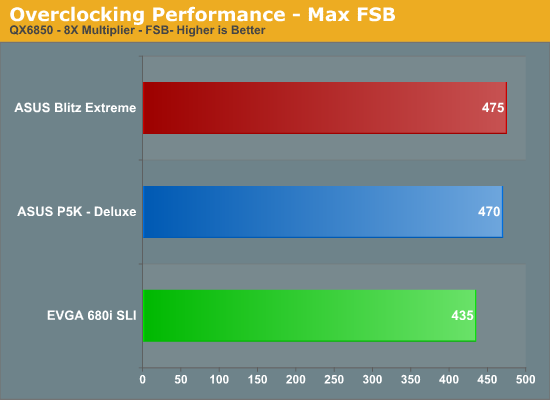
While our current EVGA 680i SLI sample tops out around 40FSB lower than our two ASUS P35 boards, we still consider 435FSB with the 680i chipset to be very good. We have a fairly strong opinion about the current FSB race and the detriments it brings to overall system performance and stability, but we'll save it for the roundup.
| EVGA 680i SLI Overclocking Testbed |
|
| Processor | Intel Core 2 Extreme QX6850 Quad Core, 3.00GHz, 8MB Unified Cache 1333FSB, 9x Multiplier |
| CPU Voltage | 1.4625V (default 1.2750V) |
| Cooling | Tuniq 120 Air Cooling |
| Power Supply | OCZ ProXStream 1000W |
| Memory | OCZ Reaper PC2-9200 (2x1GB) 3-4-3-9 |
| Video Cards | 1 x MSI 8800GTX |
| Hard Drive | Western Digital 150GB 10,000RPM SATA 16MB Buffer |
| Case | Cooler Master CM Stacker 830 |
| Maximum CPU OC | 395x10 (3-4-3-9 1T, 790MHz, 2.15V), CPU 1.4625V 3950MHz (+32% CPU) |
| Maximum FSB OC | 435x8 (3-4-3-9, 870MHz, 2.15V), CPU 1.3625V 3480MHz (+31% FSB) |
| . | |
We need to state up front that our QX6850 sample is not the best of the lot when it comes to overclocking. In fact, it seems downright disappointing to us as it does not matter what voltages or board we utilize: this processor refuses to POST once you dial in 4GHz.
 |
| Click to enlarge |
We are utilizing the recently released P30 BIOS that features additional tuning for 1333MHz FSB processors. We did notice some improvements over the P29 Beta but to be honest, the majority of improvements are with the 1066FSB based processors. These improvements range from slightly higher overclocks with lower voltage requirements to improved compatibility with our RAID cards.
Our first test is designed to maximize our CPU speed while also overclocking the FSB as much as possible. We ended up with a final 10x395 setting with our memory operating in Sync mode at DDR2-790 with timings at 3-4-3-9 1T. We noticed with this CPU and board combination that throughout testing we had a choice of either running tight timings near DDR2-800 or having to really loosen up the timings at DDR2-1066 or above in order to maintain stability.
Our OCZ PC2-9200 will normally do 4-4-4-12 timings up to DDR2-1100 but we had to run 5-5-5-15 or higher above 1000 with this CPU. We determined our best memory throughput and latencies were around DDR2-800 so we remained in this range throughout testing. We also tried additional memory modules from Corsair, G.Skill, and SuperTalent with the same results. It appears to us that some fine tuning is still required with the P30 BIOS at this time.
 |
| Click to enlarge |
We dropped the multiplier on our QX6850 to eight and were rewarded with a final 8x435FSB setting compared to a 8x475FSB on the ASUS Blitz Extreme board. This board did make it to 8x470FSB with greatly increased voltages, but it was not stable over the time it takes to run our benchmark test suite. The main culprit is heat and even with additional air cooling, the system is just not stable on a 24/7 basis.
We should also note that we experienced one of the infamous 680i "holes" with our component combination that started around 440FSB and stayed until the 465FSB range. That left us with a choice of 435FSB or 470FSB; we really tried to make the 470FSB work on a consistent basis but we just could not get the system stable enough to sign off on it for daily usage. Once again, we had a degree of difficulty running our memory in the DDR2-1066 to 1170 range without resorting to very loose timings with 5-7-7-24 required at DDR2-1170 for stability. This did not occur with our E6850 CPU so the problem seems to be the quad core setup.
While our current EVGA 680i SLI sample tops out around 40FSB lower than our two ASUS P35 boards, we still consider 435FSB with the 680i chipset to be very good. We have a fairly strong opinion about the current FSB race and the detriments it brings to overall system performance and stability, but we'll save it for the roundup.
Originally published at https://www.anandtech.com/show/2280 (Wayback Machine).