
Scythe Andy Samurai Master vs. Thermaltake MaxOrb
- Posted in
- Cases/Cooling/PSUs
Overclocking
As cooling solutions do a better job of keeping the CPU at a lower temperature, it is reasonable to expect the overclocking capabilities of the CPU will increase. In each test of a cooler we measure the highest stable overclock of a standard X6800 processor under the following conditions:
CPU Multiplier: 14x (Stock 11x)
CPU voltage: 1.5875V
FSB Voltage: 1.30V
Memory Voltage: 2.20V
nForce SPP Voltage: 1.5V
nForce MCP Voltage: 1.7V
HT nForce SPP <-> MCP: Auto
Memory is set to Auto timings on the 680i and memory speed is linked to the FSB for the overclocking tests. This removes memory as any kind of impediment to the maximum stable overclock. Linked settings on the 680i are a 1066FSB to a memory speed of DDR2-800. As FSB is raised the linked memory speed increases in proportion. The same processor is used in all cooling tests to ensure comparable results.
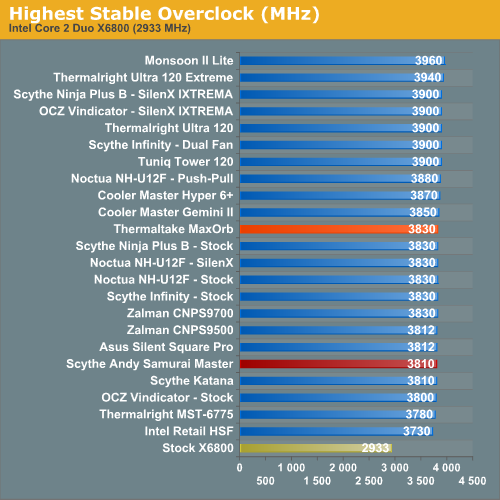
The Scythe Andy Samurai Master reached just 3.81 GHz, which is middle of the pack and competitive with the much cheaper Thermalright MST-6775 and the Scythe Katana. The Thermalright MaxOrb barely did better at 3.83 GHz. With most of the better coolers reaching 3.90 to 3.94GHz these results are somewhat disappointing.
Since the Scythe Andy Samurai Master allows easy fan swapping, we did try a number of fans with the cooler. The supplied Scythe fan is only about 50cfm compared to the 90 for the MaxOrb on high. The Scythe S-Flex SFF21F (63.7cfm), the SilenX IXTREMA (72CFM) and the Aero Cool Xtreme Turbine (89.39cfm) were all tested with the Andy Samurai. To our surprise none of the three would allow the Andy Samurai to reach higher than a 3.81GHz overclock. Apparently the close spacing of the fins is optimized for a medium output fan and more airflow just will not improve performance.
One of the arguments for down-facing coolers is that they should cool board components better than the side blowing heatpipe towers. Lower board component temperatures should allow a higher overclock, at least on paper. The unfortunate reality so far, with all the down-facing coolers tested from the Cooler Master GeminII to today's MaxOrb and Andy Samurai Master is that these down-facing coolers just do not cool as well as side-blowing heatpipe towers. Since cost is about the same as the best heatpipe towers we have tested, you really don't get great value with the down-facing designs.
As cooling solutions do a better job of keeping the CPU at a lower temperature, it is reasonable to expect the overclocking capabilities of the CPU will increase. In each test of a cooler we measure the highest stable overclock of a standard X6800 processor under the following conditions:
CPU Multiplier: 14x (Stock 11x)
CPU voltage: 1.5875V
FSB Voltage: 1.30V
Memory Voltage: 2.20V
nForce SPP Voltage: 1.5V
nForce MCP Voltage: 1.7V
HT nForce SPP <-> MCP: Auto
Memory is set to Auto timings on the 680i and memory speed is linked to the FSB for the overclocking tests. This removes memory as any kind of impediment to the maximum stable overclock. Linked settings on the 680i are a 1066FSB to a memory speed of DDR2-800. As FSB is raised the linked memory speed increases in proportion. The same processor is used in all cooling tests to ensure comparable results.
The Scythe Andy Samurai Master reached just 3.81 GHz, which is middle of the pack and competitive with the much cheaper Thermalright MST-6775 and the Scythe Katana. The Thermalright MaxOrb barely did better at 3.83 GHz. With most of the better coolers reaching 3.90 to 3.94GHz these results are somewhat disappointing.
Since the Scythe Andy Samurai Master allows easy fan swapping, we did try a number of fans with the cooler. The supplied Scythe fan is only about 50cfm compared to the 90 for the MaxOrb on high. The Scythe S-Flex SFF21F (63.7cfm), the SilenX IXTREMA (72CFM) and the Aero Cool Xtreme Turbine (89.39cfm) were all tested with the Andy Samurai. To our surprise none of the three would allow the Andy Samurai to reach higher than a 3.81GHz overclock. Apparently the close spacing of the fins is optimized for a medium output fan and more airflow just will not improve performance.
One of the arguments for down-facing coolers is that they should cool board components better than the side blowing heatpipe towers. Lower board component temperatures should allow a higher overclock, at least on paper. The unfortunate reality so far, with all the down-facing coolers tested from the Cooler Master GeminII to today's MaxOrb and Andy Samurai Master is that these down-facing coolers just do not cool as well as side-blowing heatpipe towers. Since cost is about the same as the best heatpipe towers we have tested, you really don't get great value with the down-facing designs.
Originally published at https://www.anandtech.com/show/2244 (Wayback Machine).