
Intel P35: Intel's Mainstream Chipset Grows Up
- Posted in
- CPUs
Media Encoding Performance
We are utilizing an updated video encoding test suite for this article that includes AnyDVD, Nero Recode 2, Windows Media Encoder 9, and QuickTime Pro 7.1.Our first series of tests is quite easy - we take our original Office Space DVD and use AnyDVD and Nero Recode 2 to copy the full DVD to the hard drive without compression, thus providing an almost exact duplicate of the DVD. We then fired up Nero Recode 2, selected our Office Space copy on the hard drive, and performed a shrink operation to allow the entire movie along with extras to fit on a single 4.5GB DVD disc. We then go back and use Nero Recode to shrink the full DVD copy and burn it onto our DVD disc. We left all options on their defaults except we checked off the advanced analysis option. The scores reported include the full encoding process and is represented in minutes/seconds, with lower numbers providing better performance.
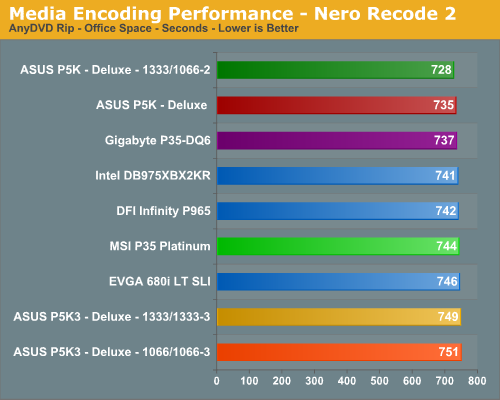
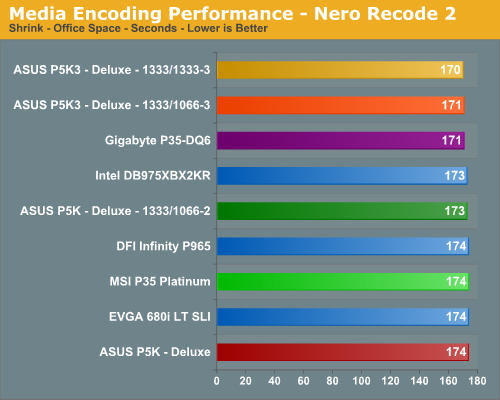
The AnyDVD Rip results are very interesting as we did not expect our DDR3 boards to perform in this manner when compared to the DDR2 boards, especially against the same chipset. Even though latencies are higher, the increased bandwidth would normally bring the DDR3 board within range of the DDR2 boards in a test that is CPU and disk intensive. The 3% performance deficit was unusual to say the least. The Shrink results are more in alignment showing a 2% difference between the boards, although for the first time we see the P5K Deluxe board falter a little at stock settings. We noticed at the beginning of the test there was always a brief stutter with this board. The change to 1333FSB really does not improve the scores.
Our next test has us converting our day at the beach AVI file into a high definition WMV file suitable for our Aunt Gertrude to view on her new high definition LCD TV. We ensured our quality settings were set to High Definition. The balance of options is set to standard settings and then we let this program do its magic. We are reporting the numbers in seconds to complete the conversion.
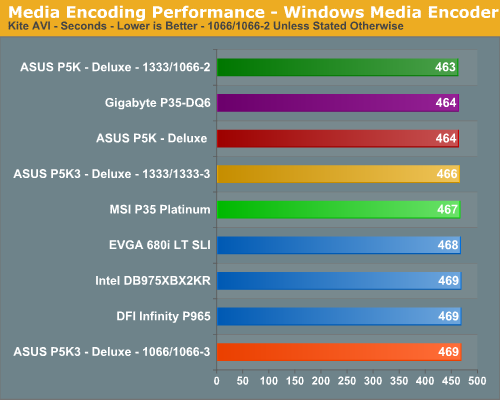
We see the boards with the best overall memory and latency performance once again leading in a test that is both CPU and memory sensitive. The difference is only a rather small 1.3% between the fastest and slowest scores, however.
Next on the list is our QuickTime Pro 7.1 test that will convert our newly downloaded .MOV file into a plasma screen pleasing H264 format. We ensured our quality settings were set to their highest levels and then let the horses loose. The values reported are in minutes/seconds for the conversion time, with lower numbers being better.
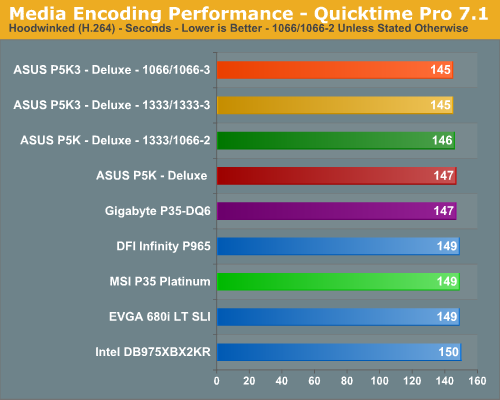
Once again, the 1333 platforms have a slight advantage in this test although the differences are minimal. Outside of the MSI board, all of the P35 boards are scoring slightly faster than the older chipsets, and the total range of scores differs by 3.5%.
Originally published at https://www.anandtech.com/show/2236 (Wayback Machine).