
Cooler Master GeminII: Performer or Poser?
- Posted in
- Cases/Cooling/PSUs
Overclocking
As cooling solutions do a better job of keeping the CPU at a lower temperature, it is reasonable to expect the overclocking capabilities of the CPU will increase. In each test of a cooler we measure the highest stable overclock of a standard X6800 processor under the following conditions:
CPU Multiplier: 14x (Stock 11x)
CPU voltage: 1.5875V
FSB Voltage: 1.30V
Memory Voltage: 1.90V
nForce SPP Voltage: 1.35V
nForce MCP Voltage: 1.7V
HT nForce SPP <-> MCP: Auto
Memory is set to Auto timings on the 680i and memory speed is linked to the FSB for the overclocking tests. This removes memory as any kind of impediment to the maximum stable overclock. Linked settings on the 680i are a 1066FSB to a memory speed of DDR2-800. As FSB is raised the linked memory speed increases in proportion. The same processor is used in all cooling tests to ensure comparable results.
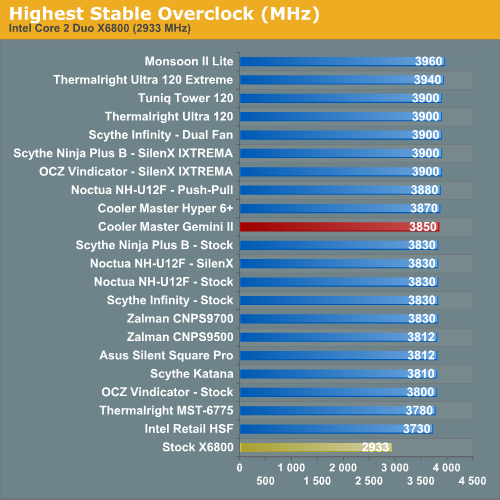
The Cooler Master GeminII with the best of the dual fan configurations reached 3.85GHz in the overclocking test. This was below the top coolers evaluated so far, which generally reached 3.90GHz to 3.94GHz with the same CPU and configuration. The design of the Gemini II seemed voltage limited to 1.5635V on this 680i motherboard, since any attempt to go higher in voltage for a higher overclock would crash. This compares to 1.6V capability with the top air coolers in our tests. Consider that the 3.85GHz result was with a high output fan with noise at more than 50 dB-A - nearly 60 dB-A, which is as loud as our tests have reached so far. The other three fan configurations all topped out at an overclock of 3.83GHz, which is even worse.
The overclocking results are even more disappointing when you compare cooling results under stress to the best air coolers we have tested. Considering the amount of board real estate required by the GeminII, the heavy weight of the cooler, and the dual fans putting out massive amounts of airflow, the overclocking results are extremely disappointing. The best air cooler tested topped out at 3.94GHz. The rest of the best air coolers reached 3.90GHz. 3.83GHz is average performance, and no challenge for the best tested so far.
As cooling solutions do a better job of keeping the CPU at a lower temperature, it is reasonable to expect the overclocking capabilities of the CPU will increase. In each test of a cooler we measure the highest stable overclock of a standard X6800 processor under the following conditions:
CPU Multiplier: 14x (Stock 11x)
CPU voltage: 1.5875V
FSB Voltage: 1.30V
Memory Voltage: 1.90V
nForce SPP Voltage: 1.35V
nForce MCP Voltage: 1.7V
HT nForce SPP <-> MCP: Auto
Memory is set to Auto timings on the 680i and memory speed is linked to the FSB for the overclocking tests. This removes memory as any kind of impediment to the maximum stable overclock. Linked settings on the 680i are a 1066FSB to a memory speed of DDR2-800. As FSB is raised the linked memory speed increases in proportion. The same processor is used in all cooling tests to ensure comparable results.
The Cooler Master GeminII with the best of the dual fan configurations reached 3.85GHz in the overclocking test. This was below the top coolers evaluated so far, which generally reached 3.90GHz to 3.94GHz with the same CPU and configuration. The design of the Gemini II seemed voltage limited to 1.5635V on this 680i motherboard, since any attempt to go higher in voltage for a higher overclock would crash. This compares to 1.6V capability with the top air coolers in our tests. Consider that the 3.85GHz result was with a high output fan with noise at more than 50 dB-A - nearly 60 dB-A, which is as loud as our tests have reached so far. The other three fan configurations all topped out at an overclock of 3.83GHz, which is even worse.
The overclocking results are even more disappointing when you compare cooling results under stress to the best air coolers we have tested. Considering the amount of board real estate required by the GeminII, the heavy weight of the cooler, and the dual fans putting out massive amounts of airflow, the overclocking results are extremely disappointing. The best air cooler tested topped out at 3.94GHz. The rest of the best air coolers reached 3.90GHz. 3.83GHz is average performance, and no challenge for the best tested so far.
Originally published at https://www.anandtech.com/show/2221 (Wayback Machine).