
EVGA nForce 650i Ultra: Performance on a Budget
- Posted in
- Motherboards
Overclocking - E6600
After trying a variety of memory timings and system voltages we discovered our 9x430 FSB setting was the limit for both our board and CPU. This resulted in a final clock speed of 3869MHz at 1.4750V which is the limit for our Tuniq 120 air cooler. We did find the typical FSB hole around 416~422 FSB but did not notice the same issues we had with the 680i LT SLI having several FSB ranges that were unusable. Vdroop was acceptable but not great during overclocking with an average drop of .04V during load testing with our E6600.
We dropped the multiplier on our E6600 to seven and were able to reach the same 509 FSB level as with the E6300. We were able to enter XP at 7x512 but the board was not stable. We were able to pass all benchmarks at the 7x509 setting but feel like the board is most comfortable around 485FSB. We have been testing the board for only a week so extensive 24/7 testing at 7x509 has not been completed at this time. However, we have not had a failure at this setting in the last 72 hours.
We noticed in overclock testing that we were able to extract an 1133 memory speed at 5-5-5-18 2T timings at 2.10V with our OCZ Flex PC2-6400. This matches the 680i LT SLI speeds at slightly worse timings although performance differences were minimal. Memory performance and stability was excellent once the board was dialed in.
Overclocking - QX6700
We were extremely pleased with quad core overclocking on this board as its performance was significantly better than some of the more expensive 680i boards in our results. Our board reached a final 360FSB at the stock multiplier. We were able to POST and enter XP at 368FSB but could not complete our benchmark testing.
Our processor voltage was set to 1.450V in order to maintain system stability at 360 FSB. Our processor will normally run in the 3600MHz range at 1.4125V on the 975X and P965 boards. Vdroop was acceptable on this board with the quad core processor. We would see drops as high as .04V under load testing with the average drop being around .03V during extended game testing.
We really had to loosen up the memory timings when compared to the dual core results as there was some significant crosstalk on the board with the quad core at extended FSB settings. In fact, we could not run CAS3 and 1T command rate stable together at stock settings. Our choice was to run 4-4-3-9 1T settings at stock as performance was better than running 3-4-4-10 2T. Since our quad core results with the ASUS and MSI 650i/430 boards are very similar, we believe the 650i SPP is the limiting factor in overclocking this processor.
This was probably the biggest surprise in our testing as the board had no issues reaching a stable 450FSB, although for 24/7 operation we felt like 8x440 would probably be safer based upon the memory timings being utilized. We were able to POST and enter XP at 474FSB but could not complete any benchmark testing. Until we complete long term 24/7 testing on this board with a quad core CPU, our suggestion is to stay below 430FSB level and run slightly tighter memory timings.
| EVGA nForce 650i Ultra E6600 Overclocking Testbed |
|
| Processor: | Intel Core 2 Duo E6600 Dual Core, 2.4GHz, 4MB Unified Cache 1066FSB, 9x Multiplier |
| CPU Voltage: | 1.4750V / 1.4500 (default 1.3250V) |
| SPP Voltage: | 1.50V |
| FSB Voltage: | 1.40V |
| Cooling: | Tuniq 120 Air Cooling |
| Power Supply: | OCZ ProXStream 1000W |
| Memory: | OCZ Flex XLC PC2-6400 (2x1GB) |
| Video Cards: | 1 x MSI 8800GTX |
| Hard Drive: | Western Digital 150GB 10,000RPM SATA 16MB Buffer |
| Case: | Cooler Master CM Stacker 830 |
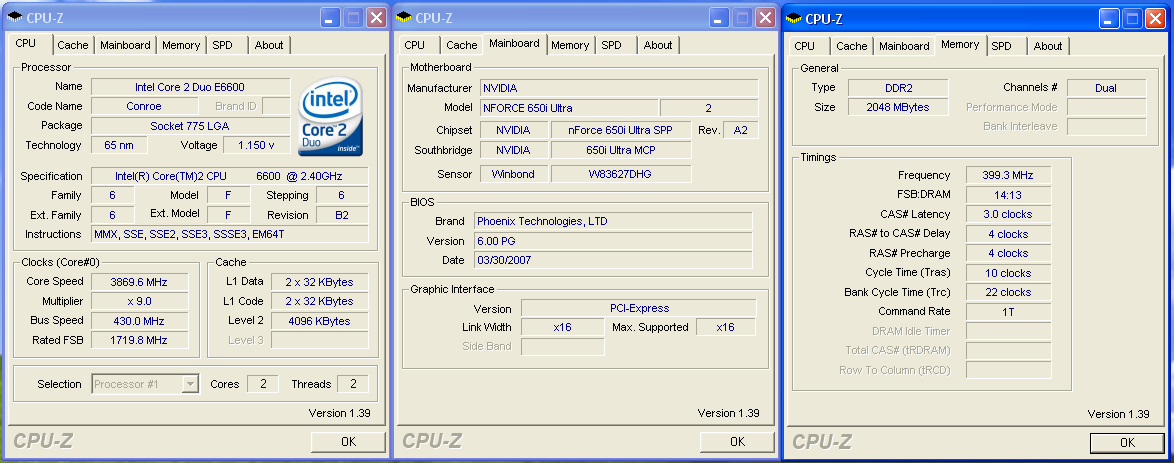
| Maximum CPU OC: | 430x9 (3-4-4-10 1T, 798MHz) 3869MHz (+61% CPU) |
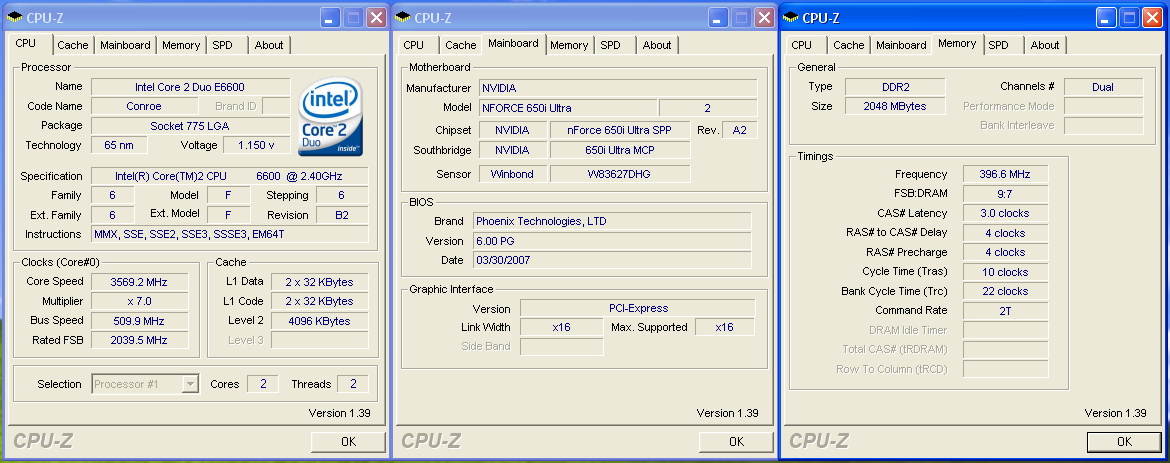
| Maximum FSB OC: | 509x7 (3-4-4-10 2T, 793MHz) 3569MHz (+91% FSB) |
| . | |
 |
| Click to enlarge |
After trying a variety of memory timings and system voltages we discovered our 9x430 FSB setting was the limit for both our board and CPU. This resulted in a final clock speed of 3869MHz at 1.4750V which is the limit for our Tuniq 120 air cooler. We did find the typical FSB hole around 416~422 FSB but did not notice the same issues we had with the 680i LT SLI having several FSB ranges that were unusable. Vdroop was acceptable but not great during overclocking with an average drop of .04V during load testing with our E6600.
 |
| Click to enlarge |
We dropped the multiplier on our E6600 to seven and were able to reach the same 509 FSB level as with the E6300. We were able to enter XP at 7x512 but the board was not stable. We were able to pass all benchmarks at the 7x509 setting but feel like the board is most comfortable around 485FSB. We have been testing the board for only a week so extensive 24/7 testing at 7x509 has not been completed at this time. However, we have not had a failure at this setting in the last 72 hours.
We noticed in overclock testing that we were able to extract an 1133 memory speed at 5-5-5-18 2T timings at 2.10V with our OCZ Flex PC2-6400. This matches the 680i LT SLI speeds at slightly worse timings although performance differences were minimal. Memory performance and stability was excellent once the board was dialed in.
Overclocking - QX6700
| EVGA nForce 650i Ultra QX6700 Overclocking Testbed |
|
| Processor: | Intel Core 2 Extreme QX6700 Quad Core, 2.66GHz, 8MB Unified Cache 1066FSB, 10x Multiplier |
| CPU Voltage: | 1.4500V / 1.4750V (default 1.3500V) |
| SPP Voltage: | 1.50V |
| FSB Voltage: | 1.40V |
| Cooling: | Tuniq 120 Air Cooling |
| Power Supply: | OCZ ProXStream 1000W |
| Memory: | OCZ Flex XLC PC2-6400 (2x1GB) |
| Video Cards: | 1 x MSI 8800GTX |
| Hard Drive: | Western Digital 150GB 10,000RPM SATA 16MB Buffer |
| Case: | Cooler Master CM Stacker 830 |
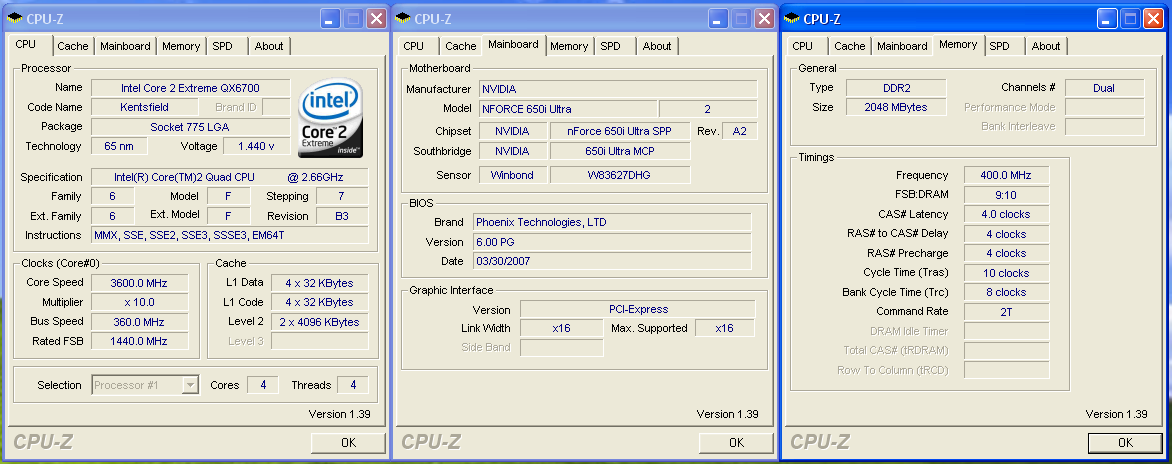
| Maximum OC: | 360x10 (4-4-4-10 2T, 800MHz, Linked) 3600MHz (+35%) |
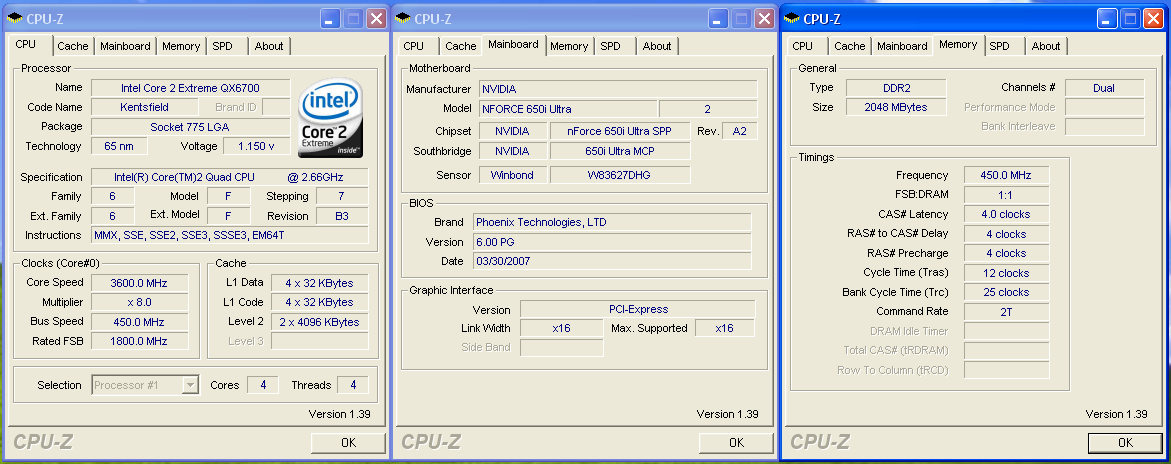
| Maximum FSB OC: | 450x8 (4-4-4-12 2T, 900MHz, Sync) 3600MHz (+69% FSB) |
| . | |
 |
| Click to enlarge |
We were extremely pleased with quad core overclocking on this board as its performance was significantly better than some of the more expensive 680i boards in our results. Our board reached a final 360FSB at the stock multiplier. We were able to POST and enter XP at 368FSB but could not complete our benchmark testing.
Our processor voltage was set to 1.450V in order to maintain system stability at 360 FSB. Our processor will normally run in the 3600MHz range at 1.4125V on the 975X and P965 boards. Vdroop was acceptable on this board with the quad core processor. We would see drops as high as .04V under load testing with the average drop being around .03V during extended game testing.
We really had to loosen up the memory timings when compared to the dual core results as there was some significant crosstalk on the board with the quad core at extended FSB settings. In fact, we could not run CAS3 and 1T command rate stable together at stock settings. Our choice was to run 4-4-3-9 1T settings at stock as performance was better than running 3-4-4-10 2T. Since our quad core results with the ASUS and MSI 650i/430 boards are very similar, we believe the 650i SPP is the limiting factor in overclocking this processor.
 |
| Click to enlarge |
This was probably the biggest surprise in our testing as the board had no issues reaching a stable 450FSB, although for 24/7 operation we felt like 8x440 would probably be safer based upon the memory timings being utilized. We were able to POST and enter XP at 474FSB but could not complete any benchmark testing. Until we complete long term 24/7 testing on this board with a quad core CPU, our suggestion is to stay below 430FSB level and run slightly tighter memory timings.
Originally published at https://www.anandtech.com/show/2207 (Wayback Machine).