
Intel Core 2 Extreme QX6800: The Fastest Desktop CPU, now with more cores
- Posted in
- CPUs
3D Rendering Performance
We've moved on to using 3dsmax 9, which allows us to run a 64-bit version of the program for our tests. The test scenario is still made up of the CPU rendering tests of the SPECapc 3dsmax benchmark. We report the rendering composite, which is simply the geometric mean of render times across seven benchmarks normalized to a set of reference scores. We ran 3dsmax 9 using its Direct3D driver given the poor state of OpenGL performance under Windows Vista.
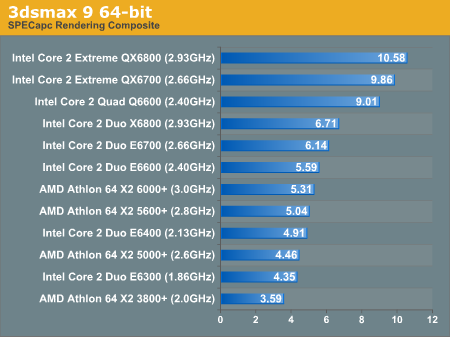
Quad-core performance is even more pronounced in 3D rendering applications, with the QX6800 maintaining a 58% performance advantage over its dual core predecessor.
The price war continues with the 6000+ falling in between the E6600 and E6400 in performance, while the 5600+ outperforms both of its competitors.
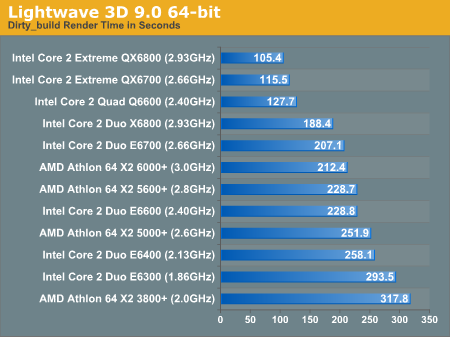
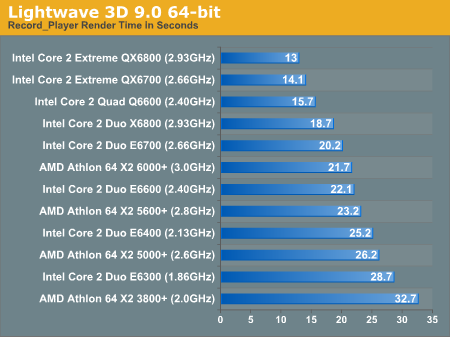
Lightwave 3D 9.0 is available with 64-bit support, giving us another 64-bit 3D rendering test. We looked at performance under two scenes that ship with the program: Dirty_Building and Record_Player. We measured the time it took to render the scene in seconds, lower numbers are obviously better.
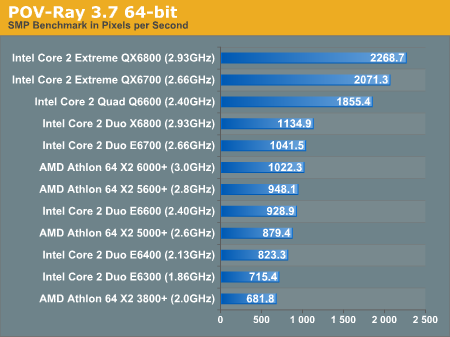
POV-Ray's ray tracing benchmark has been a popular CPU test for quite some time, and we turn to its 64-bit SMP beta to stress the CPUs here today:
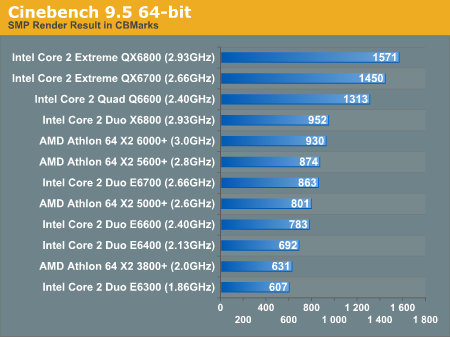
Our final 3D benchmark is the 64-bit version of Cinebench 9.5, a fairly popular 3D rendering benchmark due to its ease of use and quick runtimes. We ran the multi-threaded CPU rendering test and reported the final score in CBmarks. Higher numbers are better:
Originally published at https://www.anandtech.com/show/2206 (Wayback Machine).