
Intel Core 2 Extreme QX6800: The Fastest Desktop CPU, now with more cores
- Posted in
- CPUs
Media Encoding Performance
Although DivX was one of the first areas we saw performance gains with when moving to 64-bit years ago, our codec and encoding front end are both still 32-bit applications. We've moved to DivX 6.5.1 but our test settings remain the same. We use the codec in its unconstrained profile, using a quality present of 5 in 1-pass mode. Enhanced multithreading is enabled and we report encoding frame rate for our 1080p source file.
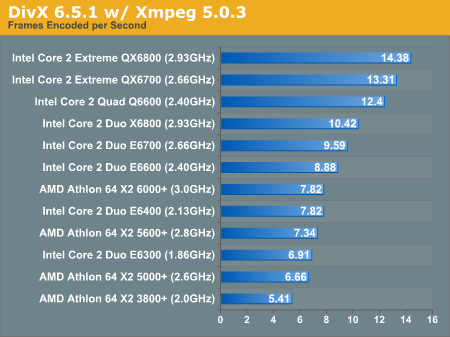
Media encoding and 3D rendering are two obvious areas where having four cores will boost performance significantly, and thus we see the four quad-core offerings at the top of the charts once more.
Moving down the list, the 6000+ performs exactly the same as the E6400, its price competitor. After Intel's price cuts take effect, the 6000+ will have to compete with the E6600 which is about 14% faster in our DivX test. The 5600+ does quite well, falling right between the E6400 and E6300 in performance.
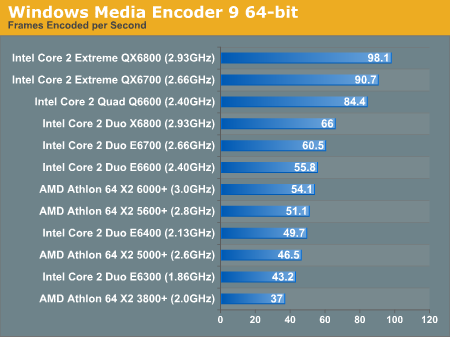
Windows Media Encoder is available in a 64-bit version and thus we used that here as one of our encoding tests. Our test remains the same as we've run it in the past, only using the 64-bit version of WME instead of the 32-bit version. Performance is reported in frames encoded per second:
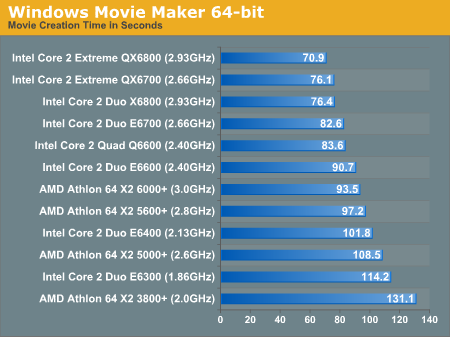
We also looked at encode time using Windows Movie Maker, a 64-bit application that comes with Windows Vista. We measured the time it took to encode content recorded off of Media Center into a format for posting on YouTube. Encode time was measured in seconds:
H.264 encoded content is still not mainstream yet, but the benefits of storing your content in the new format are numerous. We measured H.264 encode performance using Quicktime and report the results in frames encoded per second:
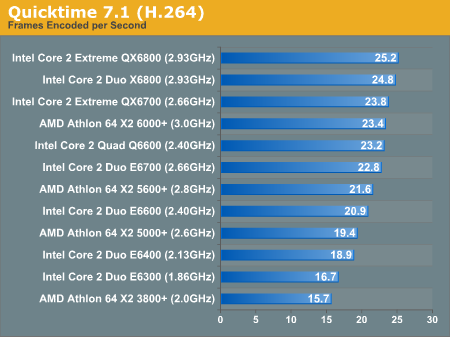
The Quicktime H.264 test paints a particularly good picture for AMD, with the 6000+ equalling even the Q6600.
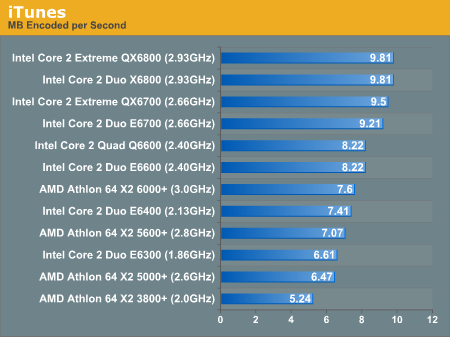
We conclude our look at Media Encoding performance with a simple conversion from a 304MB wav file to a 192kbps MP3 using iTunes. The conversion rate is reported in MB/s:
Originally published at https://www.anandtech.com/show/2206 (Wayback Machine).