
EVGA 680i LT SLI: NVIDIA's 680i Cost Reduced
- Posted in
- CPUs
Standard Gaming Performance
As usual, gaming performance was tested with a variety of current games. We ran benchmarks with our standard 1280x1024 resolution without antialiasing enabled (and generally without anisotropic filtering, though that varies by game). Given the number of users that run 19" LCDs these days, 1280x1024 represents one of the most commonly used resolutions. We could certainly increase the amount of eye candy being displayed in most of the games, but as this is a motherboard benchmark we aren't particularly interested in maxing out the graphics cards.
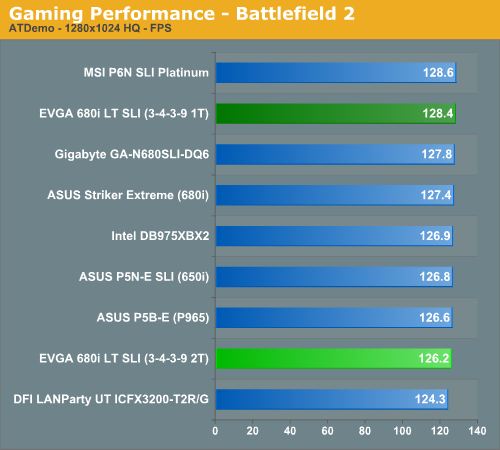
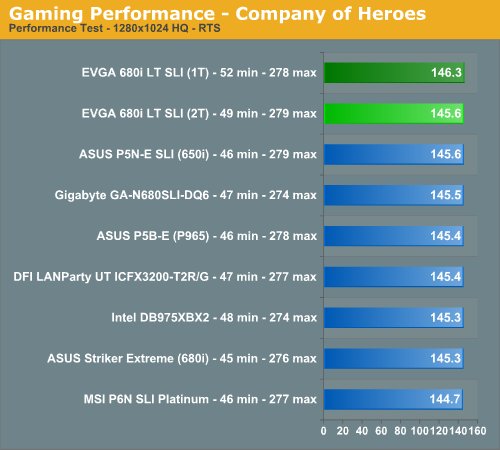
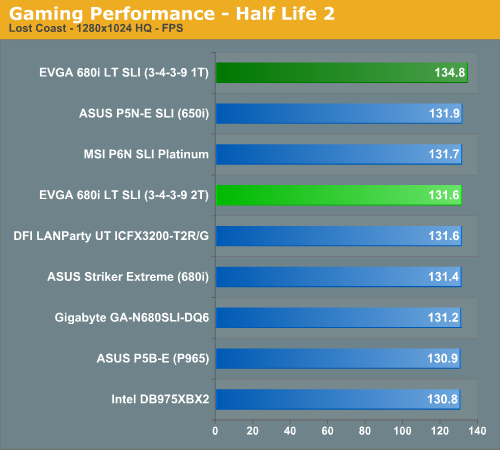
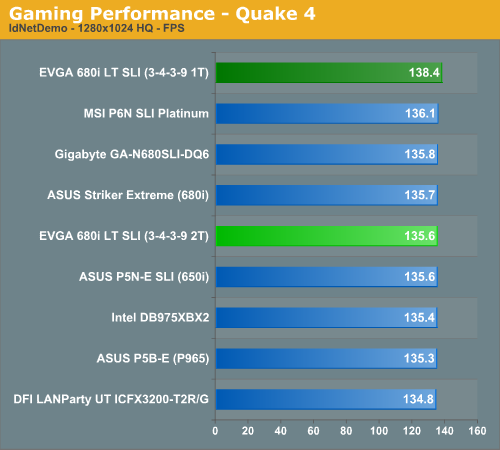
It's basically a toss up as to which chipset you select for a gaming machine. All of the results are very close and during actual game play we could not tell the difference between any of the boards. Our EVGA board finishes near the top in each test with a 2T command rate enabled and first in three tests with 1T enabled. While there is a measurable difference in the benchmarks, actual game play is the same - the largest performance increase from 1T is still only 2.5% in Half-Life 2. However, we will always take advantage of any opportunity to improve our system's performance.
We did not experience any issues during testing or during game play with the EVGA board at stock settings. We did encounter the dreaded NF4_DISP.DLL error while our system was overclocked with the E6600 processor at 9x425FSB. However, after removal/reinstallation of the video drivers along with the deletion of a particular registry key that NVIDIA suggested might be the culprit, we have not experienced any further issues. We generally play over a dozen different games for at least a couple of hours on each board to ensure there are no issues such as overheating, stuttering, or network issues when playing online with a various combination of components.
We will have a full selection of SLI game results along with a couple of new benchmarks in our next review. In the meantime, we did not find any noticeable differences in 8800GTX SLI performance between the 680i and 650i chipsets up to a resolution of 1920x1200 in games. The 3DMark06 synthetic benchmarks did show differences up to 6% but for the majority of gamers the differences in SLI performance between the two chipsets is negligible in actual game tests. It is only when you crank up the resolution to 2560x1600 or increase AA/AF settings that the dual x16 PCI Express capability on the 680i chipsets performs better than the dual x8 PCI Express setup on 650i.
As usual, gaming performance was tested with a variety of current games. We ran benchmarks with our standard 1280x1024 resolution without antialiasing enabled (and generally without anisotropic filtering, though that varies by game). Given the number of users that run 19" LCDs these days, 1280x1024 represents one of the most commonly used resolutions. We could certainly increase the amount of eye candy being displayed in most of the games, but as this is a motherboard benchmark we aren't particularly interested in maxing out the graphics cards.
It's basically a toss up as to which chipset you select for a gaming machine. All of the results are very close and during actual game play we could not tell the difference between any of the boards. Our EVGA board finishes near the top in each test with a 2T command rate enabled and first in three tests with 1T enabled. While there is a measurable difference in the benchmarks, actual game play is the same - the largest performance increase from 1T is still only 2.5% in Half-Life 2. However, we will always take advantage of any opportunity to improve our system's performance.
We did not experience any issues during testing or during game play with the EVGA board at stock settings. We did encounter the dreaded NF4_DISP.DLL error while our system was overclocked with the E6600 processor at 9x425FSB. However, after removal/reinstallation of the video drivers along with the deletion of a particular registry key that NVIDIA suggested might be the culprit, we have not experienced any further issues. We generally play over a dozen different games for at least a couple of hours on each board to ensure there are no issues such as overheating, stuttering, or network issues when playing online with a various combination of components.
We will have a full selection of SLI game results along with a couple of new benchmarks in our next review. In the meantime, we did not find any noticeable differences in 8800GTX SLI performance between the 680i and 650i chipsets up to a resolution of 1920x1200 in games. The 3DMark06 synthetic benchmarks did show differences up to 6% but for the majority of gamers the differences in SLI performance between the two chipsets is negligible in actual game tests. It is only when you crank up the resolution to 2560x1600 or increase AA/AF settings that the dual x16 PCI Express capability on the 680i chipsets performs better than the dual x8 PCI Express setup on 650i.
Originally published at https://www.anandtech.com/show/2198 (Wayback Machine).