
Scythe Infinity: 5 Heatpipes and Silent 120mm Fan
- Posted in
- Cases/Cooling/PSUs
Overclocking
As cooling solutions do a better job of keeping the CPU at a lower temperature, it is reasonable to expect the overclocking capabilities of the CPU will increase. In each test of a cooler we measure the highest stable overclock of a standard X6800 processor under the following conditions:
CPU Multiplier: 14x (Stock 11x)
CPU voltage: 1.5875V
FSB Voltage: 1.30V
Memory Voltage: 2.20V
nForce SPP Voltage: 1.5V
nForce MCP Voltage: 1.7V
HT nForce SPP <-> MCP: Auto
Memory is set to Auto timings on the 680i and memory speed is linked to the FSB for the overclocking tests. This removes memory as any kind of impediment to the maximum stable overclock. Linked settings on the 680i are a 1066FSB to a DDR2 memory speed of DDR2-800. As FSB is raised the linked memory speed increases in proportion. The same processor is used in all cooling tests to ensure comparable results.
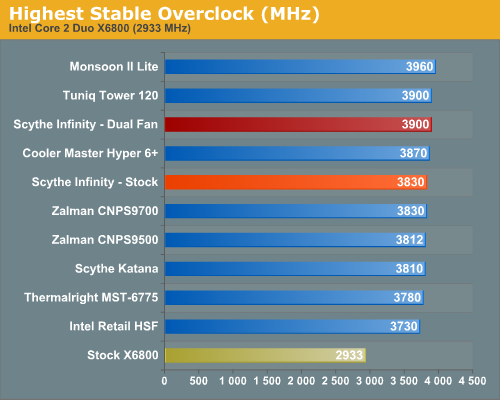
The Scythe Infinity overclocking was just average in the stock single fan configuration - reaching 3.83GHz with complete stability. However the second fan in a push-pull configuration allowed the Infinity to match the highest overclock on air we have seen with this CPU. At 3.9GHz the Tuniq Tower 120 was still cooler, but the Infinity still managed to hold 3.90GHz with stability during our load testing.
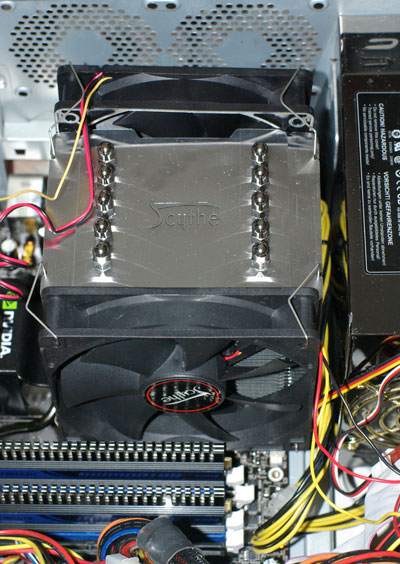
These overclocking results were particularly interesting since we have seen some forum comments that the second cooling fan made little difference on the Infinity. Our results indicate the second cooling fan can make a very significant difference in both cooling and overclocking the Infinity.
The smaller differences others have reported may have been the result of a less demanding test configuration or perhaps it was a result of a better single cooling fan on the tested Infinity. To test this second possibility, a higher RPM and CFM Silverstone fan was mounted on the Infinity as a single fan and the highest overclock was tested. The Infinity with the beefed up fan reached 3.85Ghz - a little higher than the 3.83GHz with the stock fan - with temps about 1C lower than the "silent" fan shipped with the Infinity. Clearly a fan pushing more air improves performance by a small amount, but it still does not match the performance of two "silent" fans in a push-pull arrangement.
As cooling solutions do a better job of keeping the CPU at a lower temperature, it is reasonable to expect the overclocking capabilities of the CPU will increase. In each test of a cooler we measure the highest stable overclock of a standard X6800 processor under the following conditions:
CPU Multiplier: 14x (Stock 11x)
CPU voltage: 1.5875V
FSB Voltage: 1.30V
Memory Voltage: 2.20V
nForce SPP Voltage: 1.5V
nForce MCP Voltage: 1.7V
HT nForce SPP <-> MCP: Auto
Memory is set to Auto timings on the 680i and memory speed is linked to the FSB for the overclocking tests. This removes memory as any kind of impediment to the maximum stable overclock. Linked settings on the 680i are a 1066FSB to a DDR2 memory speed of DDR2-800. As FSB is raised the linked memory speed increases in proportion. The same processor is used in all cooling tests to ensure comparable results.
The Scythe Infinity overclocking was just average in the stock single fan configuration - reaching 3.83GHz with complete stability. However the second fan in a push-pull configuration allowed the Infinity to match the highest overclock on air we have seen with this CPU. At 3.9GHz the Tuniq Tower 120 was still cooler, but the Infinity still managed to hold 3.90GHz with stability during our load testing.
These overclocking results were particularly interesting since we have seen some forum comments that the second cooling fan made little difference on the Infinity. Our results indicate the second cooling fan can make a very significant difference in both cooling and overclocking the Infinity.
The smaller differences others have reported may have been the result of a less demanding test configuration or perhaps it was a result of a better single cooling fan on the tested Infinity. To test this second possibility, a higher RPM and CFM Silverstone fan was mounted on the Infinity as a single fan and the highest overclock was tested. The Infinity with the beefed up fan reached 3.85Ghz - a little higher than the 3.83GHz with the stock fan - with temps about 1C lower than the "silent" fan shipped with the Infinity. Clearly a fan pushing more air improves performance by a small amount, but it still does not match the performance of two "silent" fans in a push-pull arrangement.
Originally published at https://www.anandtech.com/show/2181 (Wayback Machine).