
AMD Athlon 64 X2 6000+: Competing with Aggressive Pricing
- Posted in
- CPUs
Power Consumption
As always, we measured power consumption at two states: at idle sitting at the Vista desktop and under load while running our WME test. At both settings, Cool 'n Quiet/EIST were enabled to keep power consumption down to a minimum, although the biggest difference is made at idle.
Keep in mind that the X2 5000+ listed here is a 65nm Brisbane core, while the rest are 90nm parts. The X2 3800+ is a low power EE SFF core, although still based on AMD's 90nm process; all of the Intel CPUs are 65nm.
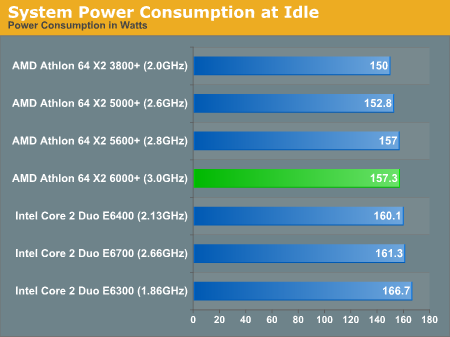
At idle, AMD's power consumption is lower than Intel by a few watts. Keep in mind that our E6300 is a particularly bad sample so it showcases the worst possible power consumption for that particular processor.
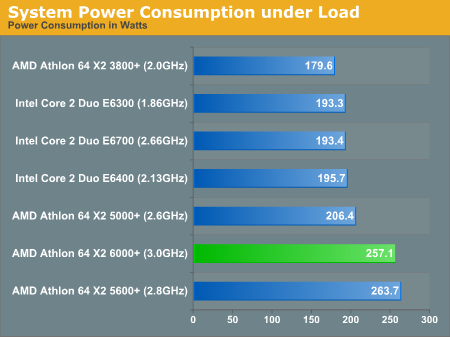
Under load it's clear that AMD needs 65nm to be competitive with Intel as only the 65nm X2 5000+ is able to draw power similar to that of its Intel counterparts. Note that AMD is at a bit of a disadvantage here as it's running on a more power hungry nForce 590 SLI chipset compared to Intel's P965, but the power requirements at 2.8GHz - 3.0GHz on AMD's 90nm process are quite real.
AMD needs 65nm top to bottom in a bad way; not only will it help ease capacity constraints, but it will also keep AMD from turning into the power hungry chip maker that Intel once was.
Originally published at https://www.anandtech.com/show/2177 (Wayback Machine).