
The Zalman Twins: 9500 & 9700 Air Tunnels
- Posted in
- Cases/Cooling/PSUs
Noise
For many enthusiasts upgrading cooling the goal is maximum stable overclock, and they will live with the inconvenience of a louder system. For other users silence is the most important factor, and these users will forgo maximum overclocking if this increase system noise levels. In general the Zalman 9500 and 9700 can be considered very quiet, but performance of either cooler is not standout against the competition - at least where noise is concerned.To test idle and load noise levels, the Zalman fan controller was used to dial in the lowest and highest fan speeds the fan could achieve. Lowest speed results are reported as idle and high speed results are reported as stress noise. These are procedures that we plan to use, if possible, in future CPU cooler reviews. Both sets of results will be reported if there is a significant difference in low-sped and high-speed noise.
There are virtually no power supplies that do not have a fan. While Zalman and a few others do make a few expensive fanless power supplies, we have not seen a fanless unit larger than 500W, or one that would be used for seriously overclocking a system. With that in mind the noise level of the system with all fans turned off except the power supply was measured. The power supply used for the cooling test bed was the OCZ PowerStream 520, which is one of the quieter of the high performance power supplies. The noise level of the power supply was 38.3dB from 24" (61cm) and 47dB from 6" (152mm). The measured noise level of the test room is 36.4dB, which would be considered a relatively quiet room with a noise floor slightly below the OCZ PowerStream 520 PSU.
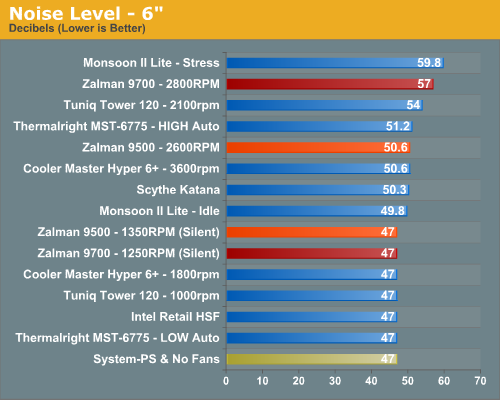
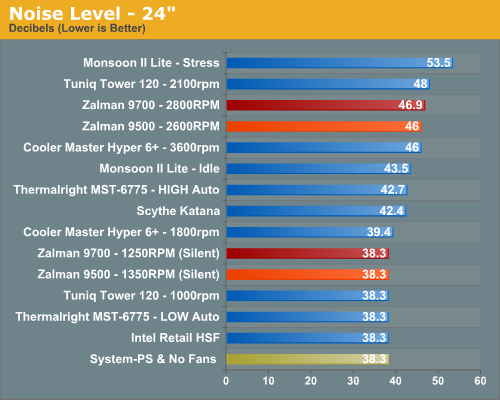
Measured noise levels in this chart should be considered worst case. Measurements were taken with an open side of a mid tower case 6" from the open HSF and 24" from the open HSF. Real world would be a completely closed case with a further reduction in noise.
Zalman, silence and low-noise all go hand-in-hand in the mind of most computer users, so Zalman is expected to be the standard against which others are measured. Put another way, noise is an area where Zalman is expected to top the charts. The Zalman 9500 and 9700 both exhibited noise levels below the system floor at idle speeds measured 6" and 24" from the cooler. This is typical performance with most of the heatpipe towers we have tested in recent weeks.
However, when pushed to the highest speeds available under stress conditions, the noise levels of the 9500 and 9700 were average at best. Neither Zalman was particularly quiet at high speed, and the 9700 was one of the noisiest coolers we have tested in the lab at 2800 RPM - 3db is twice the sound energy of the Tuniq Tower 120 at high speed and almost as loud as the Monsoon II Lite which is plagued by buzzing and clicks from fan switching. On low speed the 9500 and 9700 are very quiet, as are most heatpipe towers, but higher fan speeds yield much higher noise.
The measurements we made are also what you will get with either Zalman, since the fans are custom and embedded in the Zalman design. Zalman did not design the fans to be replaced with other 92mm (common size) or 110mm (Uncommon size fans). All-in-all the Zalman 9500 and 9700 were competitive with other tested coolers in noise levels, but they were not stand-out in any way. This is a reflection of how far the competition has come in addressing noise concerns in the PC environment.
Originally published at https://www.anandtech.com/show/2176 (Wayback Machine).