
Cooler Master Hyper 6+: Universal Heatpipe Tower
- Posted in
- Cases/Cooling/PSUs
Cooling Results
The Cooler Master Hyper 6+ is not the most effective air cooler we have tested. That distinction still is held by the Tuniq Tower 120. However the Hyper 6+ is very close to the performance level of the Tuniq, and it definitely belongs in the comparison of top heatpipe towers.
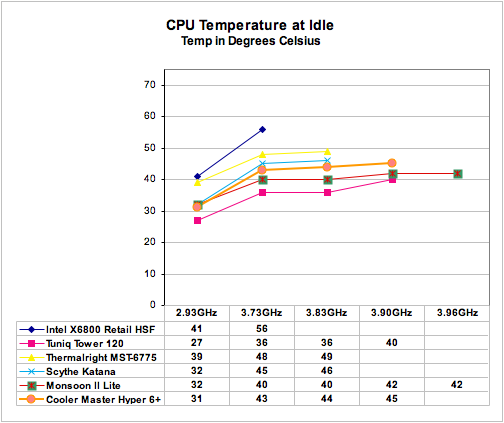
Where the very good Intel stock cooler keeps the X6800 at 41C at idle, the Hyper 6+ can manage 31C. This is not quite as cool as the Tuniq Tower 120 at stock idle, but it is significantly better than the stock Intel cooler. As processor speed increases the delta between the Tuniq and Hyper 6+ increases slightly, so that at 3.83 GHz the Tuniq is 36C and the Hyper 6+ is 44C. The larger 120mm fan on the Tuniq, coupled with the mid cooler fan mount, seems to make the performance difference.
As the processor is pushed to its highest stable overclock using the retail HSF, the delta between the Hyper 6+ and the Intel retail increases. At 3.73GHz the retail HSF is running at 56C, compared to 43C with the Cooler Master. The Hyper 6+ and Tuniq Tower 120 perform similarly at idle speeds across the operating speeds they can achieve, with the Tuniq about 4C to 5C cooler at all speeds. The Hyper 6+ also reaches much higher than the Intel stock fan, reaching 3.87 GHz overclock - only 30 MHz behind the leading Tuniq Tower 120.
It is easy to measure the effectiveness of a cooling solution at idle - when the computer is doing nothing except running the temperature measurement program. It is more difficult, however, to effectively simulate a computer being stressed by all of the conditions it might be exposed to in different operating environments. For most home users CPU power is most taxed with contemporary gaming. Therefore our stress test simulates running a demanding contemporary game.
The Far Cry River demo is looped for 30 minutes and the CPU temperature is captured at 4 second intervals with the NVIDIA monitor "logging" option. The highest temperature during the stress test is then reported. Cooling efficiency of the Cooler Master Hyper 6+ under stress conditions was compared to the retail HSF and other recently tested CPU coolers. Once again the well-regarded Tuniq Tower 120 was the top air cooling solution, with the TEC/air hybrid Monsoon II Lite as the top performer. The Cooler master Hyper 6+ was just behind the Tuniq at the top of the air cooling chart.
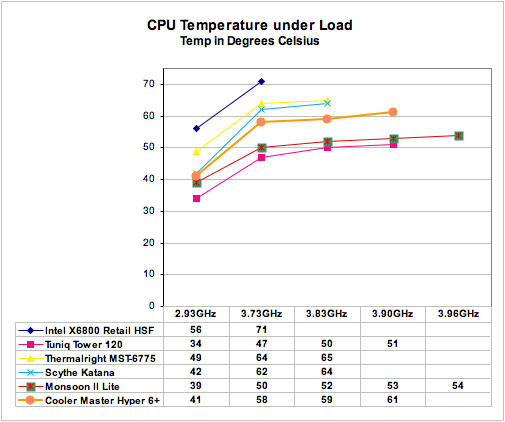
The Tuniq keeps the CPU at 34C under stress at stock speeds, where the Hyper 6+ manages 41C. By 3.83 GHz the Tuniq is at 50C compared to the Cooler Master at 59C. Only the TEC/air hybrid Monsoon II was able to reach 3.96 GHz with this processor, but the Tuniq reached an air cooling record of 3.9 GHz, with the Hyper 6+ just behind at 3.87GHz.
As stated many times, the overclocking abilities of the CPU will vary at the top, depending on the CPU. This particular CPU does higher FSB speeds than any X6800 we have tested, but the 3.9GHz top speed with the Tuniq is pretty average among the X6800 processors we have tested with Tuniq cooling. A few of the other processors tested with the best air coolers reach just over 4 GHz, but the range has been 3.8 to 4.0GHz. Stock cooling generally tops out 200 to 400 MHz lower, depending on the CPU, on the processors tested in our lab. The 3.87 GHz with the Hyper 6+ places the Cooler Master performance in the top range of air cooling.
The Cooler Master Hyper 6+ is not the most effective air cooler we have tested. That distinction still is held by the Tuniq Tower 120. However the Hyper 6+ is very close to the performance level of the Tuniq, and it definitely belongs in the comparison of top heatpipe towers.
Where the very good Intel stock cooler keeps the X6800 at 41C at idle, the Hyper 6+ can manage 31C. This is not quite as cool as the Tuniq Tower 120 at stock idle, but it is significantly better than the stock Intel cooler. As processor speed increases the delta between the Tuniq and Hyper 6+ increases slightly, so that at 3.83 GHz the Tuniq is 36C and the Hyper 6+ is 44C. The larger 120mm fan on the Tuniq, coupled with the mid cooler fan mount, seems to make the performance difference.
As the processor is pushed to its highest stable overclock using the retail HSF, the delta between the Hyper 6+ and the Intel retail increases. At 3.73GHz the retail HSF is running at 56C, compared to 43C with the Cooler Master. The Hyper 6+ and Tuniq Tower 120 perform similarly at idle speeds across the operating speeds they can achieve, with the Tuniq about 4C to 5C cooler at all speeds. The Hyper 6+ also reaches much higher than the Intel stock fan, reaching 3.87 GHz overclock - only 30 MHz behind the leading Tuniq Tower 120.
It is easy to measure the effectiveness of a cooling solution at idle - when the computer is doing nothing except running the temperature measurement program. It is more difficult, however, to effectively simulate a computer being stressed by all of the conditions it might be exposed to in different operating environments. For most home users CPU power is most taxed with contemporary gaming. Therefore our stress test simulates running a demanding contemporary game.
The Far Cry River demo is looped for 30 minutes and the CPU temperature is captured at 4 second intervals with the NVIDIA monitor "logging" option. The highest temperature during the stress test is then reported. Cooling efficiency of the Cooler Master Hyper 6+ under stress conditions was compared to the retail HSF and other recently tested CPU coolers. Once again the well-regarded Tuniq Tower 120 was the top air cooling solution, with the TEC/air hybrid Monsoon II Lite as the top performer. The Cooler master Hyper 6+ was just behind the Tuniq at the top of the air cooling chart.
The Tuniq keeps the CPU at 34C under stress at stock speeds, where the Hyper 6+ manages 41C. By 3.83 GHz the Tuniq is at 50C compared to the Cooler Master at 59C. Only the TEC/air hybrid Monsoon II was able to reach 3.96 GHz with this processor, but the Tuniq reached an air cooling record of 3.9 GHz, with the Hyper 6+ just behind at 3.87GHz.
As stated many times, the overclocking abilities of the CPU will vary at the top, depending on the CPU. This particular CPU does higher FSB speeds than any X6800 we have tested, but the 3.9GHz top speed with the Tuniq is pretty average among the X6800 processors we have tested with Tuniq cooling. A few of the other processors tested with the best air coolers reach just over 4 GHz, but the range has been 3.8 to 4.0GHz. Stock cooling generally tops out 200 to 400 MHz lower, depending on the CPU, on the processors tested in our lab. The 3.87 GHz with the Hyper 6+ places the Cooler Master performance in the top range of air cooling.
Originally published at https://www.anandtech.com/show/2173 (Wayback Machine).