
The Era of Tera: Intel Reveals more about 80-core CPU
- Posted in
- CPUs
The Network
Each of the 80 tiles in the teraflops chip are identical, which helps simplify design and manufacturing. As we mentioned earlier, each tile has two primary components: the Processing Engine (PE) and a 5-port router.
The router on each tile is used to pass data and instructions between tiles in the network. The tile passing the data doesn't have to even work on the data, it can simply be used for its router and not its PE. As such, the PE on a tile can be powered down independently of its router to save power.
The router on each tile features five 39-bit ports that can offer a total bandwidth of 80GB/s if the chip is operating at 4GHz; the data busses are double pumped. Of the 3mm^2 tile die area, only 0.34mm^2 is used for the router making it reasonable to have 80 of them on a single chip.
Four of the five ports are used for connecting to other titles as you can see from the slide below:
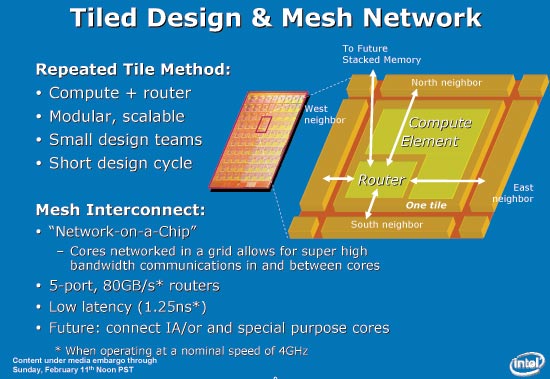
The fifth port is used for connecting to stacked memory, which Intel tells us we'll be hearing about in another quarter or so. For heat reasons the stacked memory will actually be mounted below the teraflop processor die.
The main attraction of the router and the network layout of the chip in general is that the PE can be replaced by anything, including an x86 core or a special purpose core (e.g. DSP or hardware encryption engine). Instead of a network of 80 tiles, you can imagine one with maybe 12, six of which are general purpose x86 cores and the rest are specialized cores to handle things like 3D rendering, TCP/IP offload, encoding, etc... The router network works for 80 cores, and making it work for any other number of cores, whether less or more, is trivial.
Originally published at https://www.anandtech.com/show/2170 (Wayback Machine).