
The AMD Ryzen AI 9 HX 370 Review: Unleashing Zen 5 and RDNA 3.5 Into Notebooks
AI Performance
As technology progresses at a breakneck pace, so do the demands of modern applications and workloads. As artificial intelligence (AI) and machine learning (ML) become increasingly intertwined with our daily computational tasks, it's paramount that our reviews evolve in tandem. To this end, we have AI and inferencing benchmarks in our CPU test suite for 2024.
Traditionally, CPU benchmarks have focused on various tasks, from arithmetic calculations to multimedia processing. However, with AI algorithms now driving features within some applications, from voice recognition to real-time data analysis, it's crucial to understand how modern processors handle these specific workloads. This is where our newly incorporated benchmarks come into play.
Given makers such as AMD with Ryzen AI, with multiple iterations including the XDNA 2 NPU within the Ryzen AI 9 HX 370, and Intel with their Meteor Lake mobile platform featuring AI-driven hardware, aptly named Intel AI Boost within the silicon, AI, and inferencing benchmarks will be a mainstay in our test suite as we go further into 2024 and beyond. While there's currently no defacto benchmark for AI at the moment, we've compiled a couple of different benchmarks to gauge performance.
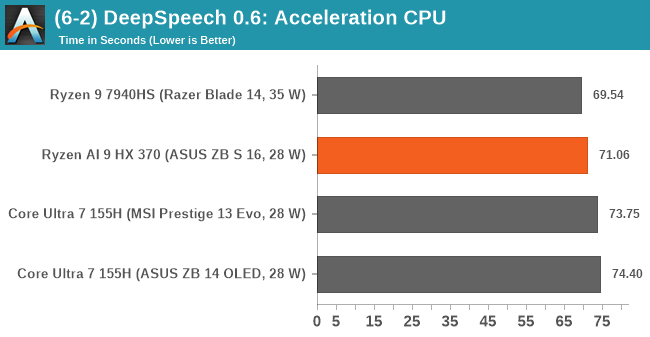
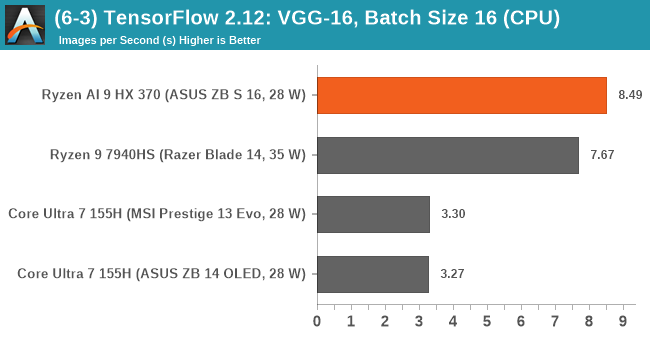
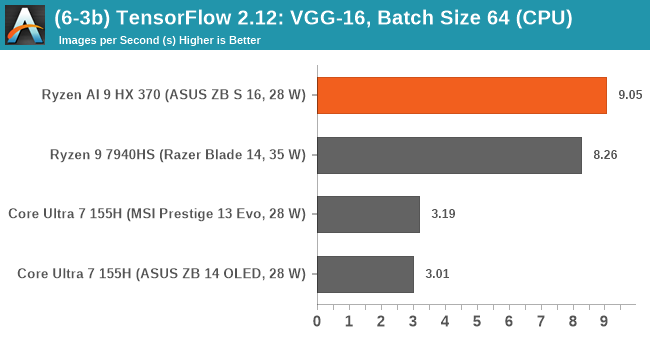
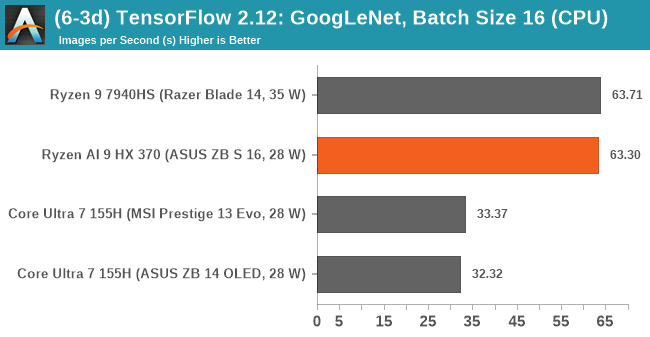
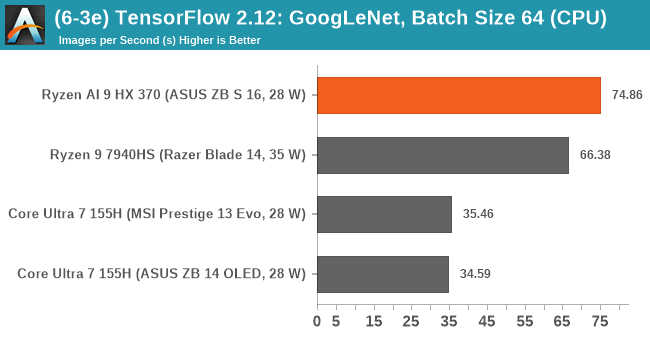
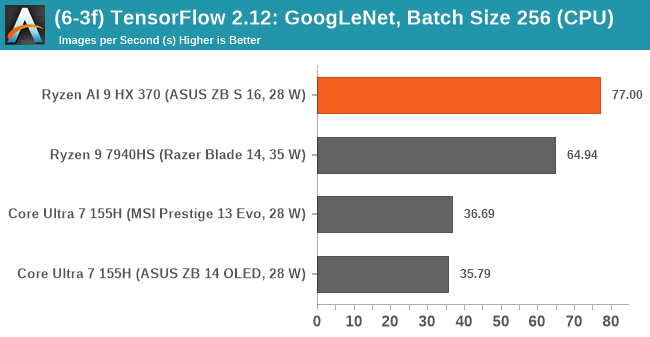
As we've said, benchmarking AI is currently something of an oxymoron, as AI models and LLMs are constantly evolving and changing at a rapid pace. There isn't a defined benchmark that tests AI performance from a level playing field, and we're seeing different models being optimized differently on architectures. The other thing is AMD, Intel, and Qualcomm are all implementing their own Neural Processing Units (NPUs) into the silicon, which in part is being driven by Microsoft and their requirement for NPUs to be above 40 TOPS for their Copilot+ PCs.
Our AI model-focused benchmarks show the Ryzen 9 7940HS at the top, marginally over the competition in our DeepSpeech acceleration test. At the same time, AMD takes advantage of our TensorFlow 2.12 tests when using the VGG-16 neural net. When switching to GoogLeNet, we actually see the Ryzen AI 9 HX 370 and the Ryzen 9 7940HS trading blows, with Intel trailing in their wake. This is what we mean about measuring AI performance, as Intel, when using OpenVino, is designed to have an advantage.
Currently, we are trying to come up with a way of testing AI performance, especially on hardware with dedicated NPUs, which is on somewhat of a more level playing field. Even the AI benchmarks within the UL Procyon suite aren't a good indicator of where each manufacturer's NPUs are at. Although the Intel-based NPUs are supported, AMD's currently aren't within the test suite, which, again, makes it difficult to find a fair battle to trade blows at.
Originally published at https://www.anandtech.com/show/21485/the-amd-ryzen-ai-hx-370-review (Wayback Machine).