
ACEMAGIC F2A 125H SFF PC Review: Mid-Range Meteor Lake at 65W
Miscellaneous Aspects and Concluding Remarks
Networking and storage are aspects that may be of vital importance in specific PC use-cases. The ACEMAGIC F2A 125H comes with a 2.5 GbE LAN port backed by a Realtek RTL8125 controller. The system is equipped with an Intel BE200 WLAN card - 2T2R 802.11be (Wi-Fi 7) with 320 MHz channels for up to 5.8 Gbps of theoretical throughput. The card also includes Bluetooth 5.4 support.
On the storage side, ACEMAGIC has equipped the F2A 125H with a Kingston Design-In SSD. The drive is a DRAM-less one with claimed read/write speeds well south of 4 GBps. Being a DRAM-less drive, that is not surprising. The drive used by ACEMAGIC (OM8SEP41024Q-A0) utilizes a Silicon Motion SM2267XT controller and BiCS5 3D TLC NAND. It barely meets the performance numbers expected out of a PCIe 4.0 x4 drive, but allows the company to market the system as one equipped with a Gen4 SSD.
From a benchmarking perspective, we provide results from the WPCstorage test of SPECworkstation 3.1. This benchmark replays access traces from various programs used in different verticals and compares the score against the one obtained with a 2017 SanDisk 512GB SATA SSD in the SPECworkstation 3.1 reference system.
| SPECworkstation 3.1.0 - WPCstorage SPEC Ratio Scores | |||
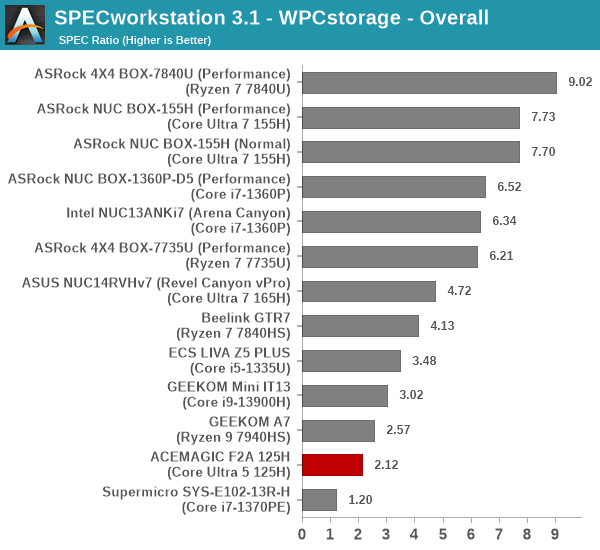
The graphs above present results for different verticals, as grouped by SPECworkstation 3.1. The storage workload consists of 60 subtests. Access traces from CFD solvers and programs such as Catia, Creo, and Soidworks come under 'Product Development'. Storage access traces from the NAMD and LAMMPS molecular dynamics simulator are under the 'Life Sciences' category. 'General Operations' includes access traces from 7-Zip and Mozilla programs. The 'Energy' category replays traces from the energy-02 SPECviewperf workload. The 'Media and Entertainment' vertical includes Handbrake, Maya, and 3dsmax. Given that the comparison is between a wide range of modern systems (almost all of which have been equipped with mid-range / high-end Gen4 SSDs), the appearance of the F2A 125H in the bottom half of the pack across all workloads is not surprising.
Closing Thoughts
The ACEMAGIC F2A 125H provided us with the opportunity to evaluate a mid-range Meteor Lake system. Note that the Core Ultra 5 125H is the entry-level MTL-H part, but is decidedly mid-range when the MTL-U lineup is also considered. ACEMAGIC has demonstrated that a stable 65W PL1 setting with excellent temperature profiles can be achieved by sacrificing a bit on the physical footprint front. For specific workloads, the 65W PL1 setting can make up for the lack of high-performance cores compared to the UCFF systems using the Core Ultra 7 155H in the 28W - 40W range.
ACEMAGIC heavily promotes the AI PC capabilities of the system. The industry as a whole is pushing that trend. The integration of an NPU (the Movidius VPU3720) enables acceleration of different neural networks and AI applications. Intel and its partners have realized that these continue to remain in the domain of developers and advanced users for now. In a bid to open them up to the mass market, sample applications are being developed using Intel's customized models for different computer vision tasks. While companies like ASRock Industrial are offering software packs as a free download as part of this endeavor, ACEMAGIC has not done anything specific on that front.
While this type of AI push is welcome, mass market adoption is going to be completely reliant on real-world use-cases such as querying of private photo albums, or automatic indexing and querying of videos from network cameras, and other such applications. It will take a few more years for these types of applications to become pervasive, and at that time, a performant NPU would become a must-have. As it stands currently, the NPU is good to have, but there aren't too many real-world use-cases to take advantage of it.

Arena Canyon NUC (T) and the ACEMAGIC F2A 125H (B)
The ACEMAGIC F2A 125H stands out from the crowd for its effective use of increased size for higher performance. It is also one of the first SFF PCs to integrate Wi-Fi 7 support (even the NUC14 series is reliant on Wi-Fi 6E for now). ACEMAGIC is currently running a $200 discount on the system with the price tag reduced to $569. At that price point, we believe it doesn't provide enough value due to the lack of Thunderbolt / USB4 support. The equivalent barebones NUC14RKU5 retails for $535, and it is equipped with two Thunderbolt 4 ports enabling additional flexibility and expansion options. Equipping that with SODIMMs, SSD, and an OS license is bound to drive up the cost, but the expansion possibilities may be worth it for a wide range of customers.
ACEMAGIC's F2A 125H could have been an easy system to recommend if a better choice of I/O ports were to complement its thermal design and board size decisions. As it stands currently, the system has some unique qualities and its thermal profile is excellent. Are those good enough to make it a better choice compared to the other MTL-H systems in the market? Only a careful consideration of the end-user's requirements can answer that question.
Originally published at https://www.anandtech.com/show/21416/acemagic-f2a-meteor-lakeh-sff-pc-review (Wayback Machine).