
GEEKOM A7 mini-PC Review : Premium Phoenix in a Compact 4x4 Package
Miscellaneous Aspects and Concluding Remarks
Networking and storage are aspects that may be of vital importance in specific PC use-cases. The GEEKOM A7 is equipped with a 2T2R MediaTek Wi-Fi 6E solution that also includes Bluetooth 5.2 support. There is also a 2.5 Gbps RJ-45 port backed by a Realtek PCIe NIC.
On the storage side, the GEEKOM A7 came pre-configured with an Acer SSD N5000 (manufactured by Biwin Technologies). This 2TB SSD is a M.2 2280 PCIe 4.0 x4 DRAM-less NVMe drive. This drive uses the Maxio MAP1602 DRAM-less controller along with 3D TLC NAND. The SSD includes a dedicated thermal solution with a thermal pad affixed to the metal frame. Based on the construction, we should likely not be seeing any thermal throttling during usage. From a benchmarking perspective, we provide results from the WPCstorage test of SPECworkstation 3.1. This benchmark replays access traces from various programs used in different verticals and compares the score against the one obtained with a 2017 SanDisk 512GB SATA SSD in the SPECworkstation 3.1 reference system.
| SPECworkstation 3.1.0 - WPCstorage SPEC Ratio Scores | |||
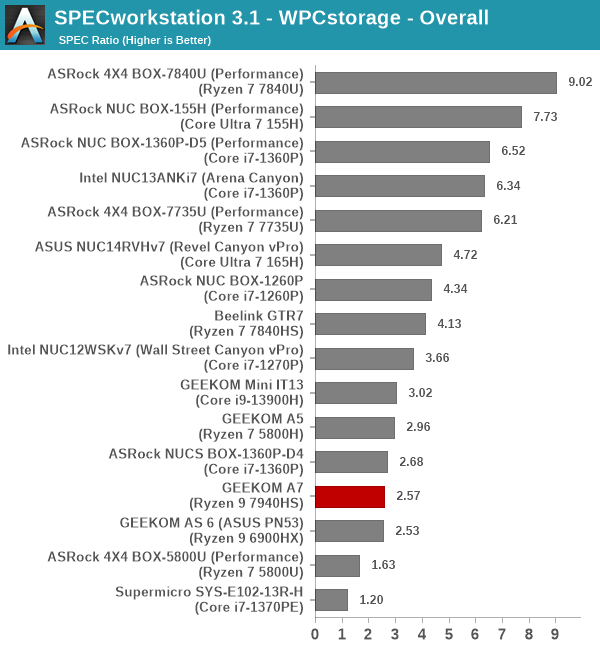
The graphs above present results for different verticals, as grouped by SPECworkstation 3.1. The storage workload consists of 60 subtests. Access traces from CFD solvers and programs such as Catia, Creo, and Soidworks come under 'Product Development'. Storage access traces from the NAMD and LAMMPS molecular dynamics simulator are under the 'Life Sciences' category. 'General Operations' includes access traces from 7-Zip and Mozilla programs. The 'Energy' category replays traces from the energy-02 SPECviewperf workload. The 'Media and Entertainment' vertical includes Handbrake, Maya, and 3dsmax. Given that the comparison is between a wide range of SSDs in the systems - including both Gen 3 and Gen 4 NVMe drives, as well as drives equipped with DRAM for the flash translation layer (FTL) - the relative numbers for most workloads are not surprising. The Acer N5000 is held back by its DRAM-less architecture. This puts the GEEKOM A7 in the bottom half of the pack.
Closing Thoughts
The GEEKOM A7 provided us with the opportunity to evaluate one of the most compact systems based on AMD's Phoenix SoCs. Interestingly, despite being compact, it manages to operate the Ryzen 9 7845HS at 35W without issues. The slightly larger ASRock Industrial 4X4-BOX-7840U operates Phoenix at 28W, while the much larger GTR7 manages it at 65W. Despite the diminutive nature, the performance of the system is good enough to keep it in the top spot in most of the evaluated workloads without any thermal issues.

(T) GEEKOM A7 (B) Intel Arena Canyon NUC
Our only quibbles with the GEEKOM A7 are the lack of a second full-speed 40 Gbps USB4 port, missing VESA mount support, and the physical placement of the WLAN / BT card's pigtail antennae. These do not matter for out-of-the-box usage for most consumers, but something GEEKOM could look to address in future iterations of the product line. Obviously, with a slightly changed form-factor, the Phoenix SoC could be operated in a more optimal cTDP configuration. The GTR7 at 65W managed to best the A7 at 35W in some of the benchmarks. Vendors like Beelink and MinisForum have already realized this and introduced a range of form-factors for the same processor with different TDPs. A form-factor capable of sustaining 54W or 65W package power is yet another avenue / product line that GEEKOM could investigate in the future.
The Phoenix SoCs are currently being replaced in the systems by Hawk Point ones with a drop-in upgrade. The key updates are the additional NPU with a more performant 'Ryzen AI', along with a slight jump in boost clock speeds. The GEEKOM A8 uses Hawk Point, and currently carries a $20 premium over the GEEKOM A7. We believe that the Phoenix-based GEEKOM A7 still has a place in the market, albeit at a much lower price point.
Originally published at https://www.anandtech.com/show/21409/geekom-a7-minipc-review (Wayback Machine).