
GEEKOM A5 mini-PC Review: Affordable Cezanne Zen 3 at 35W
Miscellaneous Aspects and Concluding Remarks
Networking and storage are aspects that may be of vital importance in specific PC use-cases. The GEEKOM A5 is equipped with a 2T2R Realtek Wi-Fi 6 solution that also includes Bluetooth 5.2 support. There is also a 2.5 Gbps RJ-45 port backed by a Realtek PCIe NIC.
On the storage side, the GEEKOM A5 came pre-configured with a Lexar NM620 512GB M.2 2280 PCIe 3.0 x4 NVMe SSD. It must be noted that this NM620 is a newer version with changed NAND and controller compared the one that received brickbats from multiple reviewers at launch time. The older version used an InnoGrit controller along with Micron's 96L 3D TLC. The newer version uses the Maxio MAP1202 DRAM-less controller along with 176L 3D TLC NAND from SK hynix. The SSD includes a dedicated thermal solution with a thermal pad affixed to the metal frame. Based on the construction, we should likely not be seeing any thermal throttling during usage. The system can also accommodate a 2.5" 7mm drive and a M.2 2242 SATA SSD. From a benchmarking perspective, we provide results from the WPCstorage test of SPECworkstation 3.1. This benchmark replays access traces from various programs used in different verticals and compares the score against the one obtained with a 2017 SanDisk 512GB SATA SSD in the SPECworkstation 3.1 reference system.
| SPECworkstation 3.1.0 - WPCstorage SPEC Ratio Scores | |||
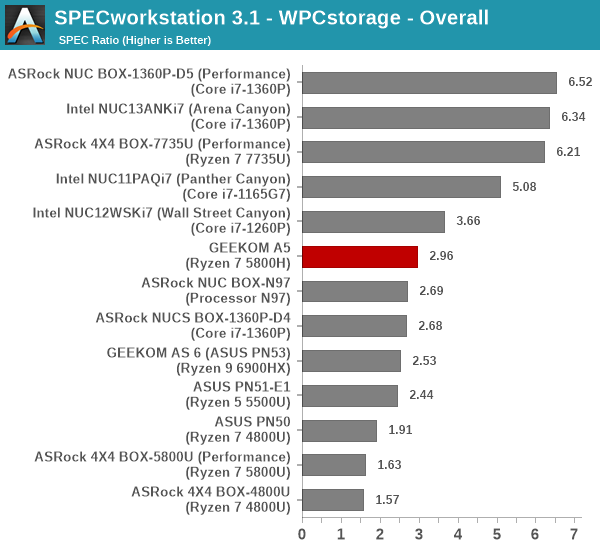
The graphs above present results for different verticals, as grouped by SPECworkstation 3.1. The storage workload consists of 60 subtests. Access traces from CFD solvers and programs such as Catia, Creo, and Soidworks come under 'Product Development'. Storage access traces from the NAMD and LAMMPS molecular dynamics simulator are under the 'Life Sciences' category. 'General Operations' includes access traces from 7-Zip and Mozilla programs. The 'Energy' category replays traces from the energy-02 SPECviewperf workload. The 'Media and Entertainment' vertical includes Handbrake, Maya, and 3dsmax. Given that the comparison is between a wide range of SSDs in the systems - including both Gen 3 and Gen 4 NVMe drives, the relative numbers for most workloads are not surprising. The NM620 in the GEEKOM A5 delivers the best numbers in its category (Gen 3 / DRAM-less). The use of newer generation NAND is one of the major reasons behind this.
Closing Thoughts
The GEEKOM A5 provided us with the opportunity to evaluate a system with a slightly dated processor complemented by a newer SSD. AMD's Cezanne is a known quantity in terms of performance, and the GEEKOM A5 manages to deliver on those expectations. The key selling point of the system is its pricing. Consumers are paying less than half of what they would have paid in 2021 for the same performance. The segment where the A5 trips up is on connectivity. Phoenix- and Raptor Lake-based systems with 'equivalent' processors are now equipped with USB4 ports that have PCIe tunneling support. This is an aspect that is unfortunately absent in the A5. However, from the same perspective, GEEKOM wants to present this as a slight step-up from Alder Lake-N-based systems, and those don't carry USB4 ports either.
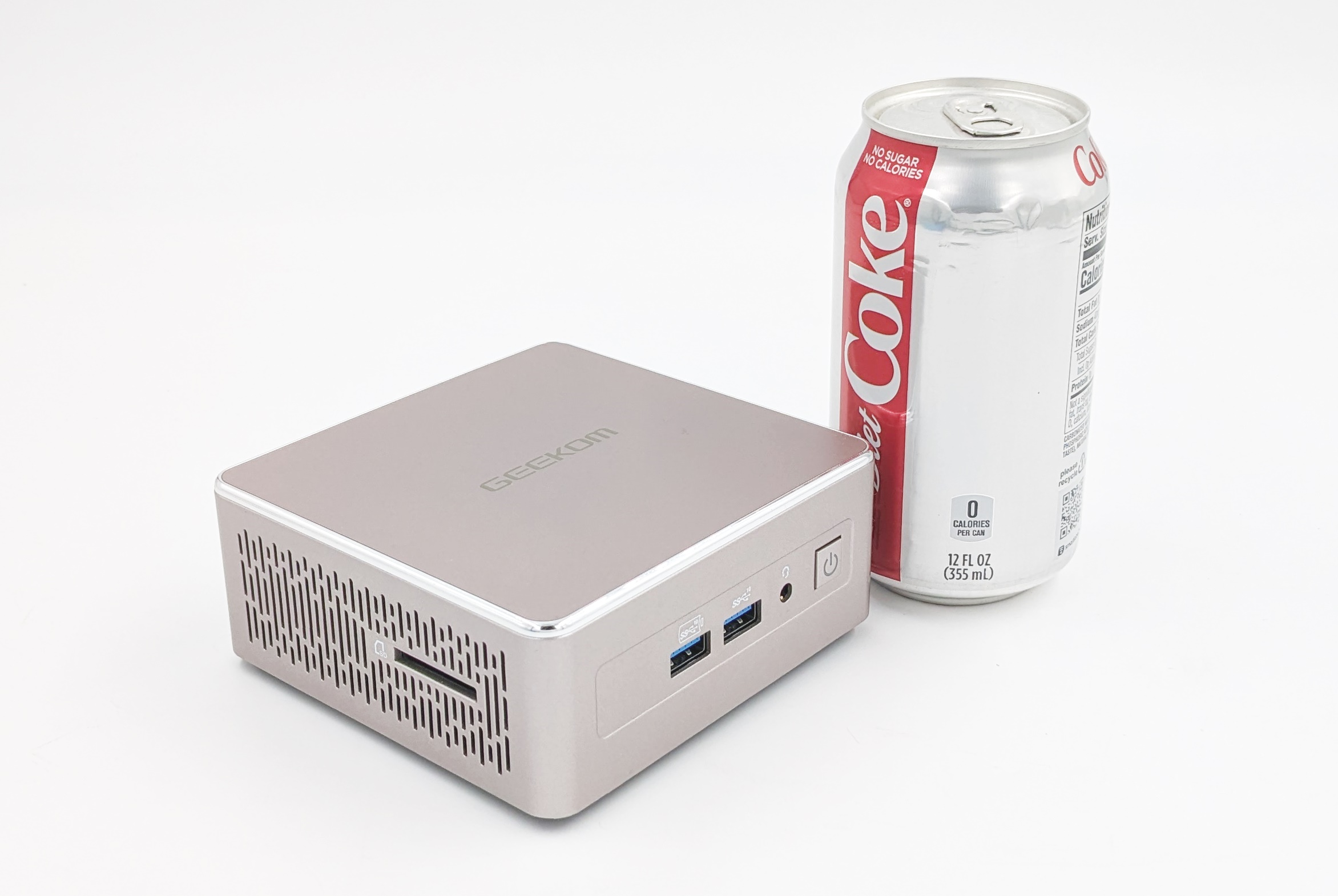
GEEKOM's systems have traditionally adopted a conservative approach to configuring package power limits for their systems. The GEEKOM AS 6's Ryzen 9 6900HX was configured with a 35W package power limit, and the GEEKOM A5 is also configured similarly despite its slightly smaller footprint. Based on our benchmarking results, it appears that the Ryzen 7 5800H needs a 45W TDP configuration to better previous Cezanne-based UCFF PCs. The silver lining is that the fan noise is not overwhelming. Interested consumers may want to tweak the power limit settings in the BIOS.
The GEEKOM A5's pricing makes it a winner from a value proposition perspective. The system is currently available for US $399 on Amazon and US $359 (after a $40 off coupon code anandtecha540) direct from the company's web store. At these price points, consumers are not going to be able to source fully configured Raptor Lake-P or Phoenix-based UCFF systems.
In terms of scope for improvement, GEEKOM should explore the possibility of a more aggressive thermal solution capable of handling 45W over a long duration in the same form-factor. Other than that, it is difficult to suggest improvement aspects for systems such as the A5. The product is clearly leftover inventory from the company's OEM / ODM business. Thanks to the price point of the system, that is actually a good thing for consumers looking for performance without breaking the bank.
Originally published at https://www.anandtech.com/show/21180/geekom-a5-minipc-review-affordable-cezanne-zen-3-at-35w (Wayback Machine).