
NVIDIA 680i: The Best Core 2 Chipset?
- Posted in
- CPUs
MediaShield
While the networking side has undergone an extensive makeover, the storage side of the nForce 680i has been fine tuned but the features remain the same as the nForce 590SLI. The nForce 680i SLI series offers three separate SATA controllers each with integrated dual PHYs that are capable of operating at 1.5Gb/s or 3.0Gb/s speeds. This results in six Serial ATA devices being available for the user instead of four as in the nForce4, Intel ICH7/ICH8, or ATI SB600. These devices can be configured in RAID 0, 1, 0+1, and 5 arrays. There is no support for RAID 1+0 although the performance numbers with RAID 0+1 are very similar.
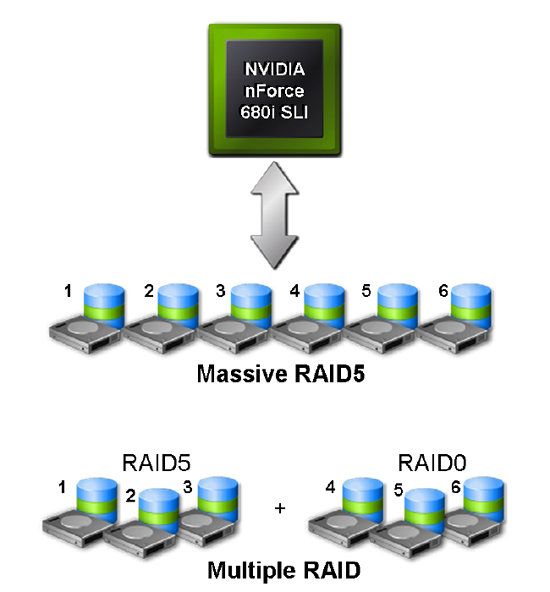
Considering the support for six drives, it is now possible to run a massive RAID 5 drive consisting of a pair of three-drive RAID 5 arrays, or running multiple combinations of RAID technology together. NVIDIA also supports the shared spare (or dedicated spare) technique in MediaShield. The spare disk feature, available with MediaShield RAID 5, offers protection with a dedicated spare drive that can take over for a failed disk until the repair is completed. However, the performance results during our RAID testing found no measurable differences between the nForce4, nForce 590SLI, and nForce 680i SLI storage systems. In fact, the "average" write performance of the nForce4 and nForce 590SLI in RAID 5 continues in the 680i SLI chipset although we still find its performance to be 5% better than the Intel ICH8R.
NVIDIA introduced a new twist to improve their SATA controller performance by offering performance profiles for specific hard drive models in the nForce 590SLI MCP. These performance profiles continue in the 680i SLI MCP. Since each hard drive has unique performance characteristics, NVIDIA matched the capabilities of their controller logic to each drive's particular strength. So far, Western Digital's 150GB Raptor has the only performance profile loaded, but there are plans to profile additional performance oriented drives that are popular in the market. In our testing with dual WD1500 Raptors we noticed benchmark results that were on average about 3% better in our IPEAK tests while the synthetic tests realized a 4% gain in some areas.
While NVIDIA has implemented six native SATA ports in their current MCP55 chipset, they reduced the available native PATA ports to one with support for two drives. This is an improvement over the PATA challenged Intel ICH8 series which requires a separate chipset for PATA support. We firmly believe the reduced number of PATA ports is still a mistake for all chipset manufacturers.
Considering the Optical drive manufacturers have been very slow to implement SATA technology in their drives, this decrease in drive support could affect those users who have multiple optical drives for audio/video content creation and manipulation. However, our discussions with the major optical drive manufacturers show an aggressive transition to SATA technology by the third quarter of 2007.
HD Audio
NVIDIA has finally decided that life after SoundStorm no longer means the continual punishment of users by only offering AC-97 based audio support in their chipsets. As with the nForce 500 lineup, the nForce 600 series will offer full support for the various "Azalia" based High Definition Audio codecs. While the choice of which HDA codec along with the associated circuitry can still greatly impact audio quality and performance, any of these options are better than the AC-97 solutions previously offered.
While the networking side has undergone an extensive makeover, the storage side of the nForce 680i has been fine tuned but the features remain the same as the nForce 590SLI. The nForce 680i SLI series offers three separate SATA controllers each with integrated dual PHYs that are capable of operating at 1.5Gb/s or 3.0Gb/s speeds. This results in six Serial ATA devices being available for the user instead of four as in the nForce4, Intel ICH7/ICH8, or ATI SB600. These devices can be configured in RAID 0, 1, 0+1, and 5 arrays. There is no support for RAID 1+0 although the performance numbers with RAID 0+1 are very similar.
Considering the support for six drives, it is now possible to run a massive RAID 5 drive consisting of a pair of three-drive RAID 5 arrays, or running multiple combinations of RAID technology together. NVIDIA also supports the shared spare (or dedicated spare) technique in MediaShield. The spare disk feature, available with MediaShield RAID 5, offers protection with a dedicated spare drive that can take over for a failed disk until the repair is completed. However, the performance results during our RAID testing found no measurable differences between the nForce4, nForce 590SLI, and nForce 680i SLI storage systems. In fact, the "average" write performance of the nForce4 and nForce 590SLI in RAID 5 continues in the 680i SLI chipset although we still find its performance to be 5% better than the Intel ICH8R.
NVIDIA introduced a new twist to improve their SATA controller performance by offering performance profiles for specific hard drive models in the nForce 590SLI MCP. These performance profiles continue in the 680i SLI MCP. Since each hard drive has unique performance characteristics, NVIDIA matched the capabilities of their controller logic to each drive's particular strength. So far, Western Digital's 150GB Raptor has the only performance profile loaded, but there are plans to profile additional performance oriented drives that are popular in the market. In our testing with dual WD1500 Raptors we noticed benchmark results that were on average about 3% better in our IPEAK tests while the synthetic tests realized a 4% gain in some areas.
While NVIDIA has implemented six native SATA ports in their current MCP55 chipset, they reduced the available native PATA ports to one with support for two drives. This is an improvement over the PATA challenged Intel ICH8 series which requires a separate chipset for PATA support. We firmly believe the reduced number of PATA ports is still a mistake for all chipset manufacturers.
Considering the Optical drive manufacturers have been very slow to implement SATA technology in their drives, this decrease in drive support could affect those users who have multiple optical drives for audio/video content creation and manipulation. However, our discussions with the major optical drive manufacturers show an aggressive transition to SATA technology by the third quarter of 2007.
HD Audio
NVIDIA has finally decided that life after SoundStorm no longer means the continual punishment of users by only offering AC-97 based audio support in their chipsets. As with the nForce 500 lineup, the nForce 600 series will offer full support for the various "Azalia" based High Definition Audio codecs. While the choice of which HDA codec along with the associated circuitry can still greatly impact audio quality and performance, any of these options are better than the AC-97 solutions previously offered.
Originally published at https://www.anandtech.com/show/2115 (Wayback Machine).