
Intel's Core 2 Extreme QX6700: The Multi-core Era Begins
- Posted in
- CPUs
Application Performance using SYSMark 2004 SE
No article looking at a new processor release would be complete without benchmarks. However, let us preface the benchmark section by stating that the benchmarks don't tell the whole story. There are numerous benchmarks and tasks that you can run that will actually show quad core processors in a better light. A lot of people will never use the applications related to these benchmarks, so in one sense we could say that most people should already know whether or not they need quad core processing. There is also definitely an element of future proofing your system by purchasing quad core now, with the hope that it will be more useful at some point during the life of the system. We definitely do not expect to see large gains in performance in most of the benchmarks we will run, simply because they were not designed or optimized to run on multi-core systems. We will also have some benchmarks that clearly do show vast improvements by moving from dual cores to quad cores, although we've already seen coverage of this in our Kentsfield preview.
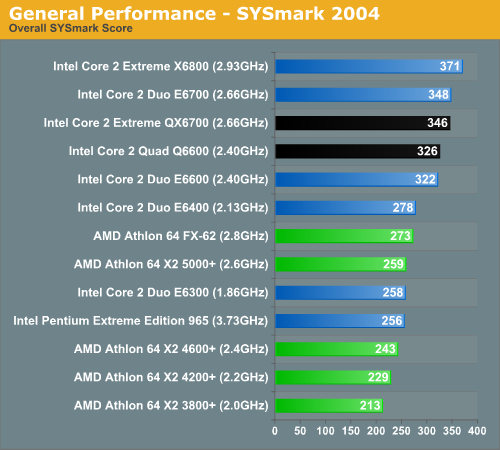
We'll start with SYSmark 2004, a benchmark suite that does have some multitasking components and multithreaded applications, but which also includes plenty of work that benefits very little from dual cores let alone quad cores. The overall scores show the quad core processors to basically be equal to their dual core counterparts in terms of performance, with the margin of error accounting for the slight differences in score. Having two more processor cores did almost nothing for SYSmark 2004, and we would expect that to be the case with many business/office applications. Drilling down into the individual results gives us a bit more information, however.
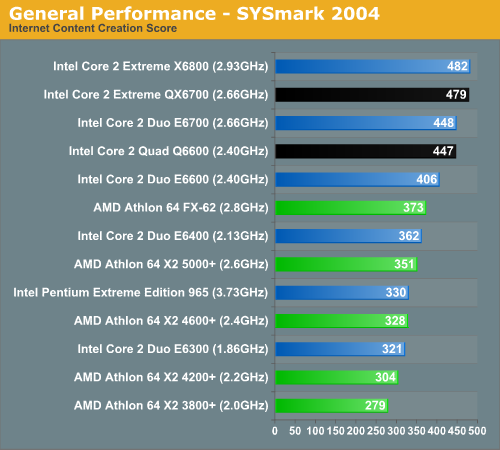
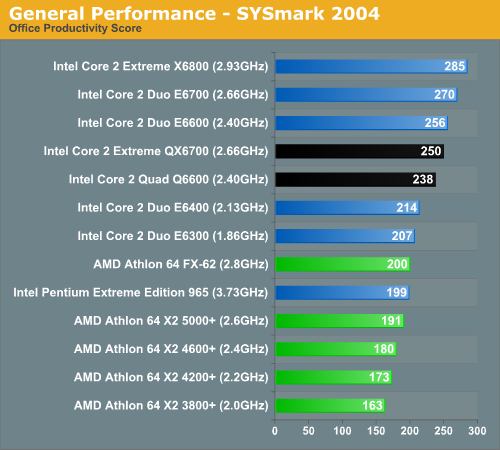
The Internet content creation score clearly does benefit by adding extra processing cores, although not a lot. The Core 2 Quad systems are more or less able to match Core 2 Duo chips clocked one bin higher. The Office Productivity scores show the exact opposite: Core 2 Quad chips are slower than Core 2 Duo chips with the same clock speed. In an ideal world, this shouldn't happen, as all other things being equal having more processor cores should not slow down your overall performance. At some low level, however, there appears to be some resource contention or operating system inefficiencies. The SYSmark 2004 overall score is a good representation of what the end-user will truly experience for this sort of application: the difference between dual cores and quad cores really isn't very apparent if you are a more or less "typical" user.
Originally published at https://www.anandtech.com/show/2112 (Wayback Machine).